

4 Solar Cells: Optical and Recombination Losses
89
For an “indirect-bandgap” semiconductor such as silicon, this is not so easy. In
this case, the momentum of the electron must also be changed. Here, a third particle is needed, for example, a phonon from the crystal lattice,
13 which provides the
necessary change of momentum. This process has a low probability because now
three particles have to interact with each other. Therefore, the lifetime τ of the carriers of “indirect-bandgap” semiconductors is larger than the lifetime for carriers of
“direct-bandgap” semiconductors. This is advantageous for silicon solar cells. On
the other hand, the mobility of charge carriers is greater in some direct semiconductors like GaAs. Nevertheless, the diffusion length, defined as
√
Dτ (square root of
lifetime times diffusion constant), according to (4.13), is only 30–50 μm for GaAs
and approximately 1200 μm for Si.
4.2.2 Recombination
As soon as an electron from the conduction band unites with a hole in the valence
band, recombination takes place. We distinguish here between four different types
of recombination:
1. Radiative recombination
2. Shockley-Read-Hall recombination
3. Auger recombination
4. Surface recombination
1. Radiative Recombination
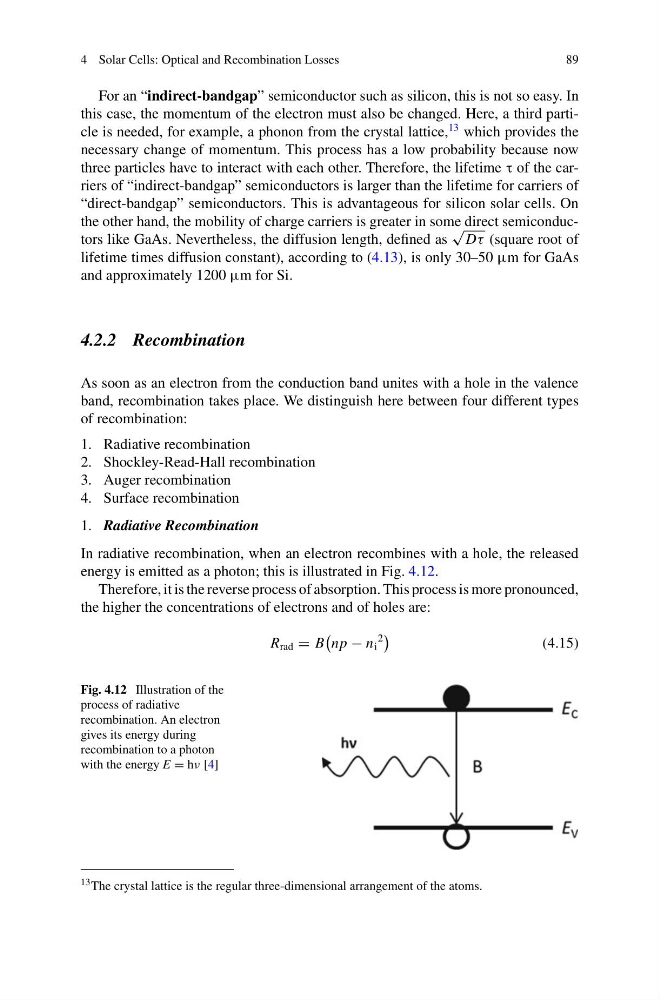
In radiative recombination, when an electron recombines with a hole, the released
energy is emitted as a photon; this is illustrated in Fig. 4.12.
Therefore, it is the reverse process of absorption. This process is more pronounced,
the higher the concentrations of electrons and of holes are:
R rad = B
np − n i
2
(4.15)
Fig. 4.12 Illustration of the
process of radiative
recombination. An electron
gives its energy during
recombination to a photon
with the energy E = hν [4]
13 The crystal lattice is the regular three-dimensional arrangement of the atoms.
89
For an “indirect-bandgap” semiconductor such as silicon, this is not so easy. In
this case, the momentum of the electron must also be changed. Here, a third particle is needed, for example, a phonon from the crystal lattice,
13 which provides the
necessary change of momentum. This process has a low probability because now
three particles have to interact with each other. Therefore, the lifetime τ of the carriers of “indirect-bandgap” semiconductors is larger than the lifetime for carriers of
“direct-bandgap” semiconductors. This is advantageous for silicon solar cells. On
the other hand, the mobility of charge carriers is greater in some direct semiconductors like GaAs. Nevertheless, the diffusion length, defined as
√
Dτ (square root of
lifetime times diffusion constant), according to (4.13), is only 30–50 μm for GaAs
and approximately 1200 μm for Si.
4.2.2 Recombination
As soon as an electron from the conduction band unites with a hole in the valence
band, recombination takes place. We distinguish here between four different types
of recombination:
1. Radiative recombination
2. Shockley-Read-Hall recombination
3. Auger recombination
4. Surface recombination
1. Radiative Recombination
In radiative recombination, when an electron recombines with a hole, the released
energy is emitted as a photon; this is illustrated in Fig. 4.12.
Therefore, it is the reverse process of absorption. This process is more pronounced,
the higher the concentrations of electrons and of holes are:
R rad = B
np − n i
2
(4.15)
Fig. 4.12 Illustration of the
process of radiative
recombination. An electron
gives its energy during
recombination to a photon
with the energy E = hν [4]
13 The crystal lattice is the regular three-dimensional arrangement of the atoms.