

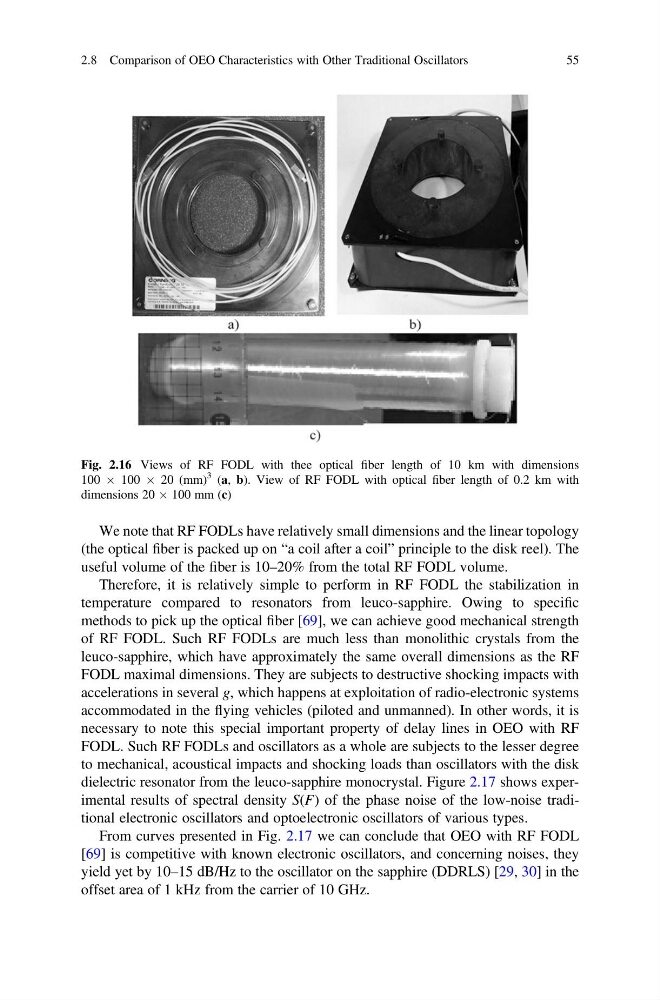
We note that RF FODLs have relatively small dimensions and the linear topology
(the optical fiber is packed up on “a coil after a coil” principle to the disk reel). The
useful volume of the fiber is 10–20% from the total RF FODL volume.
Therefore, it is relatively simple to perform in RF FODL the stabilization in
temperature compared to resonators from leuco-sapphire. Owing to specific
methods to pick up the optical fiber [69], we can achieve good mechanical strength
of RF FODL. Such RF FODLs are much less than monolithic crystals from the
leuco-sapphire, which have approximately the same overall dimensions as the RF
FODL maximal dimensions. They are subjects to destructive shocking impacts with
accelerations in several g, which happens at exploitation of radio-electronic systems
accommodated in the flying vehicles (piloted and unmanned). In other words, it is
necessary to note this special important property of delay lines in OEO with RF
FODL. Such RF FODLs and oscillators as a whole are subjects to the lesser degree
to mechanical, acoustical impacts and shocking loads than oscillators with the disk
dielectric resonator from the leuco-sapphire monocrystal. Figure 2.17 shows experimental results of spectral density S(F) of the phase noise of the low-noise traditional electronic oscillators and optoelectronic oscillators of various types.
From curves presented in Fig. 2.17 we can conclude that OEO with RF FODL
[69] is competitive with known electronic oscillators, and concerning noises, they
yield yet by 10–15 dB/Hz to the oscillator on the sapphire (DDRLS) [29, 30] in the
offset area of 1 kHz from the carrier of 10 GHz.
Fig. 2.16 Views of RF FODL with thee optical fiber length of 10 km with dimensions
100 Â 100 Â 20 (mm)
3 (a, b). View of RF FODL with optical fiber length of 0.2 km with
dimensions 20 Â 100 mm (c)
2.8 Comparison of OEO Characteristics with Other Traditional Oscillators
55
(the optical fiber is packed up on “a coil after a coil” principle to the disk reel). The
useful volume of the fiber is 10–20% from the total RF FODL volume.
Therefore, it is relatively simple to perform in RF FODL the stabilization in
temperature compared to resonators from leuco-sapphire. Owing to specific
methods to pick up the optical fiber [69], we can achieve good mechanical strength
of RF FODL. Such RF FODLs are much less than monolithic crystals from the
leuco-sapphire, which have approximately the same overall dimensions as the RF
FODL maximal dimensions. They are subjects to destructive shocking impacts with
accelerations in several g, which happens at exploitation of radio-electronic systems
accommodated in the flying vehicles (piloted and unmanned). In other words, it is
necessary to note this special important property of delay lines in OEO with RF
FODL. Such RF FODLs and oscillators as a whole are subjects to the lesser degree
to mechanical, acoustical impacts and shocking loads than oscillators with the disk
dielectric resonator from the leuco-sapphire monocrystal. Figure 2.17 shows experimental results of spectral density S(F) of the phase noise of the low-noise traditional electronic oscillators and optoelectronic oscillators of various types.
From curves presented in Fig. 2.17 we can conclude that OEO with RF FODL
[69] is competitive with known electronic oscillators, and concerning noises, they
yield yet by 10–15 dB/Hz to the oscillator on the sapphire (DDRLS) [29, 30] in the
offset area of 1 kHz from the carrier of 10 GHz.
Fig. 2.16 Views of RF FODL with thee optical fiber length of 10 km with dimensions
100 Â 100 Â 20 (mm)
3 (a, b). View of RF FODL with optical fiber length of 0.2 km with
dimensions 20 Â 100 mm (c)
2.8 Comparison of OEO Characteristics with Other Traditional Oscillators
55