

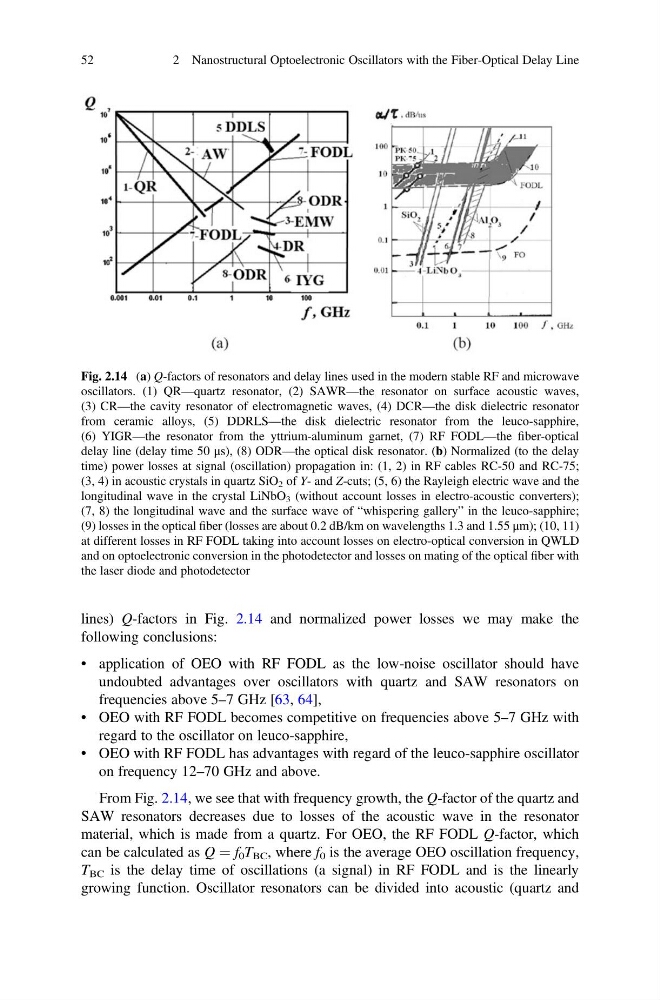
lines) Q-factors in Fig. 2.14 and normalized power losses we may make the
following conclusions:
• application of OEO with RF FODL as the low-noise oscillator should have
undoubted advantages over oscillators with quartz and SAW resonators on
frequencies above 5–7 GHz [63, 64],
• OEO with RF FODL becomes competitive on frequencies above 5–7 GHz with
regard to the oscillator on leuco-sapphire,
• OEO with RF FODL has advantages with regard of the leuco-sapphire oscillator
on frequency 12–70 GHz and above.
From Fig. 2.14, we see that with frequency growth, the Q-factor of the quartz and
SAW resonators decreases due to losses of the acoustic wave in the resonator
material, which is made from a quartz. For OEO, the RF FODL Q-factor, which
can be calculated as Q ¼ f 0 T BC , where f 0 is the average OEO oscillation frequency,
T BC is the delay time of oscillations (a signal) in RF FODL and is the linearly
growing function. Oscillator resonators can be divided into acoustic (quartz and
Fig. 2.14 (a) Q-factors of resonators and delay lines used in the modern stable RF and microwave
oscillators. (1) QR—quartz resonator, (2) SAWR—the resonator on surface acoustic waves,
(3) CR—the cavity resonator of electromagnetic waves, (4) DCR—the disk dielectric resonator
from ceramic alloys, (5) DDRLS—the disk dielectric resonator from the leuco-sapphire,
(6) YIGR—the resonator from the yttrium-aluminum garnet, (7) RF FODL—the fiber-optical
delay line (delay time 50 μs), (8) ODR—the optical disk resonator. (b) Normalized (to the delay
time) power losses at signal (oscillation) propagation in: (1, 2) in RF cables RC-50 and RC-75;
(3, 4) in acoustic crystals in quartz SiO 2 of Y- and Z-cuts; (5, 6) the Rayleigh electric wave and the
longitudinal wave in the crystal LiNbO 3 (without account losses in electro-acoustic converters);
(7, 8) the longitudinal wave and the surface wave of “whispering gallery” in the leuco-sapphire;
(9) losses in the optical fiber (losses are about 0.2 dB/km on wavelengths 1.3 and 1.55 μm); (10, 11)
at different losses in RF FODL taking into account losses on electro-optical conversion in QWLD
and on optoelectronic conversion in the photodetector and losses on mating of the optical fiber with
the laser diode and photodetector
52
2 Nanostructural Optoelectronic Oscillators with the Fiber-Optical Delay Line
following conclusions:
• application of OEO with RF FODL as the low-noise oscillator should have
undoubted advantages over oscillators with quartz and SAW resonators on
frequencies above 5–7 GHz [63, 64],
• OEO with RF FODL becomes competitive on frequencies above 5–7 GHz with
regard to the oscillator on leuco-sapphire,
• OEO with RF FODL has advantages with regard of the leuco-sapphire oscillator
on frequency 12–70 GHz and above.
From Fig. 2.14, we see that with frequency growth, the Q-factor of the quartz and
SAW resonators decreases due to losses of the acoustic wave in the resonator
material, which is made from a quartz. For OEO, the RF FODL Q-factor, which
can be calculated as Q ¼ f 0 T BC , where f 0 is the average OEO oscillation frequency,
T BC is the delay time of oscillations (a signal) in RF FODL and is the linearly
growing function. Oscillator resonators can be divided into acoustic (quartz and
Fig. 2.14 (a) Q-factors of resonators and delay lines used in the modern stable RF and microwave
oscillators. (1) QR—quartz resonator, (2) SAWR—the resonator on surface acoustic waves,
(3) CR—the cavity resonator of electromagnetic waves, (4) DCR—the disk dielectric resonator
from ceramic alloys, (5) DDRLS—the disk dielectric resonator from the leuco-sapphire,
(6) YIGR—the resonator from the yttrium-aluminum garnet, (7) RF FODL—the fiber-optical
delay line (delay time 50 μs), (8) ODR—the optical disk resonator. (b) Normalized (to the delay
time) power losses at signal (oscillation) propagation in: (1, 2) in RF cables RC-50 and RC-75;
(3, 4) in acoustic crystals in quartz SiO 2 of Y- and Z-cuts; (5, 6) the Rayleigh electric wave and the
longitudinal wave in the crystal LiNbO 3 (without account losses in electro-acoustic converters);
(7, 8) the longitudinal wave and the surface wave of “whispering gallery” in the leuco-sapphire;
(9) losses in the optical fiber (losses are about 0.2 dB/km on wavelengths 1.3 and 1.55 μm); (10, 11)
at different losses in RF FODL taking into account losses on electro-optical conversion in QWLD
and on optoelectronic conversion in the photodetector and losses on mating of the optical fiber with
the laser diode and photodetector
52
2 Nanostructural Optoelectronic Oscillators with the Fiber-Optical Delay Line