

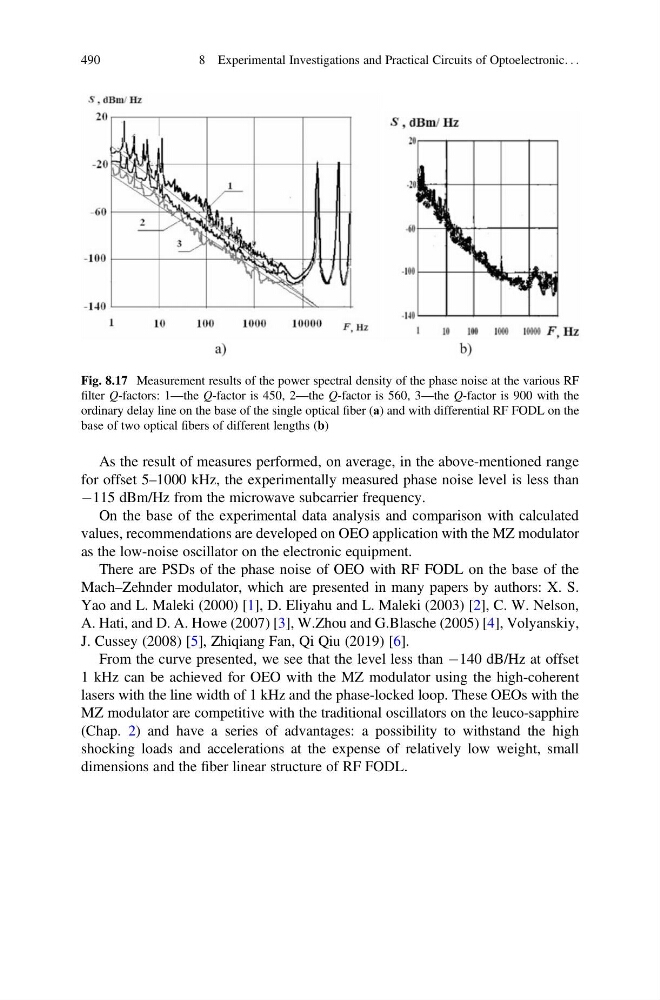
As the result of measures performed, on average, in the above-mentioned range
for offset 5–1000 kHz, the experimentally measured phase noise level is less than
À115 dBm/Hz from the microwave subcarrier frequency.
On the base of the experimental data analysis and comparison with calculated
values, recommendations are developed on OEO application with the MZ modulator
as the low-noise oscillator on the electronic equipment.
There are PSDs of the phase noise of OEO with RF FODL on the base of the
Mach–Zehnder modulator, which are presented in many papers by authors: X. S.
Yao and L. Maleki (2000) [1], D. Eliyahu and L. Maleki (2003) [2], C. W. Nelson,
A. Hati, and D. A. Howe (2007) [3], W.Zhou and G.Blasche (2005) [4], Volyanskiy,
J. Cussey (2008) [5], Zhiqiang Fan, Qi Qiu (2019) [6].
From the curve presented, we see that the level less than À140 dB/Hz at offset
1 kHz can be achieved for OEO with the MZ modulator using the high-coherent
lasers with the line width of 1 kHz and the phase-locked loop. These OEOs with the
MZ modulator are competitive with the traditional oscillators on the leuco-sapphire
(Chap. 2) and have a series of advantages: a possibility to withstand the high
shocking loads and accelerations at the expense of relatively low weight, small
dimensions and the fiber linear structure of RF FODL.
Fig. 8.17 Measurement results of the power spectral density of the phase noise at the various RF
filter Q-factors: 1—the Q-factor is 450, 2—the Q-factor is 560, 3—the Q-factor is 900 with the
ordinary delay line on the base of the single optical fiber (а) and with differential RF FODL on the
base of two optical fibers of different lengths (b)
490
8 Experimental Investigations and Practical Circuits of Optoelectronic. . .
for offset 5–1000 kHz, the experimentally measured phase noise level is less than
À115 dBm/Hz from the microwave subcarrier frequency.
On the base of the experimental data analysis and comparison with calculated
values, recommendations are developed on OEO application with the MZ modulator
as the low-noise oscillator on the electronic equipment.
There are PSDs of the phase noise of OEO with RF FODL on the base of the
Mach–Zehnder modulator, which are presented in many papers by authors: X. S.
Yao and L. Maleki (2000) [1], D. Eliyahu and L. Maleki (2003) [2], C. W. Nelson,
A. Hati, and D. A. Howe (2007) [3], W.Zhou and G.Blasche (2005) [4], Volyanskiy,
J. Cussey (2008) [5], Zhiqiang Fan, Qi Qiu (2019) [6].
From the curve presented, we see that the level less than À140 dB/Hz at offset
1 kHz can be achieved for OEO with the MZ modulator using the high-coherent
lasers with the line width of 1 kHz and the phase-locked loop. These OEOs with the
MZ modulator are competitive with the traditional oscillators on the leuco-sapphire
(Chap. 2) and have a series of advantages: a possibility to withstand the high
shocking loads and accelerations at the expense of relatively low weight, small
dimensions and the fiber linear structure of RF FODL.
Fig. 8.17 Measurement results of the power spectral density of the phase noise at the various RF
filter Q-factors: 1—the Q-factor is 450, 2—the Q-factor is 560, 3—the Q-factor is 900 with the
ordinary delay line on the base of the single optical fiber (а) and with differential RF FODL on the
base of two optical fibers of different lengths (b)
490
8 Experimental Investigations and Practical Circuits of Optoelectronic. . .