

registration of geometrical lengthening of the optical fiber on the level of 0.2 μm.
Therefore, such a QWLD is expedient to apply in high-sensitive oscillating fiberoptical sensors, as well as in oscillators with RF FODL for generation of the highstabilized harmonic radio signal. At small pumping currents, the slope of variations
of generation frequency versus the pumping current is 0.3 MHz/mA. At large
pumping currents of QWLD (5–8), the slope of variations of OEO DM versus the
pumping current is 0.003 MHz/mA.
Discovered experimentally for the first time and explained by our theoretical
analysis of the phenomenon for QWLD of polarity change of the LD time constant
and the slope inclination S f of the function f(I pump ) for OEO with LD gives a
possibility to correctly select of the pumping currents of the laser diode in OEO
and the amplitude of the modulation signal, and also to optimize the constructions of
LD modulator, the matching optical device with the optical fiber, and the
thermostabilizing block.
Main determining factors, which affect the process of oscillations formation, are:
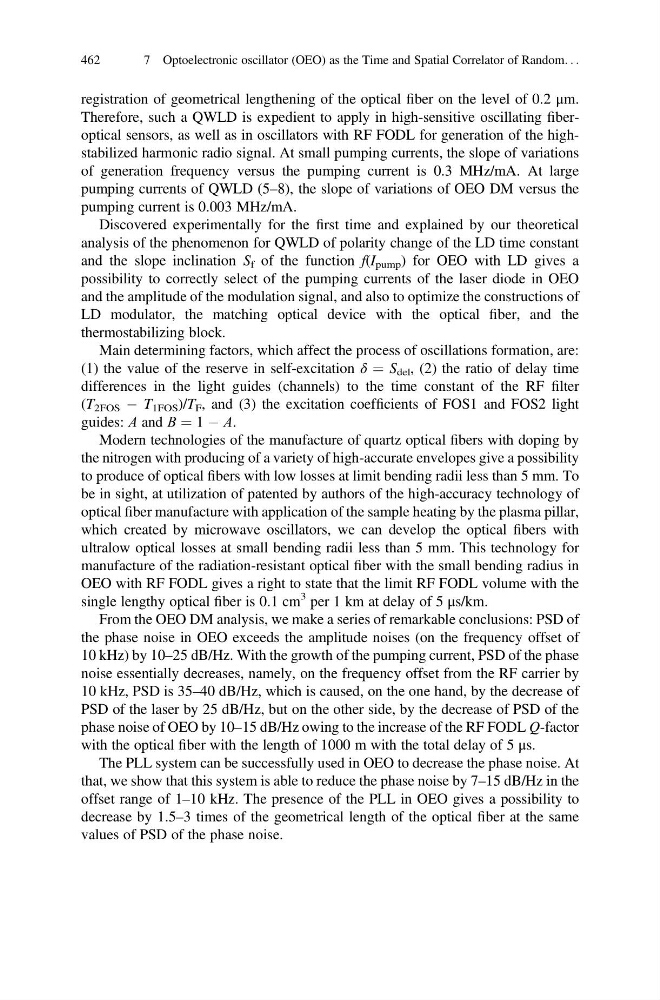
(1) the value of the reserve in self-excitation δ ¼ S del , (2) the ratio of delay time
differences in the light guides (channels) to the time constant of the RF filter
(T 2FOS À T 1FOS )/T F , and (3) the excitation coefficients of FOS1 and FOS2 light
guides: А and В ¼ 1 À А.
Modern technologies of the manufacture of quartz optical fibers with doping by
the nitrogen with producing of a variety of high-accurate envelopes give a possibility
to produce of optical fibers with low losses at limit bending radii less than 5 mm. To
be in sight, at utilization of patented by authors of the high-accuracy technology of
optical fiber manufacture with application of the sample heating by the plasma pillar,
which created by microwave oscillators, we can develop the optical fibers with
ultralow optical losses at small bending radii less than 5 mm. This technology for
manufacture of the radiation-resistant optical fiber with the small bending radius in
OEO with RF FODL gives a right to state that the limit RF FODL volume with the
single lengthy optical fiber is 0.1 cm
3 per 1 km at delay of 5 μs/km.
From the OEO DM analysis, we make a series of remarkable conclusions: PSD of
the phase noise in OEO exceeds the amplitude noises (on the frequency offset of
10 kHz) by 10–25 dB/Hz. With the growth of the pumping current, PSD of the phase
noise essentially decreases, namely, on the frequency offset from the RF carrier by
10 kHz, PSD is 35–40 dB/Hz, which is caused, on the one hand, by the decrease of
PSD of the laser by 25 dB/Hz, but on the other side, by the decrease of PSD of the
phase noise of OEO by 10–15 dB/Hz owing to the increase of the RF FODL Q-factor
with the optical fiber with the length of 1000 m with the total delay of 5 μs.
The PLL system can be successfully used in OEO to decrease the phase noise. At
that, we show that this system is able to reduce the phase noise by 7–15 dB/Hz in the
offset range of 1–10 kHz. The presence of the PLL in OEO gives a possibility to
decrease by 1.5–3 times of the geometrical length of the optical fiber at the same
values of PSD of the phase noise.
462
7 Optoelectronic oscillator (OEO) as the Time and Spatial Correlator of Random. . .
Therefore, such a QWLD is expedient to apply in high-sensitive oscillating fiberoptical sensors, as well as in oscillators with RF FODL for generation of the highstabilized harmonic radio signal. At small pumping currents, the slope of variations
of generation frequency versus the pumping current is 0.3 MHz/mA. At large
pumping currents of QWLD (5–8), the slope of variations of OEO DM versus the
pumping current is 0.003 MHz/mA.
Discovered experimentally for the first time and explained by our theoretical
analysis of the phenomenon for QWLD of polarity change of the LD time constant
and the slope inclination S f of the function f(I pump ) for OEO with LD gives a
possibility to correctly select of the pumping currents of the laser diode in OEO
and the amplitude of the modulation signal, and also to optimize the constructions of
LD modulator, the matching optical device with the optical fiber, and the
thermostabilizing block.
Main determining factors, which affect the process of oscillations formation, are:
(1) the value of the reserve in self-excitation δ ¼ S del , (2) the ratio of delay time
differences in the light guides (channels) to the time constant of the RF filter
(T 2FOS À T 1FOS )/T F , and (3) the excitation coefficients of FOS1 and FOS2 light
guides: А and В ¼ 1 À А.
Modern technologies of the manufacture of quartz optical fibers with doping by
the nitrogen with producing of a variety of high-accurate envelopes give a possibility
to produce of optical fibers with low losses at limit bending radii less than 5 mm. To
be in sight, at utilization of patented by authors of the high-accuracy technology of
optical fiber manufacture with application of the sample heating by the plasma pillar,
which created by microwave oscillators, we can develop the optical fibers with
ultralow optical losses at small bending radii less than 5 mm. This technology for
manufacture of the radiation-resistant optical fiber with the small bending radius in
OEO with RF FODL gives a right to state that the limit RF FODL volume with the
single lengthy optical fiber is 0.1 cm
3 per 1 km at delay of 5 μs/km.
From the OEO DM analysis, we make a series of remarkable conclusions: PSD of
the phase noise in OEO exceeds the amplitude noises (on the frequency offset of
10 kHz) by 10–25 dB/Hz. With the growth of the pumping current, PSD of the phase
noise essentially decreases, namely, on the frequency offset from the RF carrier by
10 kHz, PSD is 35–40 dB/Hz, which is caused, on the one hand, by the decrease of
PSD of the laser by 25 dB/Hz, but on the other side, by the decrease of PSD of the
phase noise of OEO by 10–15 dB/Hz owing to the increase of the RF FODL Q-factor
with the optical fiber with the length of 1000 m with the total delay of 5 μs.
The PLL system can be successfully used in OEO to decrease the phase noise. At
that, we show that this system is able to reduce the phase noise by 7–15 dB/Hz in the
offset range of 1–10 kHz. The presence of the PLL in OEO gives a possibility to
decrease by 1.5–3 times of the geometrical length of the optical fiber at the same
values of PSD of the phase noise.
462
7 Optoelectronic oscillator (OEO) as the Time and Spatial Correlator of Random. . .