

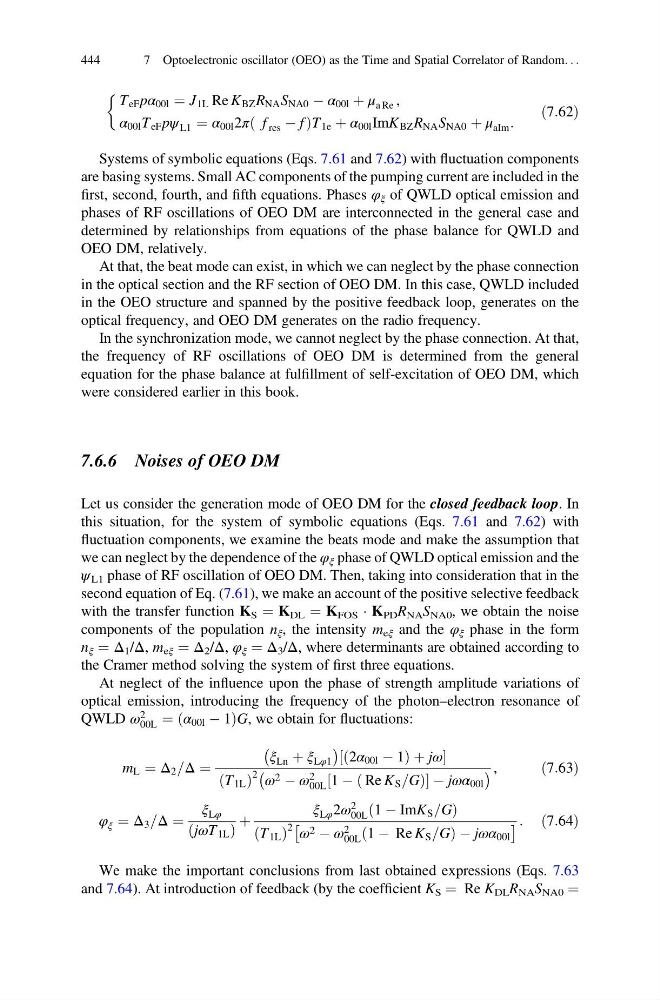
T eF pα 00l ¼ J 1L Re K BZ R NA S NA0 À α 00l þ μ a Re ,
α 00l T eF pψ L1 ¼ α 00l 2π f res À f
ð
Þ T 1e þ α 00l ImK BZ R NA S NA0 þ μ aIm :
&
ð7:62Þ
Systems of symbolic equations (Eqs. 7.61 and 7.62) with fluctuation components
are basing systems. Small AC components of the pumping current are included in the
first, second, fourth, and fifth equations. Phases φ ξ of QWLD optical emission and
phases of RF oscillations of OEO DM are interconnected in the general case and
determined by relationships from equations of the phase balance for QWLD and
OEO DM, relatively.
At that, the beat mode can exist, in which we can neglect by the phase connection
in the optical section and the RF section of OEO DM. In this case, QWLD included
in the OEO structure and spanned by the positive feedback loop, generates on the
optical frequency, and OEO DM generates on the radio frequency.
In the synchronization mode, we cannot neglect by the phase connection. At that,
the frequency of RF oscillations of OEO DM is determined from the general
equation for the phase balance at fulfillment of self-excitation of OEO DM, which
were considered earlier in this book.
7.6.6 Noises of OEO DM
Let us consider the generation mode of OEO DM for the closed feedback loop. In
this situation, for the system of symbolic equations (Eqs. 7.61 and 7.62) with
fluctuation components, we examine the beats mode and make the assumption that
we can neglect by the dependence of the φ ξ phase of QWLD optical emission and the
ψ L1 phase of RF oscillation of OEO DM. Then, taking into consideration that in the
second equation of Eq. (7.61), we make an account of the positive selective feedback
with the transfer function K S ¼ K DL ¼ K FOS Á K PD R NA S NA0 , we obtain the noise
components of the population n ξ , the intensity m eξ and the φ ξ phase in the form
n ξ ¼ Δ 1 /Δ, m eξ ¼ Δ 2 /Δ, φ ξ ¼ Δ 3 /Δ, where determinants are obtained according to
the Cramer method solving the system of first three equations.
At neglect of the influence upon the phase of strength amplitude variations of
optical emission, introducing the frequency of the photon–electron resonance of
QWLD ω
2
00L ¼ α 00l À 1
ð
Þ G, we obtain for fluctuations:
m L ¼ Δ 2 =Δ ¼
ξ Ln þ ξ Lφ1
À
Á
2α 00l À 1
ð
Þþjω
½
T 1L
ð Þ
2 ω 2 À ω 2
00L 1 À Re K S =G
ð
Þ
½
À jωα 00l
À
Á ,
ð7:63Þ
φ ξ ¼ Δ 3 =Δ ¼
ξ Lφ
jωT 1L
ð
Þ
þ
ξ Lφ 2ω
2
00L 1 À ImK S =G
ð
Þ
T 1L
ð Þ
2 ω 2 À ω 2
00L 1 À Re K S =G
ð
Þ À jωα 00l
Â
à : ð7:64Þ
We make the important conclusions from last obtained expressions (Eqs. 7.63
and 7.64). At introduction of feedback (by the coefficient K S ¼ Re K DL R NA S NA0 ¼
444
7 Optoelectronic oscillator (OEO) as the Time and Spatial Correlator of Random. . .
α 00l T eF pψ L1 ¼ α 00l 2π f res À f
ð
Þ T 1e þ α 00l ImK BZ R NA S NA0 þ μ aIm :
&
ð7:62Þ
Systems of symbolic equations (Eqs. 7.61 and 7.62) with fluctuation components
are basing systems. Small AC components of the pumping current are included in the
first, second, fourth, and fifth equations. Phases φ ξ of QWLD optical emission and
phases of RF oscillations of OEO DM are interconnected in the general case and
determined by relationships from equations of the phase balance for QWLD and
OEO DM, relatively.
At that, the beat mode can exist, in which we can neglect by the phase connection
in the optical section and the RF section of OEO DM. In this case, QWLD included
in the OEO structure and spanned by the positive feedback loop, generates on the
optical frequency, and OEO DM generates on the radio frequency.
In the synchronization mode, we cannot neglect by the phase connection. At that,
the frequency of RF oscillations of OEO DM is determined from the general
equation for the phase balance at fulfillment of self-excitation of OEO DM, which
were considered earlier in this book.
7.6.6 Noises of OEO DM
Let us consider the generation mode of OEO DM for the closed feedback loop. In
this situation, for the system of symbolic equations (Eqs. 7.61 and 7.62) with
fluctuation components, we examine the beats mode and make the assumption that
we can neglect by the dependence of the φ ξ phase of QWLD optical emission and the
ψ L1 phase of RF oscillation of OEO DM. Then, taking into consideration that in the
second equation of Eq. (7.61), we make an account of the positive selective feedback
with the transfer function K S ¼ K DL ¼ K FOS Á K PD R NA S NA0 , we obtain the noise
components of the population n ξ , the intensity m eξ and the φ ξ phase in the form
n ξ ¼ Δ 1 /Δ, m eξ ¼ Δ 2 /Δ, φ ξ ¼ Δ 3 /Δ, where determinants are obtained according to
the Cramer method solving the system of first three equations.
At neglect of the influence upon the phase of strength amplitude variations of
optical emission, introducing the frequency of the photon–electron resonance of
QWLD ω
2
00L ¼ α 00l À 1
ð
Þ G, we obtain for fluctuations:
m L ¼ Δ 2 =Δ ¼
ξ Ln þ ξ Lφ1
À
Á
2α 00l À 1
ð
Þþjω
½
T 1L
ð Þ
2 ω 2 À ω 2
00L 1 À Re K S =G
ð
Þ
½
À jωα 00l
À
Á ,
ð7:63Þ
φ ξ ¼ Δ 3 =Δ ¼
ξ Lφ
jωT 1L
ð
Þ
þ
ξ Lφ 2ω
2
00L 1 À ImK S =G
ð
Þ
T 1L
ð Þ
2 ω 2 À ω 2
00L 1 À Re K S =G
ð
Þ À jωα 00l
Â
à : ð7:64Þ
We make the important conclusions from last obtained expressions (Eqs. 7.63
and 7.64). At introduction of feedback (by the coefficient K S ¼ Re K DL R NA S NA0 ¼
444
7 Optoelectronic oscillator (OEO) as the Time and Spatial Correlator of Random. . .