

between OFs. At that, the slope of the radio-frequency control is 10
À4 to 10
À7 Hz/nm
and essentially depends on the selector choice.
At the linear law of the optical coupling coefficient C coup variation in the
directional coupler of Х-type, the law of OEO generation frequency variation at
the differential RF FODL is periodic, which period is determined by the product
C coup Z. In turn, the coefficient of optical coupling depends upon the optical frequency v L of QWLD in MLS and determines by the expression C coup ¼ C 0 (1 + C 1 v L ),
in which С 0 and С 1 are real coefficients depending on the refraction index of the
material of the light guider, the boundary medium and their geometrical sizes. Thus,
we show that the one of features of OEO is the connection of the QWLD optical
frequency with the radio frequency in OEO.
The fulfilled theoretical and experimental analysis of the OEO frequency control
systems on the base of directional optical couplers of Y- and Х-types shows that the
retuning frequency range is from 1 till 20%, and the slope of the generation
frequency control versus the FOS bias is from 10 Hz/μm till 10 kHz/μm, the
nonlinear distortion coefficient in Frequency functions is less than 2%.
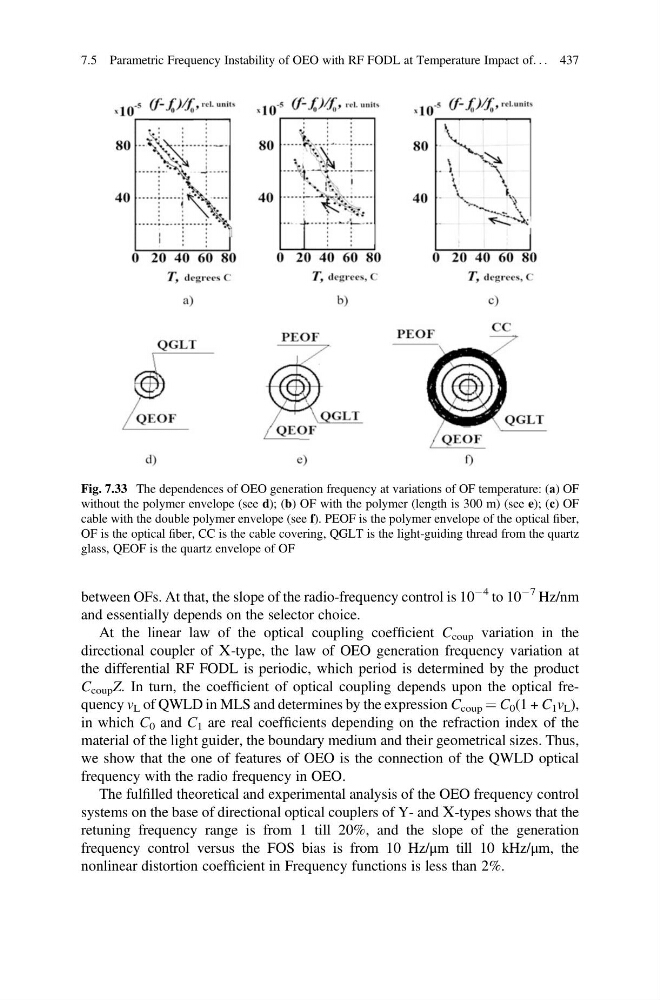
Fig. 7.33 The dependences of OEO generation frequency at variations of OF temperature: (а) OF
without the polymer envelope (see d); (b) OF with the polymer (length is 300 m) (see e); (с) OF
cable with the double polymer envelope (see f). PEOF is the polymer envelope of the optical fiber,
OF is the optical fiber, CC is the cable covering, QGLT is the light-guiding thread from the quartz
glass, QEOF is the quartz envelope of OF
7.5 Parametric Frequency Instability of OEO with RF FODL at Temperature Impact of. . . 437
À4 to 10
À7 Hz/nm
and essentially depends on the selector choice.
At the linear law of the optical coupling coefficient C coup variation in the
directional coupler of Х-type, the law of OEO generation frequency variation at
the differential RF FODL is periodic, which period is determined by the product
C coup Z. In turn, the coefficient of optical coupling depends upon the optical frequency v L of QWLD in MLS and determines by the expression C coup ¼ C 0 (1 + C 1 v L ),
in which С 0 and С 1 are real coefficients depending on the refraction index of the
material of the light guider, the boundary medium and their geometrical sizes. Thus,
we show that the one of features of OEO is the connection of the QWLD optical
frequency with the radio frequency in OEO.
The fulfilled theoretical and experimental analysis of the OEO frequency control
systems on the base of directional optical couplers of Y- and Х-types shows that the
retuning frequency range is from 1 till 20%, and the slope of the generation
frequency control versus the FOS bias is from 10 Hz/μm till 10 kHz/μm, the
nonlinear distortion coefficient in Frequency functions is less than 2%.
Fig. 7.33 The dependences of OEO generation frequency at variations of OF temperature: (а) OF
without the polymer envelope (see d); (b) OF with the polymer (length is 300 m) (see e); (с) OF
cable with the double polymer envelope (see f). PEOF is the polymer envelope of the optical fiber,
OF is the optical fiber, CC is the cable covering, QGLT is the light-guiding thread from the quartz
glass, QEOF is the quartz envelope of OF
7.5 Parametric Frequency Instability of OEO with RF FODL at Temperature Impact of. . . 437