

7.5.3 Parametric and Long-Term Frequency Instability
of OEO with the Differential RF FODL
One of the methods for decrease of relative temperature offsets of the OEO frequency is the application of the differential RF FODL. At that, the main stabilization
principle at temperature changing is utilization of segments of significant (more than
by an order) decrease of the PFC slope from the temperature variations of the
combined differential RF FODL on the base of two or several optical fibers of
different length. At that, for specified OEO frequency, we can select, for example,
two optical fiber of the different length in such a manner that total PFC of RF FODL
has in definite portions of low slope of temperature variations, and the module of the
transfer function in this chosen segment varies insignificantly (less than by 10–50%).
In turn, temperature of the thermostat for the optical fiber, for instance, 25
С must
be kept constant and adjusts at external variations of the temperature.
The influence of small quasi-static variations of OEO with RF FODL parameters,
on the base of two optical fibers of different lengths FOS1 and FOS2 (excitation
coefficients of these FOS1 and FOS2 are, relatively, А and В), taking into account
that delay time in FOS is much more than the time constant of the RF filter upon its
frequency, at small OEO non-isochronity and at condition that the equality В ¼ 1 À А
is not fulfilled (i.e., the sum of coefficients is A + B 6 ¼ 1), is described by the
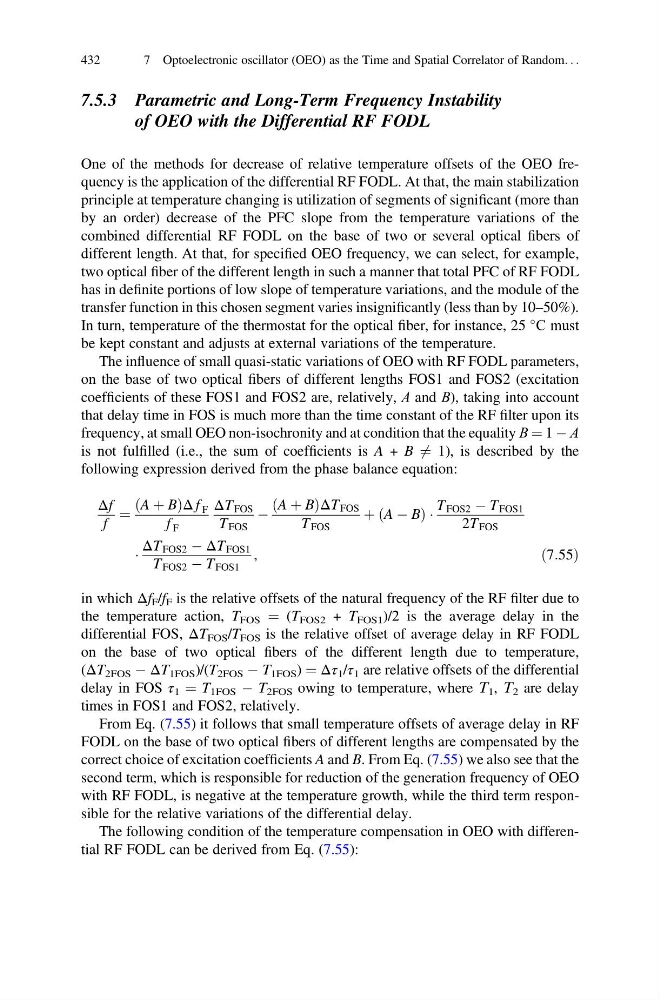
following expression derived from the phase balance equation:
Δf
f
¼
A þ B
ð
ÞΔ f F
f F
ΔT FOS
T FOS
À
A þ B
ð
ÞΔT FOS
T FOS
þ A À B
ð
ÞÁ
T FOS2 À T FOS1
2T FOS
Á
ΔT FOS2 À ΔT FOS1
T FOS2 À T FOS1
,
ð7:55Þ
in which Δf F /f F is the relative offsets of the natural frequency of the RF filter due to
the temperature action, T FOS ¼ (T FOS2 + T FOS1 )/2 is the average delay in the
differential FOS, ΔT FOS /T FOS is the relative offset of average delay in RF FODL
on the base of two optical fibers of the different length due to temperature,
(ΔT 2FOS À ΔT 1FOS )/(T 2FOS À T 1FOS ) ¼ Δτ 1 /τ 1 are relative offsets of the differential
delay in FOS τ 1 ¼ T 1FOS À T 2FOS owing to temperature, where Т 1 , Т 2 are delay
times in FOS1 and FOS2, relatively.
From Eq. (7.55) it follows that small temperature offsets of average delay in RF
FODL on the base of two optical fibers of different lengths are compensated by the
correct choice of excitation coefficients A and B. From Eq. (7.55) we also see that the
second term, which is responsible for reduction of the generation frequency of OEO
with RF FODL, is negative at the temperature growth, while the third term responsible for the relative variations of the differential delay.
The following condition of the temperature compensation in OEO with differential RF FODL can be derived from Eq. (7.55):
432
7 Optoelectronic oscillator (OEO) as the Time and Spatial Correlator of Random. . .
of OEO with the Differential RF FODL
One of the methods for decrease of relative temperature offsets of the OEO frequency is the application of the differential RF FODL. At that, the main stabilization
principle at temperature changing is utilization of segments of significant (more than
by an order) decrease of the PFC slope from the temperature variations of the
combined differential RF FODL on the base of two or several optical fibers of
different length. At that, for specified OEO frequency, we can select, for example,
two optical fiber of the different length in such a manner that total PFC of RF FODL
has in definite portions of low slope of temperature variations, and the module of the
transfer function in this chosen segment varies insignificantly (less than by 10–50%).
In turn, temperature of the thermostat for the optical fiber, for instance, 25
С must
be kept constant and adjusts at external variations of the temperature.
The influence of small quasi-static variations of OEO with RF FODL parameters,
on the base of two optical fibers of different lengths FOS1 and FOS2 (excitation
coefficients of these FOS1 and FOS2 are, relatively, А and В), taking into account
that delay time in FOS is much more than the time constant of the RF filter upon its
frequency, at small OEO non-isochronity and at condition that the equality В ¼ 1 À А
is not fulfilled (i.e., the sum of coefficients is A + B 6 ¼ 1), is described by the
following expression derived from the phase balance equation:
Δf
f
¼
A þ B
ð
ÞΔ f F
f F
ΔT FOS
T FOS
À
A þ B
ð
ÞΔT FOS
T FOS
þ A À B
ð
ÞÁ
T FOS2 À T FOS1
2T FOS
Á
ΔT FOS2 À ΔT FOS1
T FOS2 À T FOS1
,
ð7:55Þ
in which Δf F /f F is the relative offsets of the natural frequency of the RF filter due to
the temperature action, T FOS ¼ (T FOS2 + T FOS1 )/2 is the average delay in the
differential FOS, ΔT FOS /T FOS is the relative offset of average delay in RF FODL
on the base of two optical fibers of the different length due to temperature,
(ΔT 2FOS À ΔT 1FOS )/(T 2FOS À T 1FOS ) ¼ Δτ 1 /τ 1 are relative offsets of the differential
delay in FOS τ 1 ¼ T 1FOS À T 2FOS owing to temperature, where Т 1 , Т 2 are delay
times in FOS1 and FOS2, relatively.
From Eq. (7.55) it follows that small temperature offsets of average delay in RF
FODL on the base of two optical fibers of different lengths are compensated by the
correct choice of excitation coefficients A and B. From Eq. (7.55) we also see that the
second term, which is responsible for reduction of the generation frequency of OEO
with RF FODL, is negative at the temperature growth, while the third term responsible for the relative variations of the differential delay.
The following condition of the temperature compensation in OEO with differential RF FODL can be derived from Eq. (7.55):
432
7 Optoelectronic oscillator (OEO) as the Time and Spatial Correlator of Random. . .