

the relative narrow range of optical frequencies. For the wide range of optical
frequencies for the coupler of Х-type, this function may be non-monotonic.
The promising approach for the frequency control in OEO with differential RF
FODL is the variation of the optical coupling coefficient C coupl due to the variation of
the optical frequency ν of MLS, since this coefficient is proportional to the optical
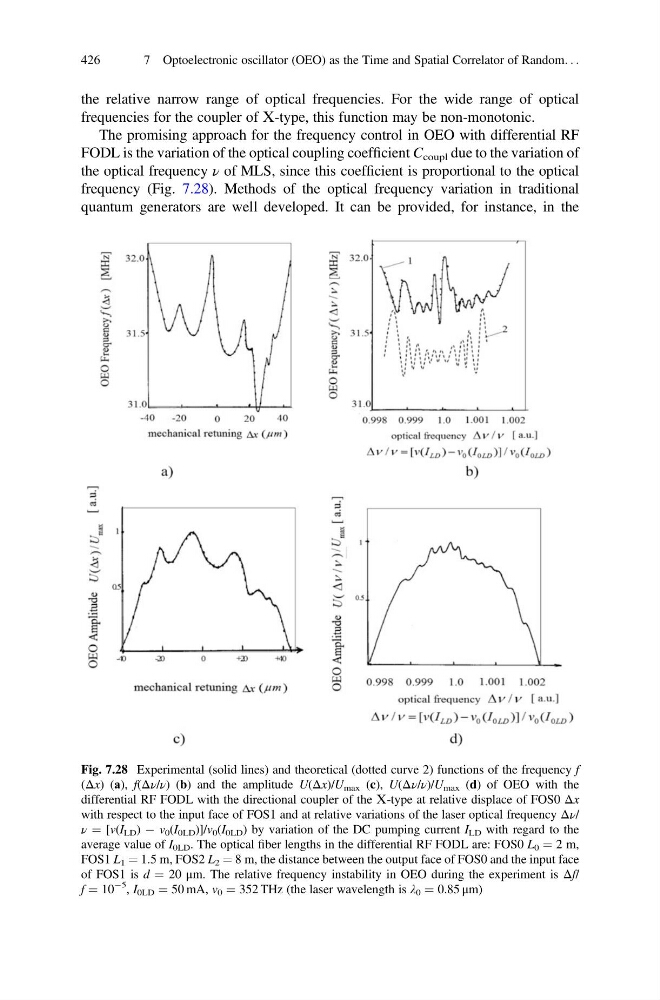
frequency (Fig. 7.28). Methods of the optical frequency variation in traditional
quantum generators are well developed. It can be provided, for instance, in the
Fig. 7.28 Experimental (solid lines) and theoretical (dotted curve 2) functions of the frequency f
(Δx) (а), f(Δν/ν) (b) and the amplitude U(Δx)/U max (c), U(Δν/ν)/U max (d) of OEO with the
differential RF FODL with the directional coupler of the Х-type at relative displace of FOS0 Δx
with respect to the input face of FOS1 and at relative variations of the laser optical frequency Δν/
ν ¼ [v(I LD ) À v 0 (I 0LD )]/v 0 (I 0LD ) by variation of the DC pumping current I LD with regard to the
average value of I 0LD . The optical fiber lengths in the differential RF FODL are: FOS0 L 0 ¼ 2 m,
FOS1 L 1 ¼ 1.5 m, FOS2 L 2 ¼ 8 m, the distance between the output face of FOS0 and the input face
of FOS1 is d ¼ 20 μm. The relative frequency instability in OEO during the experiment is Δf/
f ¼ 10
À5
, I 0LD ¼ 50 mA, v 0 ¼ 352 THz (the laser wavelength is λ 0 ¼ 0.85 μm)
426
7 Optoelectronic oscillator (OEO) as the Time and Spatial Correlator of Random. . .
frequencies for the coupler of Х-type, this function may be non-monotonic.
The promising approach for the frequency control in OEO with differential RF
FODL is the variation of the optical coupling coefficient C coupl due to the variation of
the optical frequency ν of MLS, since this coefficient is proportional to the optical
frequency (Fig. 7.28). Methods of the optical frequency variation in traditional
quantum generators are well developed. It can be provided, for instance, in the
Fig. 7.28 Experimental (solid lines) and theoretical (dotted curve 2) functions of the frequency f
(Δx) (а), f(Δν/ν) (b) and the amplitude U(Δx)/U max (c), U(Δν/ν)/U max (d) of OEO with the
differential RF FODL with the directional coupler of the Х-type at relative displace of FOS0 Δx
with respect to the input face of FOS1 and at relative variations of the laser optical frequency Δν/
ν ¼ [v(I LD ) À v 0 (I 0LD )]/v 0 (I 0LD ) by variation of the DC pumping current I LD with regard to the
average value of I 0LD . The optical fiber lengths in the differential RF FODL are: FOS0 L 0 ¼ 2 m,
FOS1 L 1 ¼ 1.5 m, FOS2 L 2 ¼ 8 m, the distance between the output face of FOS0 and the input face
of FOS1 is d ¼ 20 μm. The relative frequency instability in OEO during the experiment is Δf/
f ¼ 10
À5
, I 0LD ¼ 50 mA, v 0 ¼ 352 THz (the laser wavelength is λ 0 ¼ 0.85 μm)
426
7 Optoelectronic oscillator (OEO) as the Time and Spatial Correlator of Random. . .