

at the modulation frequency band about 40 GHz. The structure of such QWLD
includes three series-connected sections: “the block of phasing”—formation of
QWLD optical emission, “the block of optical lattice”—the discriminator on the
base of the narrowband optical filter made on the Bragg lattice, “the amplification”—
the block of QWLD optical emission amplification. The AFC of the ultra-wideband
QWLD with the modulation band of 40 GHz is presented in [9] shows the watt–
ampere characteristic and the emission spectrum of the ultra-wideband QWLD with
the modulation band of 40 GHz [9].
The frequency of the photon–electron resonance is determined by the lifetime of
carriers (photons) on the upper level and by the exceed of pumping above the
threshold level. The frequency of the photon–photon resonance in QWLD is defined
by the frequency of the external optical filter of QWLD located outside the main
resonator and tuned to the optical frequency equaled to the generated central
frequency v ¼ 30 GHz.
The attention of manufacturers is increased to development of the narrowband
QWLD [15–19] with extremely low permissible phase noises. In [15–19], the
construction (а) and the overall view of the package (b) of the narrowband modern
QWLD are shown. Such QWLD is commercially available. The price of such
QWLD is about $3000–$5000 per one piece. The spectral line width of optical
emission on the wavelength of 1.55 μm is 1–3 kHz. PSD of the phase noise for the
offset of 1 kHz from carrier is À110 to À115 dBm/Hz, which is the record value for
the compact commercial QWLD.
Experimental values of PSD of the QWLD phase noise at different offsets from
the optical carrier frequency, which corresponds to the generated wavelength of
1.55 μm (а), the watt–ampere QWLD characteristic (b) and the emission spectrum of
QWLD (c) are shown in [15–19]. The emission spectrum is measured with the help
of the spectrum analyzer “Аnritcy” with resolution in wavelength of 0.01 nm.
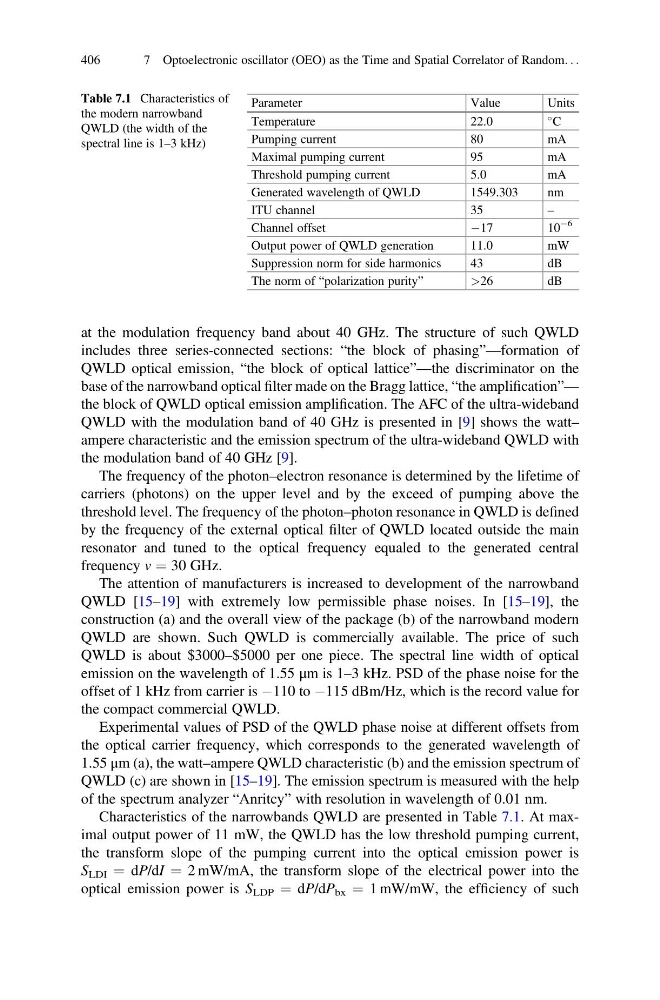
Characteristics of the narrowbands QWLD are presented in Table 7.1. At maximal output power of 11 mW, the QWLD has the low threshold pumping current,
the transform slope of the pumping current into the optical emission power is
S LDI ¼ dP/dI ¼ 2 mW/mA, the transform slope of the electrical power into the
optical emission power is S LDP ¼ dP/dP bx ¼ 1 mW/mW, the efficiency of such
Table 7.1 Characteristics of
the modern narrowband
QWLD (the width of the
spectral line is 1–3 kHz)
Parameter
Value
Units
Temperature
22.0
C
Pumping current
80
mA
Maximal pumping current
95
mA
Threshold pumping current
5.0
mA
Generated wavelength of QWLD
1549.303
nm
ITU channel
35
–
Channel offset
À17
10
À6
Output power of QWLD generation
11.0
mW
Suppression norm for side harmonics
43
dB
The norm of “polarization purity”
>26
dB
406
7 Optoelectronic oscillator (OEO) as the Time and Spatial Correlator of Random. . .
includes three series-connected sections: “the block of phasing”—formation of
QWLD optical emission, “the block of optical lattice”—the discriminator on the
base of the narrowband optical filter made on the Bragg lattice, “the amplification”—
the block of QWLD optical emission amplification. The AFC of the ultra-wideband
QWLD with the modulation band of 40 GHz is presented in [9] shows the watt–
ampere characteristic and the emission spectrum of the ultra-wideband QWLD with
the modulation band of 40 GHz [9].
The frequency of the photon–electron resonance is determined by the lifetime of
carriers (photons) on the upper level and by the exceed of pumping above the
threshold level. The frequency of the photon–photon resonance in QWLD is defined
by the frequency of the external optical filter of QWLD located outside the main
resonator and tuned to the optical frequency equaled to the generated central
frequency v ¼ 30 GHz.
The attention of manufacturers is increased to development of the narrowband
QWLD [15–19] with extremely low permissible phase noises. In [15–19], the
construction (а) and the overall view of the package (b) of the narrowband modern
QWLD are shown. Such QWLD is commercially available. The price of such
QWLD is about $3000–$5000 per one piece. The spectral line width of optical
emission on the wavelength of 1.55 μm is 1–3 kHz. PSD of the phase noise for the
offset of 1 kHz from carrier is À110 to À115 dBm/Hz, which is the record value for
the compact commercial QWLD.
Experimental values of PSD of the QWLD phase noise at different offsets from
the optical carrier frequency, which corresponds to the generated wavelength of
1.55 μm (а), the watt–ampere QWLD characteristic (b) and the emission spectrum of
QWLD (c) are shown in [15–19]. The emission spectrum is measured with the help
of the spectrum analyzer “Аnritcy” with resolution in wavelength of 0.01 nm.
Characteristics of the narrowbands QWLD are presented in Table 7.1. At maximal output power of 11 mW, the QWLD has the low threshold pumping current,
the transform slope of the pumping current into the optical emission power is
S LDI ¼ dP/dI ¼ 2 mW/mA, the transform slope of the electrical power into the
optical emission power is S LDP ¼ dP/dP bx ¼ 1 mW/mW, the efficiency of such
Table 7.1 Characteristics of
the modern narrowband
QWLD (the width of the
spectral line is 1–3 kHz)
Parameter
Value
Units
Temperature
22.0
C
Pumping current
80
mA
Maximal pumping current
95
mA
Threshold pumping current
5.0
mA
Generated wavelength of QWLD
1549.303
nm
ITU channel
35
–
Channel offset
À17
10
À6
Output power of QWLD generation
11.0
mW
Suppression norm for side harmonics
43
dB
The norm of “polarization purity”
>26
dB
406
7 Optoelectronic oscillator (OEO) as the Time and Spatial Correlator of Random. . .