

determined by р- and n-ohmic contacts, by the thickness of the р-emitter above the
active region and the substrate resistance.
The total capacitance C L value is determined by the series-connected barrier
capacitance of the junction С pn and the capacitance С d formed by the dielectric
film with the thickness d, i.e.: C L ¼ C pn C d /(C pn + C d ).
The complex transfer function of QWLD K LD ( jω) at such restrictions is written
as:
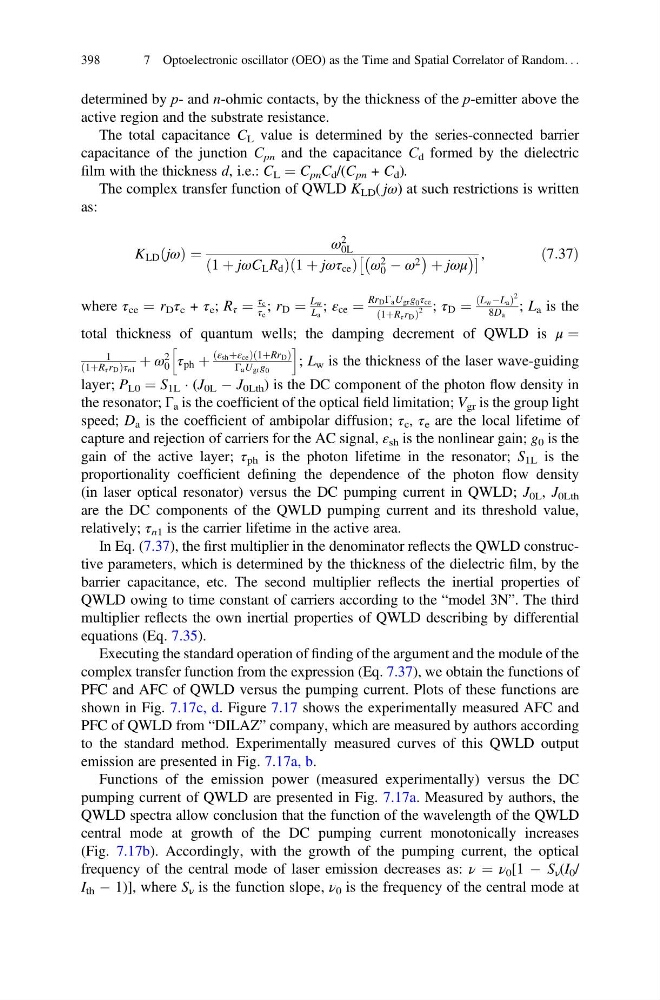
K LD jω
ð Þ ¼
ω
2
0L
1 þ jωC L R d
ð
Þ1 þ jωτ ce
ð
Þ ω 2
0 À ω 2
À
Á þ jωμ
Â
Á
,
ð7:37Þ
where τ ce ¼ r D τ c + τ e ; R τ ¼
τ c
τ e
; r D ¼
L w
L a
; ε ce ¼
Rr D Г а U gr g 0 τ ce
1þR τ r D
ð
Þ
2 ; τ D ¼
L w ÀL a
ð
Þ
2
8D a
; L a is the
total thickness of quantum wells; the damping decrement of QWLD is μ ¼
1
1þR τ r D
ð
Þ τ n1
þ ω
2
0 τ ph þ
ε sh þε ce
ð
Þ1þRr D
ð
Þ
Г а U gr g 0
h
i
; L w is the thickness of the laser wave-guiding
layer; P L0 ¼ S 1L Á (J 0L À J 0Lth ) is the DC component of the photon flow density in
the resonator; Г а is the coefficient of the optical field limitation; V gr is the group light
speed; D a is the coefficient of ambipolar diffusion; τ c , τ e are the local lifetime of
capture and rejection of carriers for the AC signal, ε sh is the nonlinear gain; g 0 is the
gain of the active layer; τ ph is the photon lifetime in the resonator; S 1L is the
proportionality coefficient defining the dependence of the photon flow density
(in laser optical resonator) versus the DC pumping current in QWLD; J 0L , J 0Lth
are the DC components of the QWLD pumping current and its threshold value,
relatively; τ n1 is the carrier lifetime in the active area.
In Eq. (7.37), the first multiplier in the denominator reflects the QWLD constructive parameters, which is determined by the thickness of the dielectric film, by the
barrier capacitance, etc. The second multiplier reflects the inertial properties of
QWLD owing to time constant of carriers according to the “model 3N”. The third
multiplier reflects the own inertial properties of QWLD describing by differential
equations (Eq. 7.35).
Executing the standard operation of finding of the argument and the module of the
complex transfer function from the expression (Eq. 7.37), we obtain the functions of
PFC and AFC of QWLD versus the pumping current. Plots of these functions are
shown in Fig. 7.17c, d. Figure 7.17 shows the experimentally measured AFC and
PFC of QWLD from “DILAZ” company, which are measured by authors according
to the standard method. Experimentally measured curves of this QWLD output
emission are presented in Fig. 7.17a, b.
Functions of the emission power (measured experimentally) versus the DC
pumping current of QWLD are presented in Fig. 7.17a. Measured by authors, the
QWLD spectra allow conclusion that the function of the wavelength of the QWLD
central mode at growth of the DC pumping current monotonically increases
(Fig. 7.17b). Accordingly, with the growth of the pumping current, the optical
frequency of the central mode of laser emission decreases as: ν ¼ ν 0 [1 À S ν (I 0 /
I th À 1)], where S ν is the function slope, ν 0 is the frequency of the central mode at
398
7 Optoelectronic oscillator (OEO) as the Time and Spatial Correlator of Random. . .
active region and the substrate resistance.
The total capacitance C L value is determined by the series-connected barrier
capacitance of the junction С pn and the capacitance С d formed by the dielectric
film with the thickness d, i.e.: C L ¼ C pn C d /(C pn + C d ).
The complex transfer function of QWLD K LD ( jω) at such restrictions is written
as:
K LD jω
ð Þ ¼
ω
2
0L
1 þ jωC L R d
ð
Þ1 þ jωτ ce
ð
Þ ω 2
0 À ω 2
À
Á þ jωμ
Â
Á
,
ð7:37Þ
where τ ce ¼ r D τ c + τ e ; R τ ¼
τ c
τ e
; r D ¼
L w
L a
; ε ce ¼
Rr D Г а U gr g 0 τ ce
1þR τ r D
ð
Þ
2 ; τ D ¼
L w ÀL a
ð
Þ
2
8D a
; L a is the
total thickness of quantum wells; the damping decrement of QWLD is μ ¼
1
1þR τ r D
ð
Þ τ n1
þ ω
2
0 τ ph þ
ε sh þε ce
ð
Þ1þRr D
ð
Þ
Г а U gr g 0
h
i
; L w is the thickness of the laser wave-guiding
layer; P L0 ¼ S 1L Á (J 0L À J 0Lth ) is the DC component of the photon flow density in
the resonator; Г а is the coefficient of the optical field limitation; V gr is the group light
speed; D a is the coefficient of ambipolar diffusion; τ c , τ e are the local lifetime of
capture and rejection of carriers for the AC signal, ε sh is the nonlinear gain; g 0 is the
gain of the active layer; τ ph is the photon lifetime in the resonator; S 1L is the
proportionality coefficient defining the dependence of the photon flow density
(in laser optical resonator) versus the DC pumping current in QWLD; J 0L , J 0Lth
are the DC components of the QWLD pumping current and its threshold value,
relatively; τ n1 is the carrier lifetime in the active area.
In Eq. (7.37), the first multiplier in the denominator reflects the QWLD constructive parameters, which is determined by the thickness of the dielectric film, by the
barrier capacitance, etc. The second multiplier reflects the inertial properties of
QWLD owing to time constant of carriers according to the “model 3N”. The third
multiplier reflects the own inertial properties of QWLD describing by differential
equations (Eq. 7.35).
Executing the standard operation of finding of the argument and the module of the
complex transfer function from the expression (Eq. 7.37), we obtain the functions of
PFC and AFC of QWLD versus the pumping current. Plots of these functions are
shown in Fig. 7.17c, d. Figure 7.17 shows the experimentally measured AFC and
PFC of QWLD from “DILAZ” company, which are measured by authors according
to the standard method. Experimentally measured curves of this QWLD output
emission are presented in Fig. 7.17a, b.
Functions of the emission power (measured experimentally) versus the DC
pumping current of QWLD are presented in Fig. 7.17a. Measured by authors, the
QWLD spectra allow conclusion that the function of the wavelength of the QWLD
central mode at growth of the DC pumping current monotonically increases
(Fig. 7.17b). Accordingly, with the growth of the pumping current, the optical
frequency of the central mode of laser emission decreases as: ν ¼ ν 0 [1 À S ν (I 0 /
I th À 1)], where S ν is the function slope, ν 0 is the frequency of the central mode at
398
7 Optoelectronic oscillator (OEO) as the Time and Spatial Correlator of Random. . .