

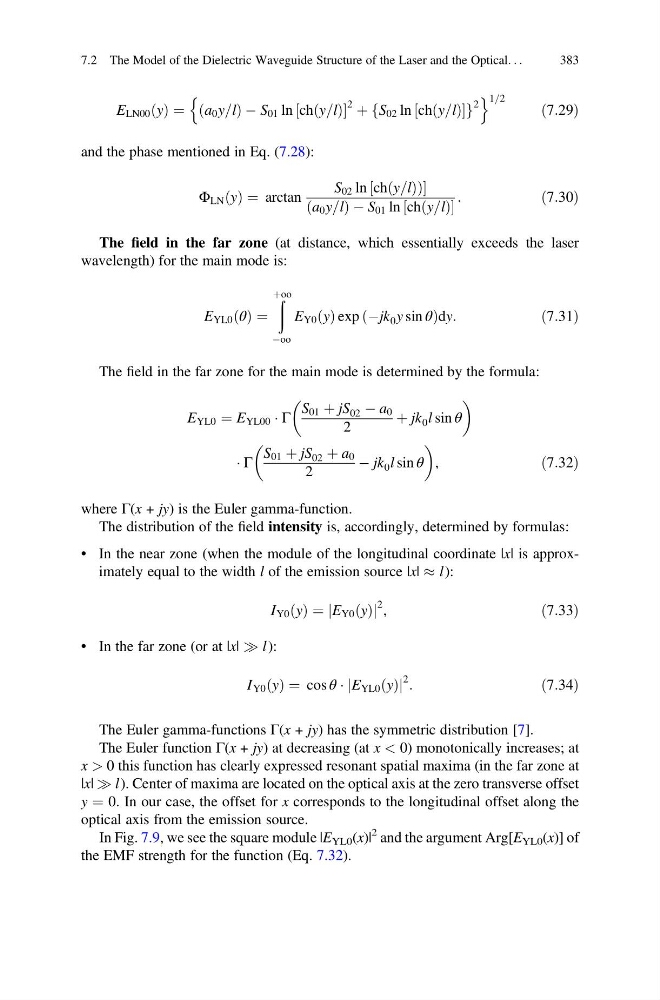
E LN00 y
ð Þ ¼ a 0 y=l
ð
ÞÀS 01 ln ch y=l
ð Þ
½
2 þ S 02 ln ch y=l
ð Þ
½
f
g
2
n
o 1=2
ð7:29Þ
and the phase mentioned in Eq. (7.28):
Φ LN y
ð Þ ¼ arctan
S 02 ln ch y=l
ð Þ
½
Þ
a 0 y=l
ð
ÞÀS 01 ln ch y=l
ð Þ
½
:
ð7:30Þ
The field in the far zone (at distance, which essentially exceeds the laser
wavelength) for the main mode is:
E YL0 θ
ð Þ ¼
ð
þoo
Àoo
E Y0 y
ð Þ exp Àjk 0 y sin θ
ð
Þ dy:
ð7:31Þ
The field in the far zone for the main mode is determined by the formula:
E YL0 ¼ E YL00 Á Γ
S 01 þ jS 02 À a 0
2
þ jk 0 l sin θ
Á Γ
S 01 þ jS 02 þ a 0
2
À jk 0 l sin θ
,
ð7:32Þ
where Γ(x + jy) is the Euler gamma-function.
The distribution of the field intensity is, accordingly, determined by formulas:
• In the near zone (when the module of the longitudinal coordinate |x| is approximately equal to the width l of the emission source |x| % l):
I Y0 y
ð Þ ¼ E Y0 y
ð Þ
j
j
2 ,
ð7:33Þ
• In the far zone (or at |x| ) l ):
I Y0 y
ð Þ ¼ cos θ Á E YL0 y
ð Þ
j
j
2 :
ð7:34Þ
The Euler gamma-functions Γ(x + jy) has the symmetric distribution [7].
The Euler function Γ(x + jy) at decreasing (at x < 0) monotonically increases; at
x > 0 this function has clearly expressed resonant spatial maxima (in the far zone at
|x| ) l). Center of maxima are located on the optical axis at the zero transverse offset
y ¼ 0. In our case, the offset for x corresponds to the longitudinal offset along the
optical axis from the emission source.
In Fig. 7.9, we see the square module |E YL0 (x)|
2 and the argument Arg[E YL0 (x)] of
the EMF strength for the function (Eq. 7.32).
7.2 The Model of the Dielectric Waveguide Structure of the Laser and the Optical. . .
383
ð Þ ¼ a 0 y=l
ð
ÞÀS 01 ln ch y=l
ð Þ
½
2 þ S 02 ln ch y=l
ð Þ
½
f
g
2
n
o 1=2
ð7:29Þ
and the phase mentioned in Eq. (7.28):
Φ LN y
ð Þ ¼ arctan
S 02 ln ch y=l
ð Þ
½
Þ
a 0 y=l
ð
ÞÀS 01 ln ch y=l
ð Þ
½
:
ð7:30Þ
The field in the far zone (at distance, which essentially exceeds the laser
wavelength) for the main mode is:
E YL0 θ
ð Þ ¼
ð
þoo
Àoo
E Y0 y
ð Þ exp Àjk 0 y sin θ
ð
Þ dy:
ð7:31Þ
The field in the far zone for the main mode is determined by the formula:
E YL0 ¼ E YL00 Á Γ
S 01 þ jS 02 À a 0
2
þ jk 0 l sin θ
Á Γ
S 01 þ jS 02 þ a 0
2
À jk 0 l sin θ
,
ð7:32Þ
where Γ(x + jy) is the Euler gamma-function.
The distribution of the field intensity is, accordingly, determined by formulas:
• In the near zone (when the module of the longitudinal coordinate |x| is approximately equal to the width l of the emission source |x| % l):
I Y0 y
ð Þ ¼ E Y0 y
ð Þ
j
j
2 ,
ð7:33Þ
• In the far zone (or at |x| ) l ):
I Y0 y
ð Þ ¼ cos θ Á E YL0 y
ð Þ
j
j
2 :
ð7:34Þ
The Euler gamma-functions Γ(x + jy) has the symmetric distribution [7].
The Euler function Γ(x + jy) at decreasing (at x < 0) monotonically increases; at
x > 0 this function has clearly expressed resonant spatial maxima (in the far zone at
|x| ) l). Center of maxima are located on the optical axis at the zero transverse offset
y ¼ 0. In our case, the offset for x corresponds to the longitudinal offset along the
optical axis from the emission source.
In Fig. 7.9, we see the square module |E YL0 (x)|
2 and the argument Arg[E YL0 (x)] of
the EMF strength for the function (Eq. 7.32).
7.2 The Model of the Dielectric Waveguide Structure of the Laser and the Optical. . .
383