

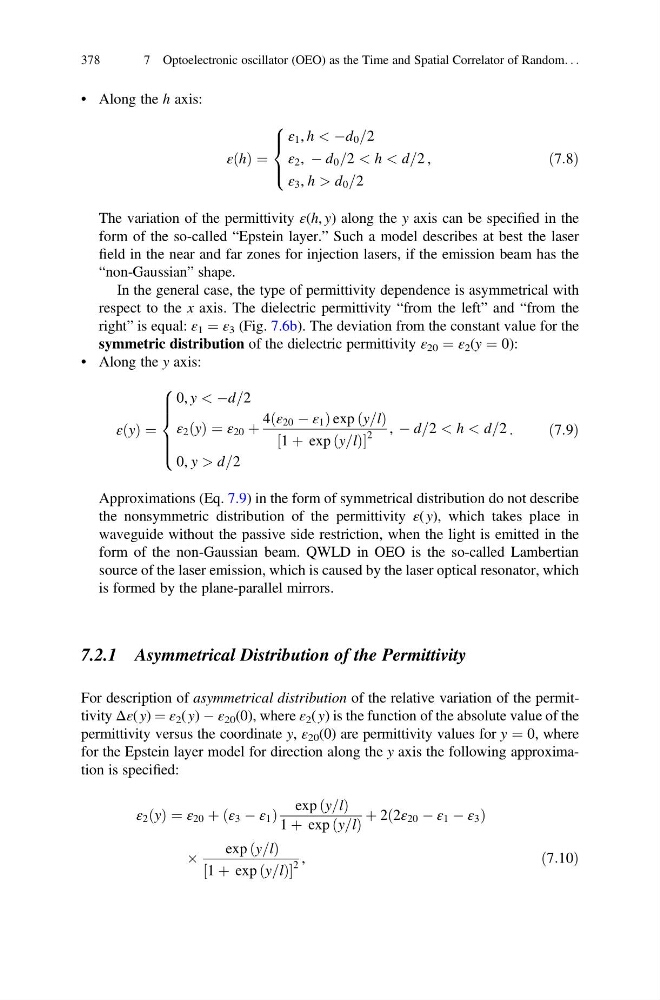
• Along the h axis:
ε h
ð Þ ¼
ε 1 , h < Àd 0 =2
ε 2 , À d 0 =2 < h < d=2
ε 3 , h > d 0 =2
8
> <
> :
,
ð7:8Þ
The variation of the permittivity ε(h, y) along the y axis can be specified in the
form of the so-called “Epstein layer.” Such a model describes at best the laser
field in the near and far zones for injection lasers, if the emission beam has the
“non-Gaussian” shape.
In the general case, the type of permittivity dependence is asymmetrical with
respect to the x axis. The dielectric permittivity “from the left” and “from the
right” is equal: ε 1 ¼ ε 3 (Fig. 7.6b). The deviation from the constant value for the
symmetric distribution of the dielectric permittivity ε 20 ¼ ε 2 (y ¼ 0):
• Along the y axis:
ε y
ð Þ ¼
0, y < Àd=2
ε 2 y
ð Þ ¼ ε 20 þ
4 ε 20 À ε 1
ð
Þexp y=l
ð Þ
1 þ exp y=l
ð Þ
½
2
, À d=2 < h < d=2
0, y > d=2
8
> > > <
> > > :
:
ð7:9Þ
Approximations (Eq. 7.9) in the form of symmetrical distribution do not describe
the nonsymmetric distribution of the permittivity ε( y), which takes place in
waveguide without the passive side restriction, when the light is emitted in the
form of the non-Gaussian beam. QWLD in OEO is the so-called Lambertian
source of the laser emission, which is caused by the laser optical resonator, which
is formed by the plane-parallel mirrors.
7.2.1 Asymmetrical Distribution of the Permittivity
For description of asymmetrical distribution of the relative variation of the permittivity Δε( y) ¼ ε 2 ( y) À ε 20 (0), where ε 2 ( y) is the function of the absolute value of the
permittivity versus the coordinate y, ε 20 (0) are permittivity values for y ¼ 0, where
for the Epstein layer model for direction along the y axis the following approximation is specified:
ε 2 y
ð Þ ¼ ε 20 þ ε 3 À ε 1
ð
Þ
exp y=l
ð Þ
1 þ exp y=l
ð Þ
þ 2 2ε 20 À ε 1 À ε 3
ð
Þ
Â
exp y=l
ð Þ
1 þ exp y=l
ð Þ
½
2
,
ð7:10Þ
378
7 Optoelectronic oscillator (OEO) as the Time and Spatial Correlator of Random. . .
ε h
ð Þ ¼
ε 1 , h < Àd 0 =2
ε 2 , À d 0 =2 < h < d=2
ε 3 , h > d 0 =2
8
> <
> :
,
ð7:8Þ
The variation of the permittivity ε(h, y) along the y axis can be specified in the
form of the so-called “Epstein layer.” Such a model describes at best the laser
field in the near and far zones for injection lasers, if the emission beam has the
“non-Gaussian” shape.
In the general case, the type of permittivity dependence is asymmetrical with
respect to the x axis. The dielectric permittivity “from the left” and “from the
right” is equal: ε 1 ¼ ε 3 (Fig. 7.6b). The deviation from the constant value for the
symmetric distribution of the dielectric permittivity ε 20 ¼ ε 2 (y ¼ 0):
• Along the y axis:
ε y
ð Þ ¼
0, y < Àd=2
ε 2 y
ð Þ ¼ ε 20 þ
4 ε 20 À ε 1
ð
Þexp y=l
ð Þ
1 þ exp y=l
ð Þ
½
2
, À d=2 < h < d=2
0, y > d=2
8
> > > <
> > > :
:
ð7:9Þ
Approximations (Eq. 7.9) in the form of symmetrical distribution do not describe
the nonsymmetric distribution of the permittivity ε( y), which takes place in
waveguide without the passive side restriction, when the light is emitted in the
form of the non-Gaussian beam. QWLD in OEO is the so-called Lambertian
source of the laser emission, which is caused by the laser optical resonator, which
is formed by the plane-parallel mirrors.
7.2.1 Asymmetrical Distribution of the Permittivity
For description of asymmetrical distribution of the relative variation of the permittivity Δε( y) ¼ ε 2 ( y) À ε 20 (0), where ε 2 ( y) is the function of the absolute value of the
permittivity versus the coordinate y, ε 20 (0) are permittivity values for y ¼ 0, where
for the Epstein layer model for direction along the y axis the following approximation is specified:
ε 2 y
ð Þ ¼ ε 20 þ ε 3 À ε 1
ð
Þ
exp y=l
ð Þ
1 þ exp y=l
ð Þ
þ 2 2ε 20 À ε 1 À ε 3
ð
Þ
Â
exp y=l
ð Þ
1 þ exp y=l
ð Þ
½
2
,
ð7:10Þ
378
7 Optoelectronic oscillator (OEO) as the Time and Spatial Correlator of Random. . .