

Two last mechanisms are discussed in Chap. 3 at analysis of modulation systems
of the laser emission in OEO.
We would like to add that in OEO MZ with the frequency division, for instance,
by 2 (Fig. 5.14), the benefit in phase noise suppression is achieved owing to not only
by the emission suppression on the central optical carrier ν 0 , but by execution of the
square root operation. As we know [1], at radio frequency division by the integer
number l, PSD of the phase noise S RFPN (F) decreases as S RFPN (F)/l
2 .
Figure 7.1a shows the structure of OEO MZ with noise sources. Taking into
consideration the fluctuation theory described in Chap. 6, we note that in the OEO
MZ structure (Fig. 7.1), the noise sources are:
• The phase noise of the laser optical oscillations (not shown in the structure).
• The detected laser noise (shown in Fig. 7.1) in the PD load.
• The noise of the photodetector (shown in Fig. 7.1).
• The noise in the input and output of the RF amplifier (shown in Fig. 7.1 by black
circles).
In the closed OEO oscillating system, the noise conversion occurs together with
the spectrum convolution of the detected laser phase noise S LPN (F) with the spectrum of the total electronic noise S EPN (F).
Figure 7.1b shows the analog model of statistical processes in OEO MZ with
utilization of the random variables correlator. The correlator structure is described
earlier in Chaps. 3, 5, and 6. It consists of the multiplier “Â,” two optical channels
with different delays, and the delay cell defining by the delay in the optical fiber.
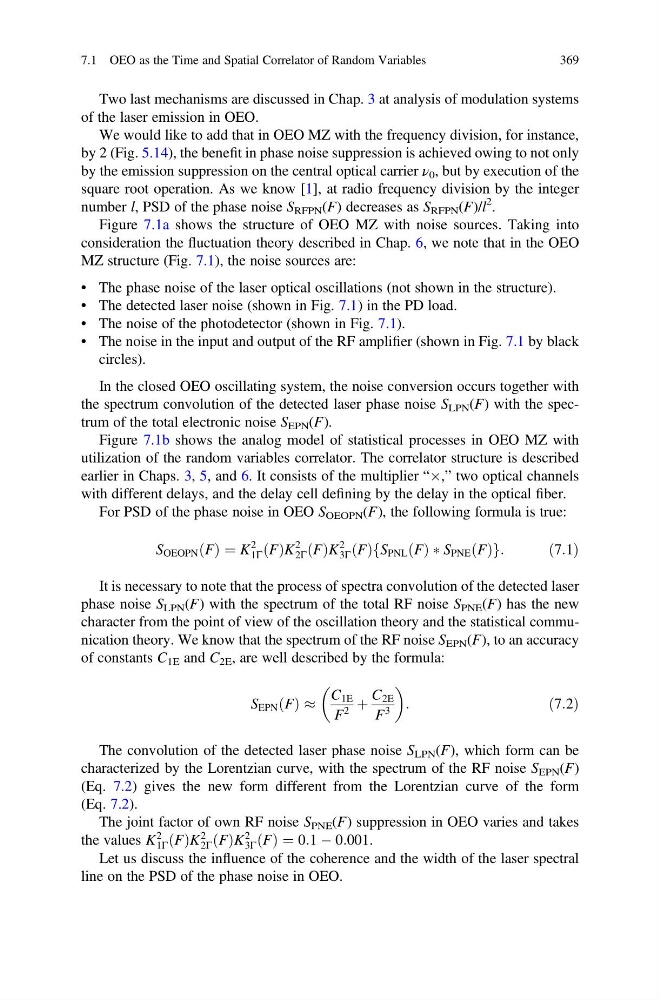
For PSD of the phase noise in OEO S OEOPN (F), the following formula is true:
S OEOPN F
ð Þ ¼ K
2
1Γ F
ð ÞK
2
2Γ F
ð ÞK
2
3Γ F
ð Þ S PNL F
ð Þ Ã S PNE F
ð Þ
f
g :
ð7:1Þ
It is necessary to note that the process of spectra convolution of the detected laser
phase noise S LPN (F) with the spectrum of the total RF noise S PNE (F) has the new
character from the point of view of the oscillation theory and the statistical communication theory. We know that the spectrum of the RF noise S EPN (F), to an accuracy
of constants C 1E and C 2E , are well described by the formula:
S EPN F
ð Þ %
C 1E
F
2
þ
C 2E
F
3
:
ð7:2Þ
The convolution of the detected laser phase noise S LPN (F), which form can be
characterized by the Lorentzian curve, with the spectrum of the RF noise S EPN (F)
(Eq. 7.2) gives the new form different from the Lorentzian curve of the form
(Eq. 7.2).
The joint factor of own RF noise S PNE (F) suppression in OEO varies and takes
the values K
2
1Γ F
ð ÞK
2
2Γ F
ð ÞK
2
3Γ F
ð Þ ¼ 0:1 À 0:001.
Let us discuss the influence of the coherence and the width of the laser spectral
line on the PSD of the phase noise in OEO.
7.1 OEO as the Time and Spatial Correlator of Random Variables
369
of the laser emission in OEO.
We would like to add that in OEO MZ with the frequency division, for instance,
by 2 (Fig. 5.14), the benefit in phase noise suppression is achieved owing to not only
by the emission suppression on the central optical carrier ν 0 , but by execution of the
square root operation. As we know [1], at radio frequency division by the integer
number l, PSD of the phase noise S RFPN (F) decreases as S RFPN (F)/l
2 .
Figure 7.1a shows the structure of OEO MZ with noise sources. Taking into
consideration the fluctuation theory described in Chap. 6, we note that in the OEO
MZ structure (Fig. 7.1), the noise sources are:
• The phase noise of the laser optical oscillations (not shown in the structure).
• The detected laser noise (shown in Fig. 7.1) in the PD load.
• The noise of the photodetector (shown in Fig. 7.1).
• The noise in the input and output of the RF amplifier (shown in Fig. 7.1 by black
circles).
In the closed OEO oscillating system, the noise conversion occurs together with
the spectrum convolution of the detected laser phase noise S LPN (F) with the spectrum of the total electronic noise S EPN (F).
Figure 7.1b shows the analog model of statistical processes in OEO MZ with
utilization of the random variables correlator. The correlator structure is described
earlier in Chaps. 3, 5, and 6. It consists of the multiplier “Â,” two optical channels
with different delays, and the delay cell defining by the delay in the optical fiber.
For PSD of the phase noise in OEO S OEOPN (F), the following formula is true:
S OEOPN F
ð Þ ¼ K
2
1Γ F
ð ÞK
2
2Γ F
ð ÞK
2
3Γ F
ð Þ S PNL F
ð Þ Ã S PNE F
ð Þ
f
g :
ð7:1Þ
It is necessary to note that the process of spectra convolution of the detected laser
phase noise S LPN (F) with the spectrum of the total RF noise S PNE (F) has the new
character from the point of view of the oscillation theory and the statistical communication theory. We know that the spectrum of the RF noise S EPN (F), to an accuracy
of constants C 1E and C 2E , are well described by the formula:
S EPN F
ð Þ %
C 1E
F
2
þ
C 2E
F
3
:
ð7:2Þ
The convolution of the detected laser phase noise S LPN (F), which form can be
characterized by the Lorentzian curve, with the spectrum of the RF noise S EPN (F)
(Eq. 7.2) gives the new form different from the Lorentzian curve of the form
(Eq. 7.2).
The joint factor of own RF noise S PNE (F) suppression in OEO varies and takes
the values K
2
1Γ F
ð ÞK
2
2Γ F
ð ÞK
2
3Γ F
ð Þ ¼ 0:1 À 0:001.
Let us discuss the influence of the coherence and the width of the laser spectral
line on the PSD of the phase noise in OEO.
7.1 OEO as the Time and Spatial Correlator of Random Variables
369