

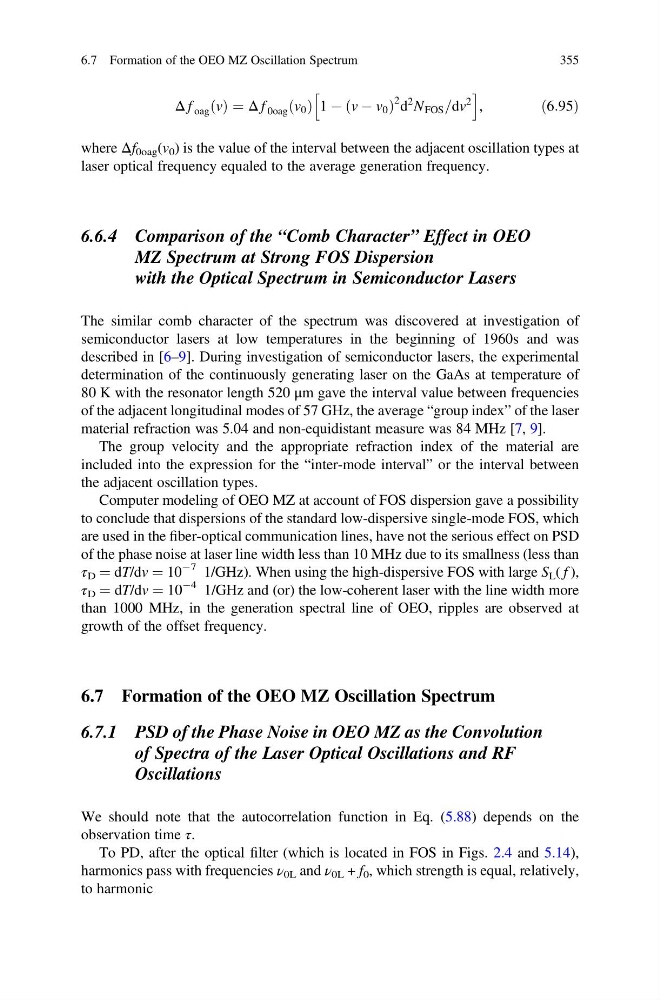
Δ f oag v
ð Þ ¼ Δ f 0oag v 0
ð Þ 1 À v À v 0
ð
Þ
2 d
2 N FOS =dv
2
h
i
,
ð6:95Þ
where Δf 0oag (v 0 ) is the value of the interval between the adjacent oscillation types at
laser optical frequency equaled to the average generation frequency.
6.6.4 Comparison of the “Comb Character” Effect in OEO
MZ Spectrum at Strong FOS Dispersion
with the Optical Spectrum in Semiconductor Lasers
The similar comb character of the spectrum was discovered at investigation of
semiconductor lasers at low temperatures in the beginning of 1960s and was
described in [6–9]. During investigation of semiconductor lasers, the experimental
determination of the continuously generating laser on the GaAs at temperature of
80 K with the resonator length 520 μm gave the interval value between frequencies
of the adjacent longitudinal modes of 57 GHz, the average “group index” of the laser
material refraction was 5.04 and non-equidistant measure was 84 MHz [7, 9].
The group velocity and the appropriate refraction index of the material are
included into the expression for the “inter-mode interval” or the interval between
the adjacent oscillation types.
Computer modeling of OEO MZ at account of FOS dispersion gave a possibility
to conclude that dispersions of the standard low-dispersive single-mode FOS, which
are used in the fiber-optical communication lines, have not the serious effect on PSD
of the phase noise at laser line width less than 10 MHz due to its smallness (less than
τ D ¼ dT/dv ¼ 10
À7 1/GHz). When using the high-dispersive FOS with large S L ( f ),
τ D ¼ dT/dv ¼ 10
À4 1/GHz and (or) the low-coherent laser with the line width more
than 1000 MHz, in the generation spectral line of OEO, ripples are observed at
growth of the offset frequency.
6.7 Formation of the OEO MZ Oscillation Spectrum
6.7.1 PSD of the Phase Noise in OEO MZ as the Convolution
of Spectra of the Laser Optical Oscillations and RF
Oscillations
We should note that the autocorrelation function in Eq. (5.88) depends on the
observation time τ.
To PD, after the optical filter (which is located in FOS in Figs. 2.4 and 5.14),
harmonics pass with frequencies ν 0L and ν 0L + f 0 , which strength is equal, relatively,
to harmonic
6.7 Formation of the OEO MZ Oscillation Spectrum
355
ð Þ ¼ Δ f 0oag v 0
ð Þ 1 À v À v 0
ð
Þ
2 d
2 N FOS =dv
2
h
i
,
ð6:95Þ
where Δf 0oag (v 0 ) is the value of the interval between the adjacent oscillation types at
laser optical frequency equaled to the average generation frequency.
6.6.4 Comparison of the “Comb Character” Effect in OEO
MZ Spectrum at Strong FOS Dispersion
with the Optical Spectrum in Semiconductor Lasers
The similar comb character of the spectrum was discovered at investigation of
semiconductor lasers at low temperatures in the beginning of 1960s and was
described in [6–9]. During investigation of semiconductor lasers, the experimental
determination of the continuously generating laser on the GaAs at temperature of
80 K with the resonator length 520 μm gave the interval value between frequencies
of the adjacent longitudinal modes of 57 GHz, the average “group index” of the laser
material refraction was 5.04 and non-equidistant measure was 84 MHz [7, 9].
The group velocity and the appropriate refraction index of the material are
included into the expression for the “inter-mode interval” or the interval between
the adjacent oscillation types.
Computer modeling of OEO MZ at account of FOS dispersion gave a possibility
to conclude that dispersions of the standard low-dispersive single-mode FOS, which
are used in the fiber-optical communication lines, have not the serious effect on PSD
of the phase noise at laser line width less than 10 MHz due to its smallness (less than
τ D ¼ dT/dv ¼ 10
À7 1/GHz). When using the high-dispersive FOS with large S L ( f ),
τ D ¼ dT/dv ¼ 10
À4 1/GHz and (or) the low-coherent laser with the line width more
than 1000 MHz, in the generation spectral line of OEO, ripples are observed at
growth of the offset frequency.
6.7 Formation of the OEO MZ Oscillation Spectrum
6.7.1 PSD of the Phase Noise in OEO MZ as the Convolution
of Spectra of the Laser Optical Oscillations and RF
Oscillations
We should note that the autocorrelation function in Eq. (5.88) depends on the
observation time τ.
To PD, after the optical filter (which is located in FOS in Figs. 2.4 and 5.14),
harmonics pass with frequencies ν 0L and ν 0L + f 0 , which strength is equal, relatively,
to harmonic
6.7 Formation of the OEO MZ Oscillation Spectrum
355