

where we remind that P 0L |K FODL | is the dimensionless quantity and it defines by the
product of the laser power P 0L by the transfer function |K FODL | on the amplitude of
the first voltage harmonic in the MZ electrical input.
In this case, at the choice of (ΔT M Á Δν L ) ! 1 with the help of OEO MZ, we make
the measurement of the laser spectral line width Δν L % [Δf 0.5 ]/4. For lasers with the
generation line width less than 10 kHz, such measurements are very relevant and
very important, because the measurement technique of modern commercially available optical spectrometers (for example, from Hitachi company) is restricted by the
limit values 0.1 nm (which corresponds the laser bandwidth). The property of OEO
MZ to transform of the laser phase fluctuations in the above-mentioned case into
phase fluctuations of OEO RF signal can be used for measurement of the laser
spectral line width with small values of Δν L .
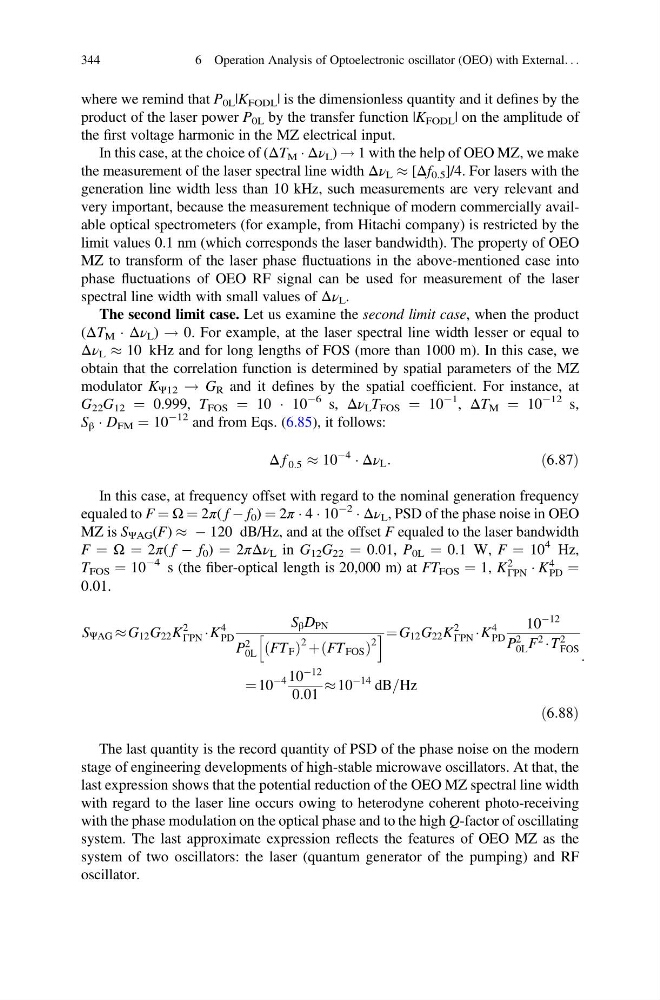
The second limit case. Let us examine the second limit case, when the product
(ΔT M Á Δν L ) ! 0. For example, at the laser spectral line width lesser or equal to
Δν L % 10 kHz and for long lengths of FOS (more than 1000 m). In this case, we
obtain that the correlation function is determined by spatial parameters of the MZ
modulator K Ψ12 ! G R and it defines by the spatial coefficient. For instance, at
G 22 G 12 ¼ 0.999, T FOS ¼ 10 Á 10
À6 s, Δν L T FOS ¼ 10
À1 , ΔT M ¼ 10
À12 s,
S β Á D FM ¼ 10
À12 and from Eqs. (6.85), it follows:
Δ f 0:5 % 10
À4
Á Δν L :
ð6:87Þ
In this case, at frequency offset with regard to the nominal generation frequency
equaled to F ¼ Ω ¼ 2π( f À f 0 ) ¼ 2π Á 4 Á 10
À2
Á Δν L , PSD of the phase noise in OEO
MZ is S ΨAG (F) % À 120 dB/Hz, and at the offset F equaled to the laser bandwidth
F ¼ Ω ¼ 2π( f À f 0 ) ¼ 2πΔν L in G 12 G 22 ¼ 0.01, P 0L ¼ 0.1 W, F ¼ 10
4
Нz,
T FOS ¼ 10
À4 s (the fiber-optical length is 20,000 m) at FT FOS ¼ 1, K
2
ΓPN Á K
4
PD ¼
0:01.
S ΨAG % G 12 G 22 K
2
ΓPN ÁK
4
PD
S β D PN
P
2
0L FT F
ð
Þ
2 þ FT FOS
ð
Þ
2
h
i ¼ G 12 G 22 K
2
ΓPN ÁK
4
PD
10
À12
P
2
0L F
2
ÁT
2
FOS
¼ 10
À4 10
À12
0:01
% 10
À14 dB=Hz
:
ð6:88Þ
The last quantity is the record quantity of PSD of the phase noise on the modern
stage of engineering developments of high-stable microwave oscillators. At that, the
last expression shows that the potential reduction of the OEO MZ spectral line width
with regard to the laser line occurs owing to heterodyne coherent photo-receiving
with the phase modulation on the optical phase and to the high Q-factor of oscillating
system. The last approximate expression reflects the features of OEO MZ as the
system of two oscillators: the laser (quantum generator of the pumping) and RF
oscillator.
344
6 Operation Analysis of Optoelectronic oscillator (OEO) with External. . .
product of the laser power P 0L by the transfer function |K FODL | on the amplitude of
the first voltage harmonic in the MZ electrical input.
In this case, at the choice of (ΔT M Á Δν L ) ! 1 with the help of OEO MZ, we make
the measurement of the laser spectral line width Δν L % [Δf 0.5 ]/4. For lasers with the
generation line width less than 10 kHz, such measurements are very relevant and
very important, because the measurement technique of modern commercially available optical spectrometers (for example, from Hitachi company) is restricted by the
limit values 0.1 nm (which corresponds the laser bandwidth). The property of OEO
MZ to transform of the laser phase fluctuations in the above-mentioned case into
phase fluctuations of OEO RF signal can be used for measurement of the laser
spectral line width with small values of Δν L .
The second limit case. Let us examine the second limit case, when the product
(ΔT M Á Δν L ) ! 0. For example, at the laser spectral line width lesser or equal to
Δν L % 10 kHz and for long lengths of FOS (more than 1000 m). In this case, we
obtain that the correlation function is determined by spatial parameters of the MZ
modulator K Ψ12 ! G R and it defines by the spatial coefficient. For instance, at
G 22 G 12 ¼ 0.999, T FOS ¼ 10 Á 10
À6 s, Δν L T FOS ¼ 10
À1 , ΔT M ¼ 10
À12 s,
S β Á D FM ¼ 10
À12 and from Eqs. (6.85), it follows:
Δ f 0:5 % 10
À4
Á Δν L :
ð6:87Þ
In this case, at frequency offset with regard to the nominal generation frequency
equaled to F ¼ Ω ¼ 2π( f À f 0 ) ¼ 2π Á 4 Á 10
À2
Á Δν L , PSD of the phase noise in OEO
MZ is S ΨAG (F) % À 120 dB/Hz, and at the offset F equaled to the laser bandwidth
F ¼ Ω ¼ 2π( f À f 0 ) ¼ 2πΔν L in G 12 G 22 ¼ 0.01, P 0L ¼ 0.1 W, F ¼ 10
4
Нz,
T FOS ¼ 10
À4 s (the fiber-optical length is 20,000 m) at FT FOS ¼ 1, K
2
ΓPN Á K
4
PD ¼
0:01.
S ΨAG % G 12 G 22 K
2
ΓPN ÁK
4
PD
S β D PN
P
2
0L FT F
ð
Þ
2 þ FT FOS
ð
Þ
2
h
i ¼ G 12 G 22 K
2
ΓPN ÁK
4
PD
10
À12
P
2
0L F
2
ÁT
2
FOS
¼ 10
À4 10
À12
0:01
% 10
À14 dB=Hz
:
ð6:88Þ
The last quantity is the record quantity of PSD of the phase noise on the modern
stage of engineering developments of high-stable microwave oscillators. At that, the
last expression shows that the potential reduction of the OEO MZ spectral line width
with regard to the laser line occurs owing to heterodyne coherent photo-receiving
with the phase modulation on the optical phase and to the high Q-factor of oscillating
system. The last approximate expression reflects the features of OEO MZ as the
system of two oscillators: the laser (quantum generator of the pumping) and RF
oscillator.
344
6 Operation Analysis of Optoelectronic oscillator (OEO) with External. . .