

S PD2 F
ð Þ¼
1À
k
k 02
Áexp ÀΔν L ÁT FOS
ð
Þ
h
i
1À
A 1
A 2
Áexp ÀΔν L ÁT FOS
ð
Þ K
2
ΓPN ÁK
4
PD S 2βPN
h
i
P 0L F
2 T
2
0L
,
ð6:76Þ
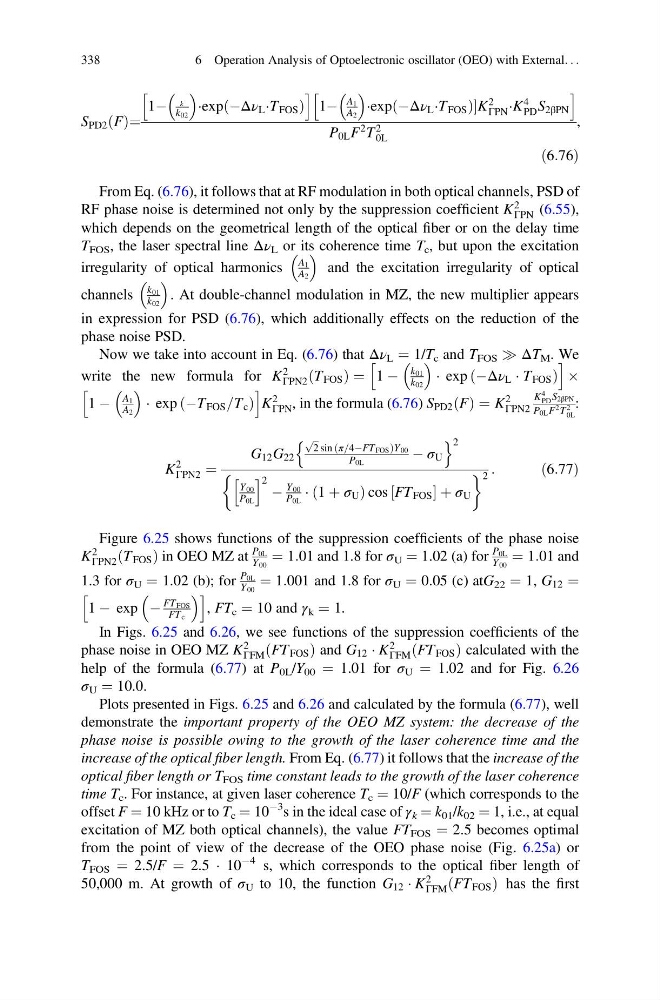
From Eq. (6.76), it follows that at RF modulation in both optical channels, PSD of
RF phase noise is determined not only by the suppression coefficient K
2
ΓPN (6.55),
which depends on the geometrical length of the optical fiber or on the delay time
T FOS , the laser spectral line Δν L or its coherence time T c , but upon the excitation
irregularity of optical harmonics
A 1
A 2
and the excitation irregularity of optical
channels
k 01
k 02
. At double-channel modulation in MZ, the new multiplier appears
in expression for PSD (6.76), which additionally effects on the reduction of the
phase noise PSD.
Now we take into account in Eq. (6.76) that Δν L ¼ 1/T c and T FOS ) ΔT M . We
write the new formula for K
2
ΓPN2 T FOS
ð
Þ¼ 1 À
k 01
k 02
Á exp ÀΔν L Á T FOS
ð
Þ
h
i
Â
1 À
A 1
A 2
Á exp ÀT FOS =T c
ð
Þ
h
i
K
2
ΓPN , in the formula (6.76) S PD2 F
ð Þ ¼ K
2
ΓPN2
K
4
PD S 2βPN
P 0L F
2 T
2
0L
:
K
2
ΓPN2 ¼
G 12 G 22
ffiffi
2
p
sin π=4ÀFT FOS
ð
Þ Y 00
P 0L
À σ U
n
o 2
Y 00
P 0L
h i 2 À
Y 00
P 0L
Á 1 þ σ U
ð
Þcos FT FOS
½
þσ U
&
' 2 :
ð6:77Þ
Figure 6.25 shows functions of the suppression coefficients of the phase noise
K
2
ΓPN2 T FOS
ð
Þin OEO MZ at
P 0L
Y 00
¼ 1:01 and 1.8 for σ U ¼ 1.02 (a) for
P 0L
Y 00
¼ 1:01 and
1.3 for σ U ¼ 1.02 (b); for
P 0L
Y 00
¼ 1:001 and 1.8 for σ U ¼ 0.05 (c) atG 22 ¼ 1, G 12 ¼
1 À exp À
FT FOS
FT c
h
i
, FT c ¼ 10 and γ k ¼ 1.
In Figs. 6.25 and 6.26, we see functions of the suppression coefficients of the
phase noise in OEO MZ K
2
ΓFM FT FOS
ð
Þand G 12 Á K
2
ΓFM FT FOS
ð
Þcalculated with the
help of the formula (6.77) at P 0L /Y 00 ¼ 1.01 for σ U ¼ 1.02 and for Fig. 6.26
σ U ¼ 10.0.
Plots presented in Figs. 6.25 and 6.26 and calculated by the formula (6.77), well
demonstrate the important property of the OEO MZ system: the decrease of the
phase noise is possible owing to the growth of the laser coherence time and the
increase of the optical fiber length. From Eq. (6.77) it follows that the increase of the
optical fiber length or T FOS time constant leads to the growth of the laser coherence
time T c . For instance, at given laser coherence T c ¼ 10/F (which corresponds to the
offset F ¼ 10 kHz or to T c ¼ 10
À3 s in the ideal case of γ k ¼ k 01 /k 02 ¼ 1, i.e., at equal
excitation of MZ both optical channels), the value FT FOS ¼ 2.5 becomes optimal
from the point of view of the decrease of the OEO phase noise (Fig. 6.25a) or
T FOS ¼ 2.5/F ¼ 2.5 Á 10
À4 s, which corresponds to the optical fiber length of
50,000 m. At growth of σ U to 10, the function G 12 Á K
2
ΓFM FT FOS
ð
Þ has the first
338
6 Operation Analysis of Optoelectronic oscillator (OEO) with External. . .
ð Þ¼
1À
k
k 02
Áexp ÀΔν L ÁT FOS
ð
Þ
h
i
1À
A 1
A 2
Áexp ÀΔν L ÁT FOS
ð
Þ K
2
ΓPN ÁK
4
PD S 2βPN
h
i
P 0L F
2 T
2
0L
,
ð6:76Þ
From Eq. (6.76), it follows that at RF modulation in both optical channels, PSD of
RF phase noise is determined not only by the suppression coefficient K
2
ΓPN (6.55),
which depends on the geometrical length of the optical fiber or on the delay time
T FOS , the laser spectral line Δν L or its coherence time T c , but upon the excitation
irregularity of optical harmonics
A 1
A 2
and the excitation irregularity of optical
channels
k 01
k 02
. At double-channel modulation in MZ, the new multiplier appears
in expression for PSD (6.76), which additionally effects on the reduction of the
phase noise PSD.
Now we take into account in Eq. (6.76) that Δν L ¼ 1/T c and T FOS ) ΔT M . We
write the new formula for K
2
ΓPN2 T FOS
ð
Þ¼ 1 À
k 01
k 02
Á exp ÀΔν L Á T FOS
ð
Þ
h
i
Â
1 À
A 1
A 2
Á exp ÀT FOS =T c
ð
Þ
h
i
K
2
ΓPN , in the formula (6.76) S PD2 F
ð Þ ¼ K
2
ΓPN2
K
4
PD S 2βPN
P 0L F
2 T
2
0L
:
K
2
ΓPN2 ¼
G 12 G 22
ffiffi
2
p
sin π=4ÀFT FOS
ð
Þ Y 00
P 0L
À σ U
n
o 2
Y 00
P 0L
h i 2 À
Y 00
P 0L
Á 1 þ σ U
ð
Þcos FT FOS
½
þσ U
&
' 2 :
ð6:77Þ
Figure 6.25 shows functions of the suppression coefficients of the phase noise
K
2
ΓPN2 T FOS
ð
Þin OEO MZ at
P 0L
Y 00
¼ 1:01 and 1.8 for σ U ¼ 1.02 (a) for
P 0L
Y 00
¼ 1:01 and
1.3 for σ U ¼ 1.02 (b); for
P 0L
Y 00
¼ 1:001 and 1.8 for σ U ¼ 0.05 (c) atG 22 ¼ 1, G 12 ¼
1 À exp À
FT FOS
FT c
h
i
, FT c ¼ 10 and γ k ¼ 1.
In Figs. 6.25 and 6.26, we see functions of the suppression coefficients of the
phase noise in OEO MZ K
2
ΓFM FT FOS
ð
Þand G 12 Á K
2
ΓFM FT FOS
ð
Þcalculated with the
help of the formula (6.77) at P 0L /Y 00 ¼ 1.01 for σ U ¼ 1.02 and for Fig. 6.26
σ U ¼ 10.0.
Plots presented in Figs. 6.25 and 6.26 and calculated by the formula (6.77), well
demonstrate the important property of the OEO MZ system: the decrease of the
phase noise is possible owing to the growth of the laser coherence time and the
increase of the optical fiber length. From Eq. (6.77) it follows that the increase of the
optical fiber length or T FOS time constant leads to the growth of the laser coherence
time T c . For instance, at given laser coherence T c ¼ 10/F (which corresponds to the
offset F ¼ 10 kHz or to T c ¼ 10
À3 s in the ideal case of γ k ¼ k 01 /k 02 ¼ 1, i.e., at equal
excitation of MZ both optical channels), the value FT FOS ¼ 2.5 becomes optimal
from the point of view of the decrease of the OEO phase noise (Fig. 6.25a) or
T FOS ¼ 2.5/F ¼ 2.5 Á 10
À4 s, which corresponds to the optical fiber length of
50,000 m. At growth of σ U to 10, the function G 12 Á K
2
ΓFM FT FOS
ð
Þ has the first
338
6 Operation Analysis of Optoelectronic oscillator (OEO) with External. . .