

S ΨOEO
P G
¼
G 12 K
2
PD
S βPN P G
P 0L F
2 T
2
0L
þ 2eI 0PD R PD þ D Y kT
P G
K
2
ΓPN ,
ð6:66Þ
where the coefficient K
2
ΓPN corresponds to Eq. (6.58). Also, we used in Eq. (6.36) for
Y aRe , Y aIm and Y 00 , the aboмe-introduced formulas. Supposing that OEO MZ
operates at small exceeds above the generation threshold (with small excitation
reserve) and
Y 00
P 0L
¼
y M 1þFT EF
½
P 0L K FODL
j
j % 1. Then the expression (6.66) is:
S ΨOEO
P G
¼ K
2
ΓPN
G 12 Á K
2
PD S βPN P G
P G P 0L F
2 T
2
0L
þ
2eS 0PD Á P 0L R PD
P G
þ
D Y kT
P G
!
:
ð6:67Þ
We use for an analysis the expression (6.67) and for the OEO power Eq. (6.60):
P G ¼ P OEO ¼
2S 01
3R PD S 03
Á 1 À
Y 00
S 01 P 0L
, and I 0PD ¼ S 0PD Á P 0L .
If we take into consideration that the Q-factor of oscillating system is equal to
Q L ¼ ν 0L T 0L , where ν 0L ¼ ν 0 is the optical generation frequency of the laser,
T 0L % T c , T 0L is the time constant of the laser oscillating system, the RF oscillation
power in OEO (at cubic NA nonlinearity)
Using the earlier-considered function P G of P 0L determining as Eq. (6.60), then
the expression (6.67) is simplified as:
S ΨOEO
P G
¼ K
2
ΓPN Á K
2
PD
G 12 S βPN
P 0L F
2 T
2
0L
þ
K
2
ΓPN
2S 01
3R PD S 03
Á 1 À
Y 00
S 01 P 0L
Á
2eS 0PD Á R PD
1
P 0L þ
D Y kT
1
!
,
ð6:68Þ
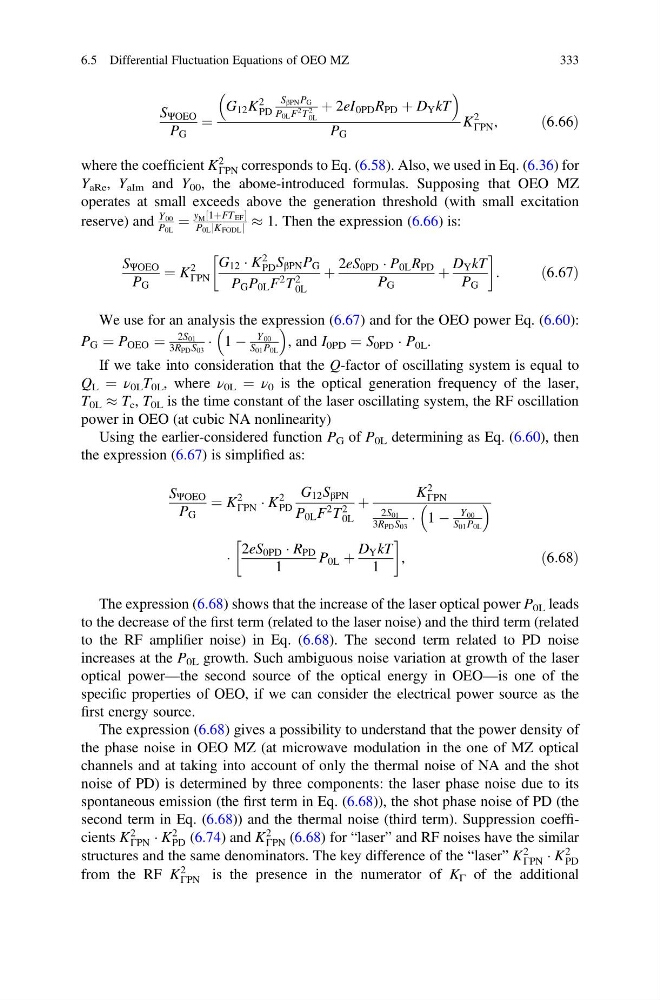
The expression (6.68) shows that the increase of the laser optical power P 0L leads
to the decrease of the first term (related to the laser noise) and the third term (related
to the RF amplifier noise) in Eq. (6.68). The second term related to PD noise
increases at the P 0L growth. Such ambiguous noise variation at growth of the laser
optical power—the second source of the optical energy in OEO—is one of the
specific properties of OEO, if we can consider the electrical power source as the
first energy source.
The expression (6.68) gives a possibility to understand that the power density of
the phase noise in OEO MZ (at microwave modulation in the one of MZ optical
channels and at taking into account of only the thermal noise of NA and the shot
noise of PD) is determined by three components: the laser phase noise due to its
spontaneous emission (the first term in Eq. (6.68)), the shot phase noise of PD (the
second term in Eq. (6.68)) and the thermal noise (third term). Suppression coefficients K
2
ΓPN Á K
2
PD (6.74) and K
2
ΓPN (6.68) for “laser” and RF noises have the similar
structures and the same denominators. The key difference of the “laser” K
2
ΓPN Á K
2
PD
from the RF K
2
ΓPN is the presence in the numerator of K Γ of the additional
6.5 Differential Fluctuation Equations of OEO MZ
333
P G
¼
G 12 K
2
PD
S βPN P G
P 0L F
2 T
2
0L
þ 2eI 0PD R PD þ D Y kT
P G
K
2
ΓPN ,
ð6:66Þ
where the coefficient K
2
ΓPN corresponds to Eq. (6.58). Also, we used in Eq. (6.36) for
Y aRe , Y aIm and Y 00 , the aboмe-introduced formulas. Supposing that OEO MZ
operates at small exceeds above the generation threshold (with small excitation
reserve) and
Y 00
P 0L
¼
y M 1þFT EF
½
P 0L K FODL
j
j % 1. Then the expression (6.66) is:
S ΨOEO
P G
¼ K
2
ΓPN
G 12 Á K
2
PD S βPN P G
P G P 0L F
2 T
2
0L
þ
2eS 0PD Á P 0L R PD
P G
þ
D Y kT
P G
!
:
ð6:67Þ
We use for an analysis the expression (6.67) and for the OEO power Eq. (6.60):
P G ¼ P OEO ¼
2S 01
3R PD S 03
Á 1 À
Y 00
S 01 P 0L
, and I 0PD ¼ S 0PD Á P 0L .
If we take into consideration that the Q-factor of oscillating system is equal to
Q L ¼ ν 0L T 0L , where ν 0L ¼ ν 0 is the optical generation frequency of the laser,
T 0L % T c , T 0L is the time constant of the laser oscillating system, the RF oscillation
power in OEO (at cubic NA nonlinearity)
Using the earlier-considered function P G of P 0L determining as Eq. (6.60), then
the expression (6.67) is simplified as:
S ΨOEO
P G
¼ K
2
ΓPN Á K
2
PD
G 12 S βPN
P 0L F
2 T
2
0L
þ
K
2
ΓPN
2S 01
3R PD S 03
Á 1 À
Y 00
S 01 P 0L
Á
2eS 0PD Á R PD
1
P 0L þ
D Y kT
1
!
,
ð6:68Þ
The expression (6.68) shows that the increase of the laser optical power P 0L leads
to the decrease of the first term (related to the laser noise) and the third term (related
to the RF amplifier noise) in Eq. (6.68). The second term related to PD noise
increases at the P 0L growth. Such ambiguous noise variation at growth of the laser
optical power—the second source of the optical energy in OEO—is one of the
specific properties of OEO, if we can consider the electrical power source as the
first energy source.
The expression (6.68) gives a possibility to understand that the power density of
the phase noise in OEO MZ (at microwave modulation in the one of MZ optical
channels and at taking into account of only the thermal noise of NA and the shot
noise of PD) is determined by three components: the laser phase noise due to its
spontaneous emission (the first term in Eq. (6.68)), the shot phase noise of PD (the
second term in Eq. (6.68)) and the thermal noise (third term). Suppression coefficients K
2
ΓPN Á K
2
PD (6.74) and K
2
ΓPN (6.68) for “laser” and RF noises have the similar
structures and the same denominators. The key difference of the “laser” K
2
ΓPN Á K
2
PD
from the RF K
2
ΓPN is the presence in the numerator of K Γ of the additional
6.5 Differential Fluctuation Equations of OEO MZ
333