

arctan
sin 2πνT 2M þ γ k sin 2πνT 1M
cos 2πνT 2M þ γ k cos 2πνT 1M
&
'
þ arctan ωT eM
ð
Þ
þ arctan ωT FOS
ð
ÞÀ arctan ωT F
ð
Þ¼ 2πm,
ð6:14Þ
where ν is the laser optical frequency, R PD is the load resistance of PD, T eM is the
time constant defining by the MZ electrodes, T FOS is the group light delay in the
FOS, T 1M , T 2M are the group light delays in the MZ optical channels OC1 and OC2.
We calculated the frequency response of MZ transfer function module |M Z |, of the
RF filter |K F |, and its products |M Z | Á |K F |. The graphical method of the frequency
determination for OEO MZ is presented in Fig. 3.19 with the help of the solution of
the balance equations for the phase and the amplitude for OEO MZ.
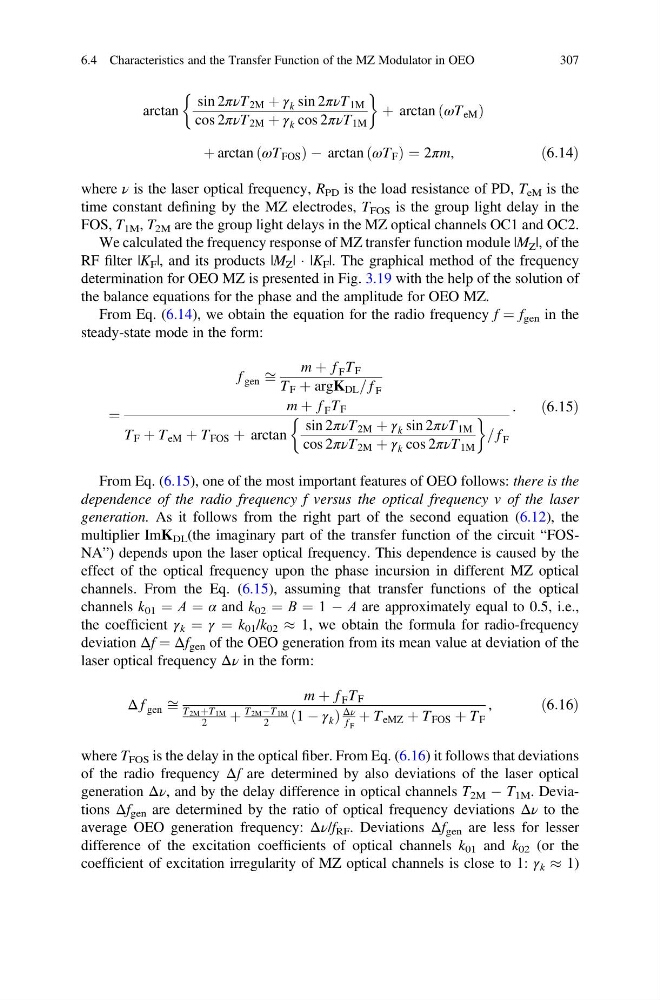
From Eq. (6.14), we obtain the equation for the radio frequency f ¼ f gen in the
steady-state mode in the form:
f gen ffi
m þ f F T F
T F þ argK DL = f F
¼
m þ f F T F
T F þ T eM þ T FOS þ arctan
sin 2πνT 2M þ γ k sin 2πνT 1M
cos 2πνT 2M þ γ k cos 2πνT 1M
&
'
= f F
:
ð6:15Þ
From Eq. (6.15), one of the most important features of OEO follows: there is the
dependence of the radio frequency f versus the optical frequency v of the laser
generation. As it follows from the right part of the second equation (6.12), the
multiplier ImK DL (the imaginary part of the transfer function of the circuit “FOSNA”) depends upon the laser optical frequency. This dependence is caused by the
effect of the optical frequency upon the phase incursion in different MZ optical
channels. From the Eq. (6.15), assuming that transfer functions of the optical
channels k 01 ¼ А ¼ α and k 02 ¼ В ¼ 1 À А are approximately equal to 0.5, i.e.,
the coefficient γ k ¼ γ ¼ k 01 /k 02 % 1, we obtain the formula for radio-frequency
deviation Δf ¼ Δf gen of the OEO generation from its mean value at deviation of the
laser optical frequency Δν in the form:
Δ f gen ffi
m þ f F T F
T 2M þT 1M
2
þ
T 2M ÀT 1M
2
1 À γ k
ð
Þ
Δν
f F
þ T eMZ þ T FOS þ T F
,
ð6:16Þ
where T FOS is the delay in the optical fiber. From Eq. (6.16) it follows that deviations
of the radio frequency Δf are determined by also deviations of the laser optical
generation Δν, and by the delay difference in optical channels T 2M À T 1M . Deviations Δf gen are determined by the ratio of optical frequency deviations Δν to the
average OEO generation frequency: Δν/f RF . Deviations Δf gen are less for lesser
difference of the excitation coefficients of optical channels k 01 and k 02 (or the
coefficient of excitation irregularity of MZ optical channels is close to 1: γ k % 1)
6.4 Characteristics and the Transfer Function of the MZ Modulator in OEO
307
sin 2πνT 2M þ γ k sin 2πνT 1M
cos 2πνT 2M þ γ k cos 2πνT 1M
&
'
þ arctan ωT eM
ð
Þ
þ arctan ωT FOS
ð
ÞÀ arctan ωT F
ð
Þ¼ 2πm,
ð6:14Þ
where ν is the laser optical frequency, R PD is the load resistance of PD, T eM is the
time constant defining by the MZ electrodes, T FOS is the group light delay in the
FOS, T 1M , T 2M are the group light delays in the MZ optical channels OC1 and OC2.
We calculated the frequency response of MZ transfer function module |M Z |, of the
RF filter |K F |, and its products |M Z | Á |K F |. The graphical method of the frequency
determination for OEO MZ is presented in Fig. 3.19 with the help of the solution of
the balance equations for the phase and the amplitude for OEO MZ.
From Eq. (6.14), we obtain the equation for the radio frequency f ¼ f gen in the
steady-state mode in the form:
f gen ffi
m þ f F T F
T F þ argK DL = f F
¼
m þ f F T F
T F þ T eM þ T FOS þ arctan
sin 2πνT 2M þ γ k sin 2πνT 1M
cos 2πνT 2M þ γ k cos 2πνT 1M
&
'
= f F
:
ð6:15Þ
From Eq. (6.15), one of the most important features of OEO follows: there is the
dependence of the radio frequency f versus the optical frequency v of the laser
generation. As it follows from the right part of the second equation (6.12), the
multiplier ImK DL (the imaginary part of the transfer function of the circuit “FOSNA”) depends upon the laser optical frequency. This dependence is caused by the
effect of the optical frequency upon the phase incursion in different MZ optical
channels. From the Eq. (6.15), assuming that transfer functions of the optical
channels k 01 ¼ А ¼ α and k 02 ¼ В ¼ 1 À А are approximately equal to 0.5, i.e.,
the coefficient γ k ¼ γ ¼ k 01 /k 02 % 1, we obtain the formula for radio-frequency
deviation Δf ¼ Δf gen of the OEO generation from its mean value at deviation of the
laser optical frequency Δν in the form:
Δ f gen ffi
m þ f F T F
T 2M þT 1M
2
þ
T 2M ÀT 1M
2
1 À γ k
ð
Þ
Δν
f F
þ T eMZ þ T FOS þ T F
,
ð6:16Þ
where T FOS is the delay in the optical fiber. From Eq. (6.16) it follows that deviations
of the radio frequency Δf are determined by also deviations of the laser optical
generation Δν, and by the delay difference in optical channels T 2M À T 1M . Deviations Δf gen are determined by the ratio of optical frequency deviations Δν to the
average OEO generation frequency: Δν/f RF . Deviations Δf gen are less for lesser
difference of the excitation coefficients of optical channels k 01 and k 02 (or the
coefficient of excitation irregularity of MZ optical channels is close to 1: γ k % 1)
6.4 Characteristics and the Transfer Function of the MZ Modulator in OEO
307