

this switch Sw is opened, the external RF generator must be connected to the
electrical input of the MZ modulator to provide the optical emission modulation.
5.5.2 The OEO Model as the Correlator with the Positive
Feedback
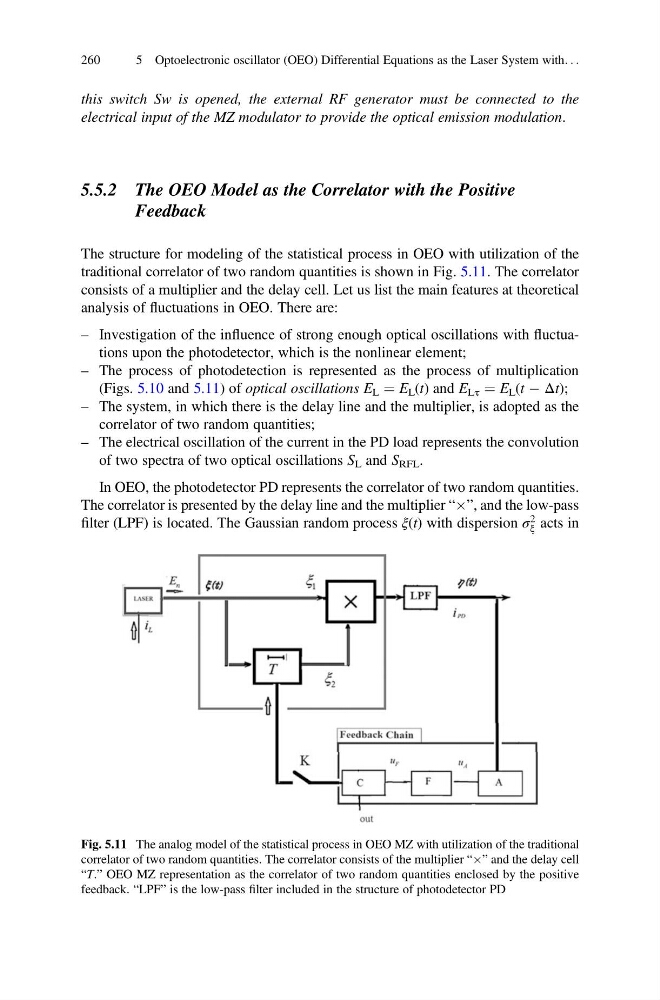
The structure for modeling of the statistical process in OEO with utilization of the
traditional correlator of two random quantities is shown in Fig. 5.11. The correlator
consists of a multiplier and the delay cell. Let us list the main features at theoretical
analysis of fluctuations in OEO. There are:
– Investigation of the influence of strong enough optical oscillations with fluctuations upon the photodetector, which is the nonlinear element;
– The process of photodetection is represented as the process of multiplication
(Figs. 5.10 and 5.11) of optical oscillations E L ¼ E L (t) and E Lτ ¼ E L (t À Δt);
– The system, in which there is the delay line and the multiplier, is adopted as the
correlator of two random quantities;
– The electrical oscillation of the current in the PD load represents the convolution
of two spectra of two optical oscillations S L and S RFL .
In OEO, the photodetector PD represents the correlator of two random quantities.
The correlator is presented by the delay line and the multiplier “”, and the low-pass
filter (LPF) is located. The Gaussian random process ξ(t) with dispersion σ
2
ξ acts in
Fig. 5.11 The analog model of the statistical process in OEO MZ with utilization of the traditional
correlator of two random quantities. The correlator consists of the multiplier “” and the delay cell
“T.” OEO MZ representation as the correlator of two random quantities enclosed by the positive
feedback. “LPF” is the low-pass filter included in the structure of photodetector PD
260
5 Optoelectronic oscillator (OEO) Differential Equations as the Laser System with. . .
electrical input of the MZ modulator to provide the optical emission modulation.
5.5.2 The OEO Model as the Correlator with the Positive
Feedback
The structure for modeling of the statistical process in OEO with utilization of the
traditional correlator of two random quantities is shown in Fig. 5.11. The correlator
consists of a multiplier and the delay cell. Let us list the main features at theoretical
analysis of fluctuations in OEO. There are:
– Investigation of the influence of strong enough optical oscillations with fluctuations upon the photodetector, which is the nonlinear element;
– The process of photodetection is represented as the process of multiplication
(Figs. 5.10 and 5.11) of optical oscillations E L ¼ E L (t) and E Lτ ¼ E L (t À Δt);
– The system, in which there is the delay line and the multiplier, is adopted as the
correlator of two random quantities;
– The electrical oscillation of the current in the PD load represents the convolution
of two spectra of two optical oscillations S L and S RFL .
In OEO, the photodetector PD represents the correlator of two random quantities.
The correlator is presented by the delay line and the multiplier “”, and the low-pass
filter (LPF) is located. The Gaussian random process ξ(t) with dispersion σ
2
ξ acts in
Fig. 5.11 The analog model of the statistical process in OEO MZ with utilization of the traditional
correlator of two random quantities. The correlator consists of the multiplier “” and the delay cell
“T.” OEO MZ representation as the correlator of two random quantities enclosed by the positive
feedback. “LPF” is the low-pass filter included in the structure of photodetector PD
260
5 Optoelectronic oscillator (OEO) Differential Equations as the Laser System with. . .