

(Eq. 5.62). This equation is similar to the equation for the double-circuit RF
oscillator, which is repeatedly solved in the specific tasks of the oscillation theory.
The specific property of this equation is the inertial nonlinearity, which is defined
by the pumping circuit, and for lasers with the distributed pumping system with the
third- and fourth-level of pumping, it is different. This is similar to the double-circuit
RF oscillator equation, which was repeatedly solved in the specific problems of the
oscillation tasks.
5.4.7 Differential Equations with Fluctuations
and the Analog Model of OEO MZ
Before the writing of differential equation system for OEO MZ, we must explain
some features of oscillation transformation in the optoelectronic structure of the
“modulator of Mach–Zehnder—the coupler” (or MZ-C).
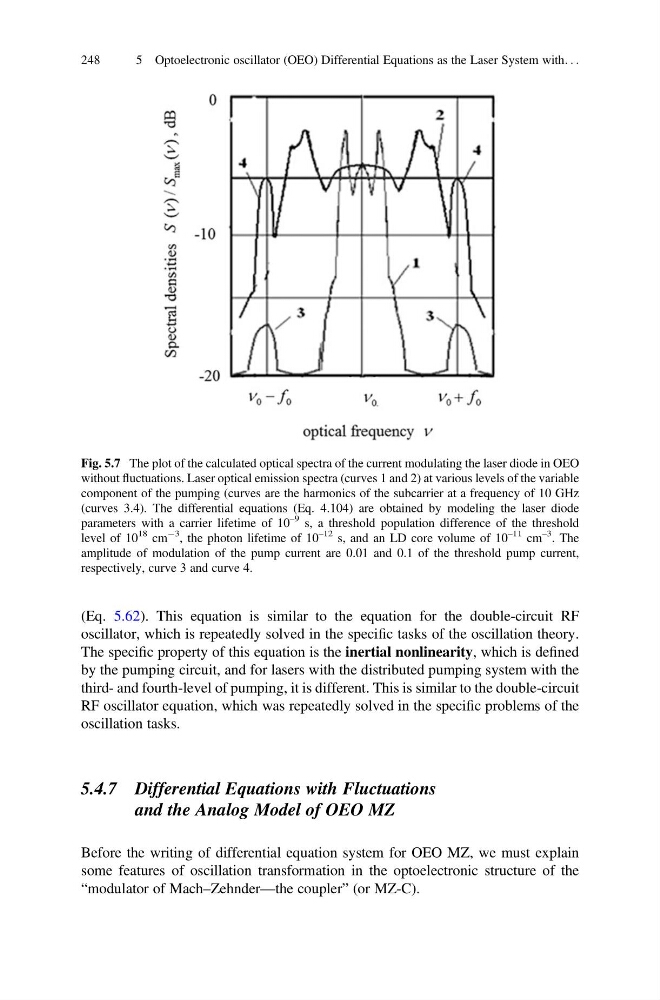
Fig. 5.7 The plot of the calculated optical spectra of the current modulating the laser diode in OEO
without fluctuations. Laser optical emission spectra (curves 1 and 2) at various levels of the variable
component of the pumping (curves are the harmonics of the subcarrier at a frequency of 10 GHz
(curves 3.4). The differential equations (Eq. 4.104) are obtained by modeling the laser diode
parameters with a carrier lifetime of 10
–9 s, a threshold population difference of the threshold
level of 10
18 cm
À3
, the photon lifetime of 10
–12 s, and an LD core volume of 10
–11 cm
–3
. The
amplitude of modulation of the pump current are 0.01 and 0.1 of the threshold pump current,
respectively, curve 3 and curve 4.
248
5 Optoelectronic oscillator (OEO) Differential Equations as the Laser System with. . .
oscillator, which is repeatedly solved in the specific tasks of the oscillation theory.
The specific property of this equation is the inertial nonlinearity, which is defined
by the pumping circuit, and for lasers with the distributed pumping system with the
third- and fourth-level of pumping, it is different. This is similar to the double-circuit
RF oscillator equation, which was repeatedly solved in the specific problems of the
oscillation tasks.
5.4.7 Differential Equations with Fluctuations
and the Analog Model of OEO MZ
Before the writing of differential equation system for OEO MZ, we must explain
some features of oscillation transformation in the optoelectronic structure of the
“modulator of Mach–Zehnder—the coupler” (or MZ-C).
Fig. 5.7 The plot of the calculated optical spectra of the current modulating the laser diode in OEO
without fluctuations. Laser optical emission spectra (curves 1 and 2) at various levels of the variable
component of the pumping (curves are the harmonics of the subcarrier at a frequency of 10 GHz
(curves 3.4). The differential equations (Eq. 4.104) are obtained by modeling the laser diode
parameters with a carrier lifetime of 10
–9 s, a threshold population difference of the threshold
level of 10
18 cm
À3
, the photon lifetime of 10
–12 s, and an LD core volume of 10
–11 cm
–3
. The
amplitude of modulation of the pump current are 0.01 and 0.1 of the threshold pump current,
respectively, curve 3 and curve 4.
248
5 Optoelectronic oscillator (OEO) Differential Equations as the Laser System with. . .