

contributions of the spontaneous emission, the amplitude noise, the medium polarization noises into formation of the power spectral density of phase noises.
Thus, we can conclude that we obtain for QWLD the fluctuation symbolic
equation (Eq. 5.48) in the steady-state mode for values N ¼ N 0 and E n ¼ E 0n at
large (by 4–10 times) excess of pumping α N00 Á J 0L over the threshold value.
Deduced differential equation coincides in the form with the symbolic equation,
which is usually used for calculation of the power spectral density of the amplitude
and phase noises in traditional double-circuit RF oscillators with delay.
5.4.4 PSD of Amplitude and Phase Noise of the Laser
Let us perform the calculation of PSD of amplitude and phase noises of the laser at
linearization of the fluctuation symbolic equation (Eq. 5.45). The total complex
noisy component ξ SN can be presented as a sum of the real ξ SNRe and imaginary
ξ SNIm parts: ξ SN ¼ ξ SNRe + jξ SNIm.
We use the standard approach for abbreviation of differential equations according
to Evtianov method [1] for finding the PSD of amplitude and phase noises for the
laser. We choose the own frequency of the laser optical resonator 2πν 0F as the
reference frequency. Replacing p to j2πf 0e + p 1 , combining terms in groups
according to the smallness order, keeping only the first order of smallness terms,
we obtain the expression for the abbreviated conductance in the first approximation
in the left part of Eq. (5.48) [1]. Then, abbreviated equations for the slowly changing
functions Q Re ( p) and Q Im ( p) at transfer to the operator p 1 will take the form
Q Re p
ð Þ !
j2πν 0 þp 1 Q F Re p 1
ð Þ , Q Im p
ð Þ !
j2πν 0 þp 1 Q FIm p 1
ð Þ , where the arrow “!
j2π f 0e þp 1 ”
designates the representation of the controlling conductance in the abbreviated form.
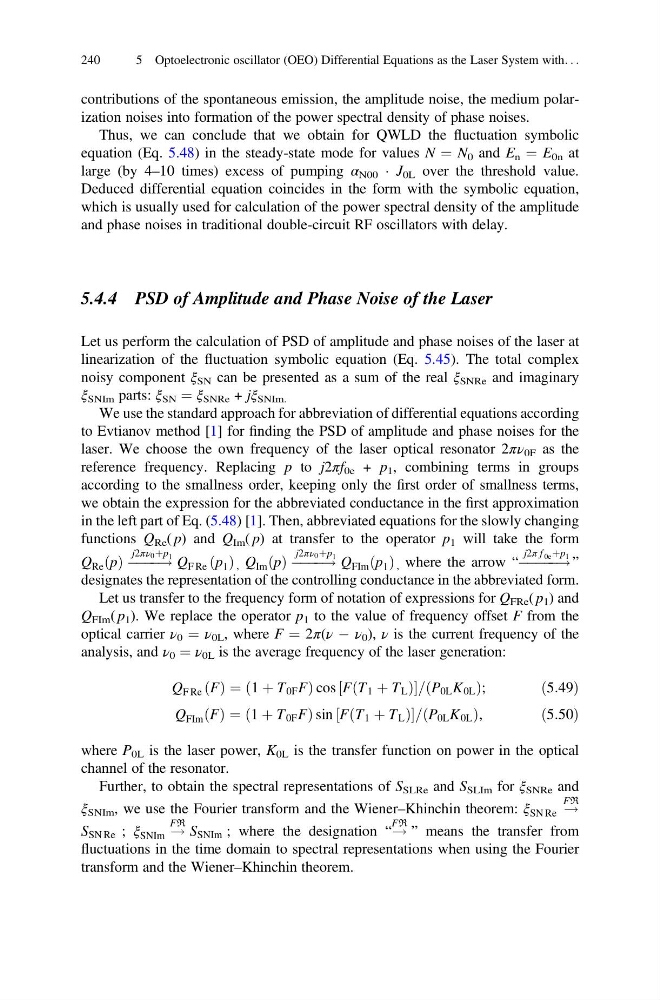
Let us transfer to the frequency form of notation of expressions for Q FRe ( p 1 ) and
Q FIm ( p 1 ). We replace the operator p 1 to the value of frequency offset F from the
optical carrier ν 0 ¼ ν 0L , where F ¼ 2π(ν À ν 0 ), ν is the current frequency of the
analysis, and ν 0 ¼ ν 0L is the average frequency of the laser generation:
Q F Re F
ð Þ ¼ 1 þ T 0F F
ð
Þcos F T 1 þ T L
ð
Þ
½
= P 0L K 0L
ð
Þ;
ð5:49Þ
Q FIm F
ð Þ ¼ 1 þ T 0F F
ð
Þsin F T 1 þ T L
ð
Þ
½
= P 0L K 0L
ð
Þ,
ð5:50Þ
where P 0L is the laser power, K 0L is the transfer function on power in the optical
channel of the resonator.
Further, to obtain the spectral representations of S SLRe and S SLIm for ξ SNRe and
ξ SNIm , we use the Fourier transform and the Wiener–Khinchin theorem: ξ SN Re !
Fℜ
S SN Re ; ξ SNIm !
Fℜ S SNIm ; where the designation “!
Fℜ ” means the transfer from
fluctuations in the time domain to spectral representations when using the Fourier
transform and the Wiener–Khinchin theorem.
240
5 Optoelectronic oscillator (OEO) Differential Equations as the Laser System with. . .
Thus, we can conclude that we obtain for QWLD the fluctuation symbolic
equation (Eq. 5.48) in the steady-state mode for values N ¼ N 0 and E n ¼ E 0n at
large (by 4–10 times) excess of pumping α N00 Á J 0L over the threshold value.
Deduced differential equation coincides in the form with the symbolic equation,
which is usually used for calculation of the power spectral density of the amplitude
and phase noises in traditional double-circuit RF oscillators with delay.
5.4.4 PSD of Amplitude and Phase Noise of the Laser
Let us perform the calculation of PSD of amplitude and phase noises of the laser at
linearization of the fluctuation symbolic equation (Eq. 5.45). The total complex
noisy component ξ SN can be presented as a sum of the real ξ SNRe and imaginary
ξ SNIm parts: ξ SN ¼ ξ SNRe + jξ SNIm.
We use the standard approach for abbreviation of differential equations according
to Evtianov method [1] for finding the PSD of amplitude and phase noises for the
laser. We choose the own frequency of the laser optical resonator 2πν 0F as the
reference frequency. Replacing p to j2πf 0e + p 1 , combining terms in groups
according to the smallness order, keeping only the first order of smallness terms,
we obtain the expression for the abbreviated conductance in the first approximation
in the left part of Eq. (5.48) [1]. Then, abbreviated equations for the slowly changing
functions Q Re ( p) and Q Im ( p) at transfer to the operator p 1 will take the form
Q Re p
ð Þ !
j2πν 0 þp 1 Q F Re p 1
ð Þ , Q Im p
ð Þ !
j2πν 0 þp 1 Q FIm p 1
ð Þ , where the arrow “!
j2π f 0e þp 1 ”
designates the representation of the controlling conductance in the abbreviated form.
Let us transfer to the frequency form of notation of expressions for Q FRe ( p 1 ) and
Q FIm ( p 1 ). We replace the operator p 1 to the value of frequency offset F from the
optical carrier ν 0 ¼ ν 0L , where F ¼ 2π(ν À ν 0 ), ν is the current frequency of the
analysis, and ν 0 ¼ ν 0L is the average frequency of the laser generation:
Q F Re F
ð Þ ¼ 1 þ T 0F F
ð
Þcos F T 1 þ T L
ð
Þ
½
= P 0L K 0L
ð
Þ;
ð5:49Þ
Q FIm F
ð Þ ¼ 1 þ T 0F F
ð
Þsin F T 1 þ T L
ð
Þ
½
= P 0L K 0L
ð
Þ,
ð5:50Þ
where P 0L is the laser power, K 0L is the transfer function on power in the optical
channel of the resonator.
Further, to obtain the spectral representations of S SLRe and S SLIm for ξ SNRe and
ξ SNIm , we use the Fourier transform and the Wiener–Khinchin theorem: ξ SN Re !
Fℜ
S SN Re ; ξ SNIm !
Fℜ S SNIm ; where the designation “!
Fℜ ” means the transfer from
fluctuations in the time domain to spectral representations when using the Fourier
transform and the Wiener–Khinchin theorem.
240
5 Optoelectronic oscillator (OEO) Differential Equations as the Laser System with. . .