

5.4.3 Symbolic DEs of the Laser with Fluctuations
in the Quasi-Stationary Small-Signal Mode
In the steady-state mode, for values N ¼ N 0 and E n ¼ E 0n , at large excess (by 4–10
times) of the DC pumping component α N00 Á I 0L above the threshold value, the
system (Eq. 5.74) can be reduced to the single differential equation of the fourth
order, which simplifies the determination of PSD of the amplitude and phase noise.
This can be done at small deviations of N and E n from the appropriate steady-state
values of N 0 and E 0n . At that, for population, in Chap. 3 the following expression
was obtained:
N ¼
1
1 þ T 1 Á j2π ν À ν 0
ð
Þ
Á
N 0
1 þ
T 1 G 00 E
2
0n
1þT 1 Á j2π νÀν 0
ð
Þ
½
:
ð5:44Þ
The expression (Eq. 5.44) shows that in the considered vicinity of the laser
generation frequencies ν, which are shifted from the average generation frequency
ν 0 , the dependence of the inversed population is decreasing at |ν À ν 0 | growth. If to
perform the analogy with RF circuits, then it reminds the transfer function of the
low-pass filter.
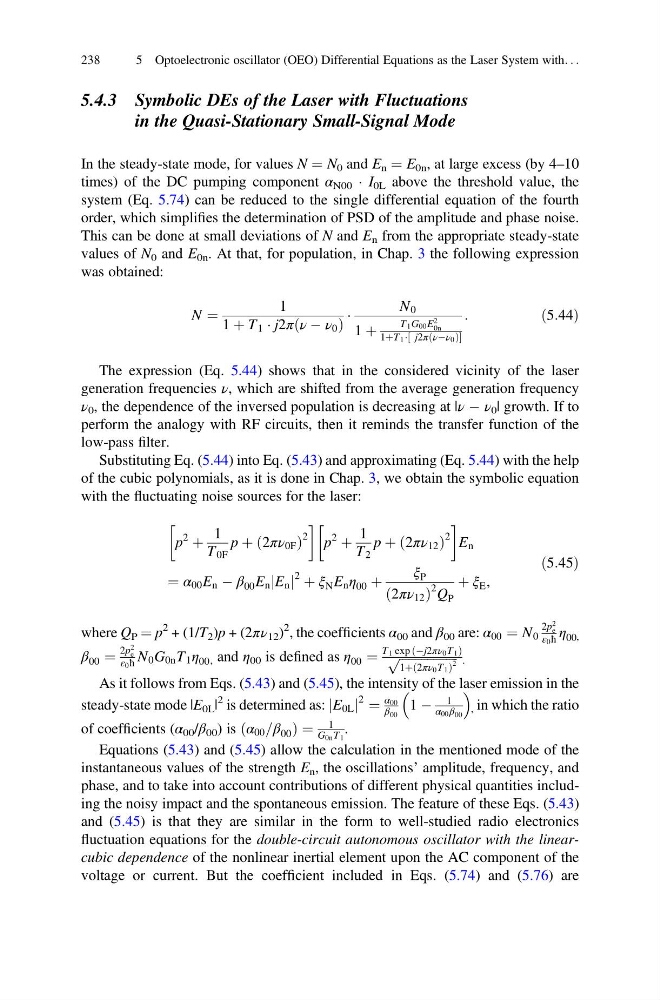
Substituting Eq. (5.44) into Eq. (5.43) and approximating (Eq. 5.44) with the help
of the cubic polynomials, as it is done in Chap. 3, we obtain the symbolic equation
with the fluctuating noise sources for the laser:
p
2
þ
1
T 0F
p þ 2πν 0F
ð
Þ
2
!
p
2
þ
1
T 2
p þ 2πν 12
ð
Þ
2
!
E n
¼ α 00 E n À β 00 E n E n
j j
2 þ ξ N E n η 00 þ
ξ P
2πν 12
ð
Þ
2 Q P
þ ξ E ,
ð5:45Þ
where Q P ¼ p
2 + (1/T 2 )p + (2πν 12 )
2 , the coefficients α 00 and β 00 are: α 00 ¼ N 0
2p
2
e
ε 0 ħ η 00,
β 00 ¼
2p
2
e
ε 0 ħ N 0 G 0n T 1 η 00, and η 00 is defined as η 00 ¼
T 1 exp Àj2πν 0 T 1
ð
Þ
ffiffiffiffiffiffiffiffiffiffiffiffiffiffiffiffiffiffi ffi
1þ 2πν 0 T 1
ð
Þ
2
p
.
As it follows from Eqs. (5.43) and (5.45), the intensity of the laser emission in the
steady-state mode |E 0L |
2 is determined as: E 0L
j j
2 ¼
α 00
β 00
1 À
1
α 00 β 00
, in which the ratio
of coefficients (α 00 /β 00 ) is α 00 =β 00
ð
Þ¼
1
G 0n T 1
.
Equations (5.43) and (5.45) allow the calculation in the mentioned mode of the
instantaneous values of the strength E n , the oscillations’ amplitude, frequency, and
phase, and to take into account contributions of different physical quantities including the noisy impact and the spontaneous emission. The feature of these Eqs. (5.43)
and (5.45) is that they are similar in the form to well-studied radio electronics
fluctuation equations for the double-circuit autonomous oscillator with the linearcubic dependence of the nonlinear inertial element upon the AC component of the
voltage or current. But the coefficient included in Eqs. (5.74) and (5.76) are
238
5 Optoelectronic oscillator (OEO) Differential Equations as the Laser System with. . .
in the Quasi-Stationary Small-Signal Mode
In the steady-state mode, for values N ¼ N 0 and E n ¼ E 0n , at large excess (by 4–10
times) of the DC pumping component α N00 Á I 0L above the threshold value, the
system (Eq. 5.74) can be reduced to the single differential equation of the fourth
order, which simplifies the determination of PSD of the amplitude and phase noise.
This can be done at small deviations of N and E n from the appropriate steady-state
values of N 0 and E 0n . At that, for population, in Chap. 3 the following expression
was obtained:
N ¼
1
1 þ T 1 Á j2π ν À ν 0
ð
Þ
Á
N 0
1 þ
T 1 G 00 E
2
0n
1þT 1 Á j2π νÀν 0
ð
Þ
½
:
ð5:44Þ
The expression (Eq. 5.44) shows that in the considered vicinity of the laser
generation frequencies ν, which are shifted from the average generation frequency
ν 0 , the dependence of the inversed population is decreasing at |ν À ν 0 | growth. If to
perform the analogy with RF circuits, then it reminds the transfer function of the
low-pass filter.
Substituting Eq. (5.44) into Eq. (5.43) and approximating (Eq. 5.44) with the help
of the cubic polynomials, as it is done in Chap. 3, we obtain the symbolic equation
with the fluctuating noise sources for the laser:
p
2
þ
1
T 0F
p þ 2πν 0F
ð
Þ
2
!
p
2
þ
1
T 2
p þ 2πν 12
ð
Þ
2
!
E n
¼ α 00 E n À β 00 E n E n
j j
2 þ ξ N E n η 00 þ
ξ P
2πν 12
ð
Þ
2 Q P
þ ξ E ,
ð5:45Þ
where Q P ¼ p
2 + (1/T 2 )p + (2πν 12 )
2 , the coefficients α 00 and β 00 are: α 00 ¼ N 0
2p
2
e
ε 0 ħ η 00,
β 00 ¼
2p
2
e
ε 0 ħ N 0 G 0n T 1 η 00, and η 00 is defined as η 00 ¼
T 1 exp Àj2πν 0 T 1
ð
Þ
ffiffiffiffiffiffiffiffiffiffiffiffiffiffiffiffiffiffi ffi
1þ 2πν 0 T 1
ð
Þ
2
p
.
As it follows from Eqs. (5.43) and (5.45), the intensity of the laser emission in the
steady-state mode |E 0L |
2 is determined as: E 0L
j j
2 ¼
α 00
β 00
1 À
1
α 00 β 00
, in which the ratio
of coefficients (α 00 /β 00 ) is α 00 =β 00
ð
Þ¼
1
G 0n T 1
.
Equations (5.43) and (5.45) allow the calculation in the mentioned mode of the
instantaneous values of the strength E n , the oscillations’ amplitude, frequency, and
phase, and to take into account contributions of different physical quantities including the noisy impact and the spontaneous emission. The feature of these Eqs. (5.43)
and (5.45) is that they are similar in the form to well-studied radio electronics
fluctuation equations for the double-circuit autonomous oscillator with the linearcubic dependence of the nonlinear inertial element upon the AC component of the
voltage or current. But the coefficient included in Eqs. (5.74) and (5.76) are
238
5 Optoelectronic oscillator (OEO) Differential Equations as the Laser System with. . .