

The investigation of oscillation excitation conditions in QWLD, positions of
steady-state points and the limit cycle existence in the phase plane of generalized
parameters is performed. It enables to obtain the system of inequalities for main
parameters, which is important for the laser system analysis in the quasi-linear mode
with high exceed of the pumping current over its threshold value. Utilization of the
locus method and the Nyquist criterion help us to analyze more accurate conditions
of excitation taking inertia property into account.
Modeling results are presented in quasi-stationary mode of laser generation at
inertial nonlinearity. Analysis of time-functions gives new information about stable
laser generation close to harmonic. Phase portraits are built, which have interesting
features, for instance, the loop-type phase portrait and the cycloid symmetric closed
trajectories and curves with singularities. In particular, at inertial property absence, at
linear-hyperbolic nonlinearity, there is restricted region of values of pumping. The
limit cycle of single-frequency oscillations exists in the restricted range of pumping,
which defines by the two-resonance system formed the laser and its optical
resonator.
At examination of the dynamic oscillation picture, taking into consideration the
inertia property of laser nonlinear element, together with the in-phase component in
existing oscillating motions of field strength the quadratic component plays the
significant role. At that, exit to the limit cycle is accompanied by oscillations caused
by nonlinear interaction of harmonics. The special role in analysis is attracted to
4
K=0.2
K=4.4
K=5.4
2
-2
-4
a)
b)
c)
(s^ 2 +0.1s+1)x=0.4*(0.5x-(x*x*x/8))*s
(s^ 2 +0.1s+1.)x – 4.4*(0.5 x-(x*x*x/8))*s
(s^ 2 +0.1s+1.)=5.4*(0.5-(x*x/8))*s
-4 -2
2
-2
-2
2
4
–4
2
4
s
-2
-2
2
4
–4
2
4
s
4 s
x
x
x
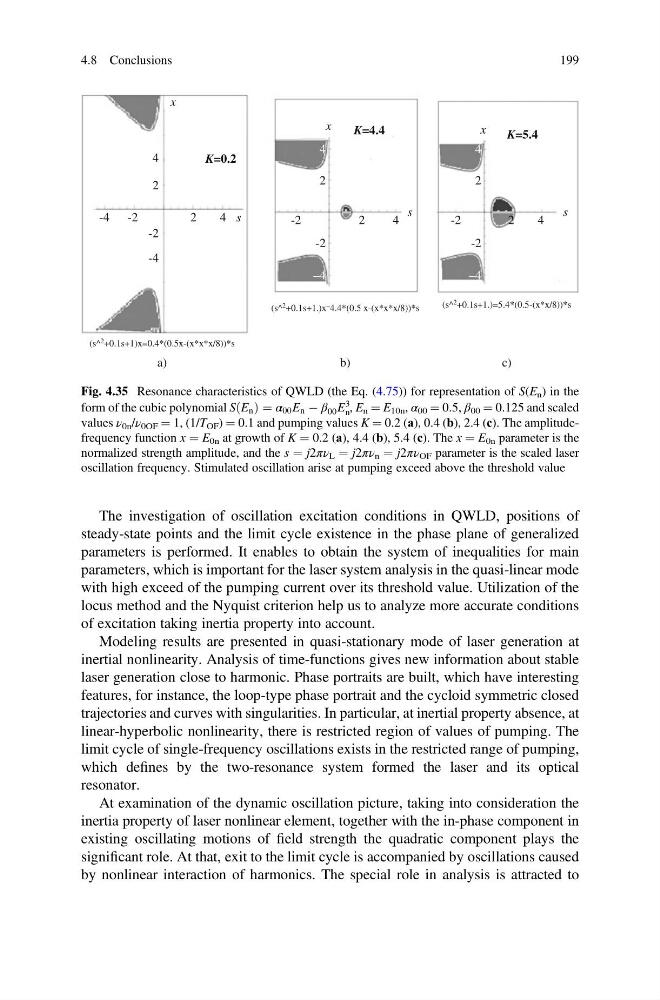
Fig. 4.35 Resonance characteristics of QWLD (the Eq. (4.75)) for representation of S(E n ) in the
form of the cubic polynomial S E n
ð Þ ¼ α 00 E n À β 00 E
3
n , E n ¼ E 10n , α 00 ¼ 0.5, β 00 ¼ 0.125 and scaled
values ν 0n /ν 0OF ¼ 1, (1/T OF ) ¼ 0.1 and pumping values K ¼ 0.2 (а), 0.4 (b), 2.4 (с). The amplitudefrequency function x ¼ E 0n at growth of K ¼ 0.2 (а), 4.4 (b), 5.4 (с). The x ¼ E 0n parameter is the
normalized strength amplitude, and the s ¼ j2πν L ¼ j2πν n ¼ j2πν OF parameter is the scaled laser
oscillation frequency. Stimulated oscillation arise at pumping exceed above the threshold value
4.8 Conclusions
199
steady-state points and the limit cycle existence in the phase plane of generalized
parameters is performed. It enables to obtain the system of inequalities for main
parameters, which is important for the laser system analysis in the quasi-linear mode
with high exceed of the pumping current over its threshold value. Utilization of the
locus method and the Nyquist criterion help us to analyze more accurate conditions
of excitation taking inertia property into account.
Modeling results are presented in quasi-stationary mode of laser generation at
inertial nonlinearity. Analysis of time-functions gives new information about stable
laser generation close to harmonic. Phase portraits are built, which have interesting
features, for instance, the loop-type phase portrait and the cycloid symmetric closed
trajectories and curves with singularities. In particular, at inertial property absence, at
linear-hyperbolic nonlinearity, there is restricted region of values of pumping. The
limit cycle of single-frequency oscillations exists in the restricted range of pumping,
which defines by the two-resonance system formed the laser and its optical
resonator.
At examination of the dynamic oscillation picture, taking into consideration the
inertia property of laser nonlinear element, together with the in-phase component in
existing oscillating motions of field strength the quadratic component plays the
significant role. At that, exit to the limit cycle is accompanied by oscillations caused
by nonlinear interaction of harmonics. The special role in analysis is attracted to
4
K=0.2
K=4.4
K=5.4
2
-2
-4
a)
b)
c)
(s^ 2 +0.1s+1)x=0.4*(0.5x-(x*x*x/8))*s
(s^ 2 +0.1s+1.)x – 4.4*(0.5 x-(x*x*x/8))*s
(s^ 2 +0.1s+1.)=5.4*(0.5-(x*x/8))*s
-4 -2
2
-2
-2
2
4
–4
2
4
s
-2
-2
2
4
–4
2
4
s
4 s
x
x
x
Fig. 4.35 Resonance characteristics of QWLD (the Eq. (4.75)) for representation of S(E n ) in the
form of the cubic polynomial S E n
ð Þ ¼ α 00 E n À β 00 E
3
n , E n ¼ E 10n , α 00 ¼ 0.5, β 00 ¼ 0.125 and scaled
values ν 0n /ν 0OF ¼ 1, (1/T OF ) ¼ 0.1 and pumping values K ¼ 0.2 (а), 0.4 (b), 2.4 (с). The amplitudefrequency function x ¼ E 0n at growth of K ¼ 0.2 (а), 4.4 (b), 5.4 (с). The x ¼ E 0n parameter is the
normalized strength amplitude, and the s ¼ j2πν L ¼ j2πν n ¼ j2πν OF parameter is the scaled laser
oscillation frequency. Stimulated oscillation arise at pumping exceed above the threshold value
4.8 Conclusions
199