

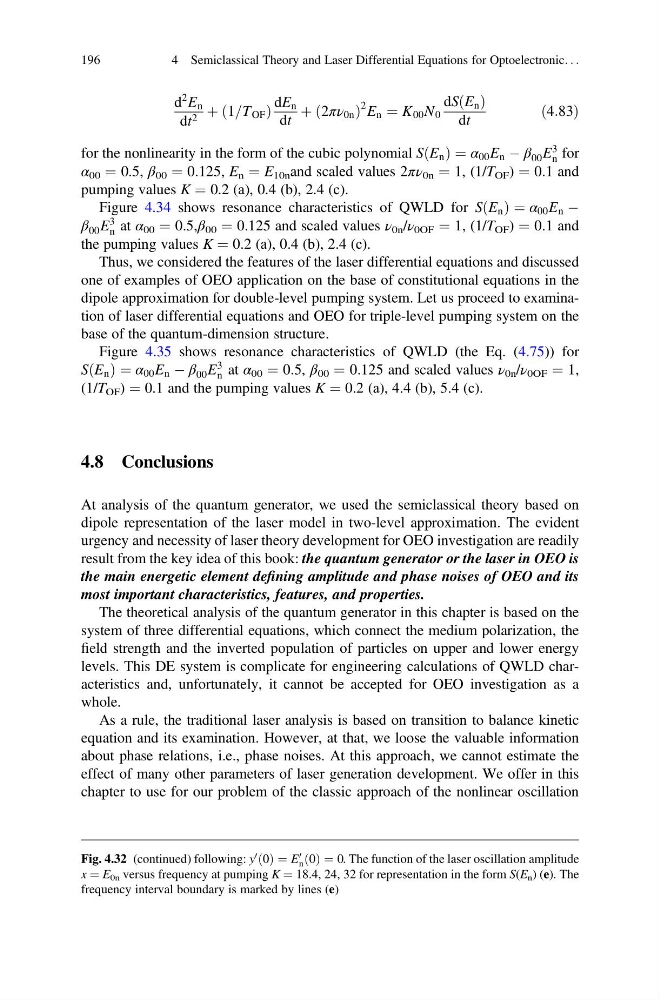
d
2 E n
dt 2 þ 1=T OF
ð
Þ
dE n
dt
þ 2πν 0n
ð
Þ
2 E n ¼ K 00 N 0
dS E n
ð Þ
dt
ð4:83Þ
for the nonlinearity in the form of the cubic polynomial S E n
ð Þ ¼ α 00 E n À β 00 E
3
n for
α 00 ¼ 0.5, β 00 ¼ 0.125, E n ¼ E 10n and scaled values 2πν 0n ¼ 1, (1/T OF ) ¼ 0.1 and
pumping values K ¼ 0.2 (а), 0.4 (b), 2.4 (с).
Figure 4.34 shows resonance characteristics of QWLD for S E n
ð Þ ¼ α 00 E n À
β 00 E
3
n at α 00 ¼ 0.5,β 00 ¼ 0.125 and scaled values ν 0n /ν 0OF ¼ 1, (1/T OF ) ¼ 0.1 and
the pumping values K ¼ 0.2 (а), 0.4 (b), 2.4 (с).
Thus, we considered the features of the laser differential equations and discussed
one of examples of OEO application on the base of constitutional equations in the
dipole approximation for double-level pumping system. Let us proceed to examination of laser differential equations and OEO for triple-level pumping system on the
base of the quantum-dimension structure.
Figure 4.35 shows resonance characteristics of QWLD (the Eq. (4.75)) for
S E n
ð Þ ¼ α 00 E n À β 00 E
3
n at α 00 ¼ 0.5, β 00 ¼ 0.125 and scaled values ν 0n /ν 0OF ¼ 1,
(1/T OF ) ¼ 0.1 and the pumping values K ¼ 0.2 (а), 4.4 (b), 5.4 (с).
4.8 Conclusions
At analysis of the quantum generator, we used the semiclassical theory based on
dipole representation of the laser model in two-level approximation. The evident
urgency and necessity of laser theory development for OEO investigation are readily
result from the key idea of this book: the quantum generator or the laser in OEO is
the main energetic element defining amplitude and phase noises of OEO and its
most important characteristics, features, and properties.
The theoretical analysis of the quantum generator in this chapter is based on the
system of three differential equations, which connect the medium polarization, the
field strength and the inverted population of particles on upper and lower energy
levels. This DE system is complicate for engineering calculations of QWLD characteristics and, unfortunately, it cannot be accepted for OEO investigation as a
whole.
As a rule, the traditional laser analysis is based on transition to balance kinetic
equation and its examination. However, at that, we loose the valuable information
about phase relations, i.e., phase noises. At this approach, we cannot estimate the
effect of many other parameters of laser generation development. We offer in this
chapter to use for our problem of the classic approach of the nonlinear oscillation
Fig. 4.32 (continued) following: y
0 0
ð Þ ¼ E
0
n 0
ð Þ ¼ 0. The function of the laser oscillation amplitude
x ¼ E 0n versus frequency at pumping K ¼ 18.4, 24, 32 for representation in the form S(E n ) (e). The
frequency interval boundary is marked by lines (e)
196
4 Semiclassical Theory and Laser Differential Equations for Optoelectronic. . .
2 E n
dt 2 þ 1=T OF
ð
Þ
dE n
dt
þ 2πν 0n
ð
Þ
2 E n ¼ K 00 N 0
dS E n
ð Þ
dt
ð4:83Þ
for the nonlinearity in the form of the cubic polynomial S E n
ð Þ ¼ α 00 E n À β 00 E
3
n for
α 00 ¼ 0.5, β 00 ¼ 0.125, E n ¼ E 10n and scaled values 2πν 0n ¼ 1, (1/T OF ) ¼ 0.1 and
pumping values K ¼ 0.2 (а), 0.4 (b), 2.4 (с).
Figure 4.34 shows resonance characteristics of QWLD for S E n
ð Þ ¼ α 00 E n À
β 00 E
3
n at α 00 ¼ 0.5,β 00 ¼ 0.125 and scaled values ν 0n /ν 0OF ¼ 1, (1/T OF ) ¼ 0.1 and
the pumping values K ¼ 0.2 (а), 0.4 (b), 2.4 (с).
Thus, we considered the features of the laser differential equations and discussed
one of examples of OEO application on the base of constitutional equations in the
dipole approximation for double-level pumping system. Let us proceed to examination of laser differential equations and OEO for triple-level pumping system on the
base of the quantum-dimension structure.
Figure 4.35 shows resonance characteristics of QWLD (the Eq. (4.75)) for
S E n
ð Þ ¼ α 00 E n À β 00 E
3
n at α 00 ¼ 0.5, β 00 ¼ 0.125 and scaled values ν 0n /ν 0OF ¼ 1,
(1/T OF ) ¼ 0.1 and the pumping values K ¼ 0.2 (а), 4.4 (b), 5.4 (с).
4.8 Conclusions
At analysis of the quantum generator, we used the semiclassical theory based on
dipole representation of the laser model in two-level approximation. The evident
urgency and necessity of laser theory development for OEO investigation are readily
result from the key idea of this book: the quantum generator or the laser in OEO is
the main energetic element defining amplitude and phase noises of OEO and its
most important characteristics, features, and properties.
The theoretical analysis of the quantum generator in this chapter is based on the
system of three differential equations, which connect the medium polarization, the
field strength and the inverted population of particles on upper and lower energy
levels. This DE system is complicate for engineering calculations of QWLD characteristics and, unfortunately, it cannot be accepted for OEO investigation as a
whole.
As a rule, the traditional laser analysis is based on transition to balance kinetic
equation and its examination. However, at that, we loose the valuable information
about phase relations, i.e., phase noises. At this approach, we cannot estimate the
effect of many other parameters of laser generation development. We offer in this
chapter to use for our problem of the classic approach of the nonlinear oscillation
Fig. 4.32 (continued) following: y
0 0
ð Þ ¼ E
0
n 0
ð Þ ¼ 0. The function of the laser oscillation amplitude
x ¼ E 0n versus frequency at pumping K ¼ 18.4, 24, 32 for representation in the form S(E n ) (e). The
frequency interval boundary is marked by lines (e)
196
4 Semiclassical Theory and Laser Differential Equations for Optoelectronic. . .