

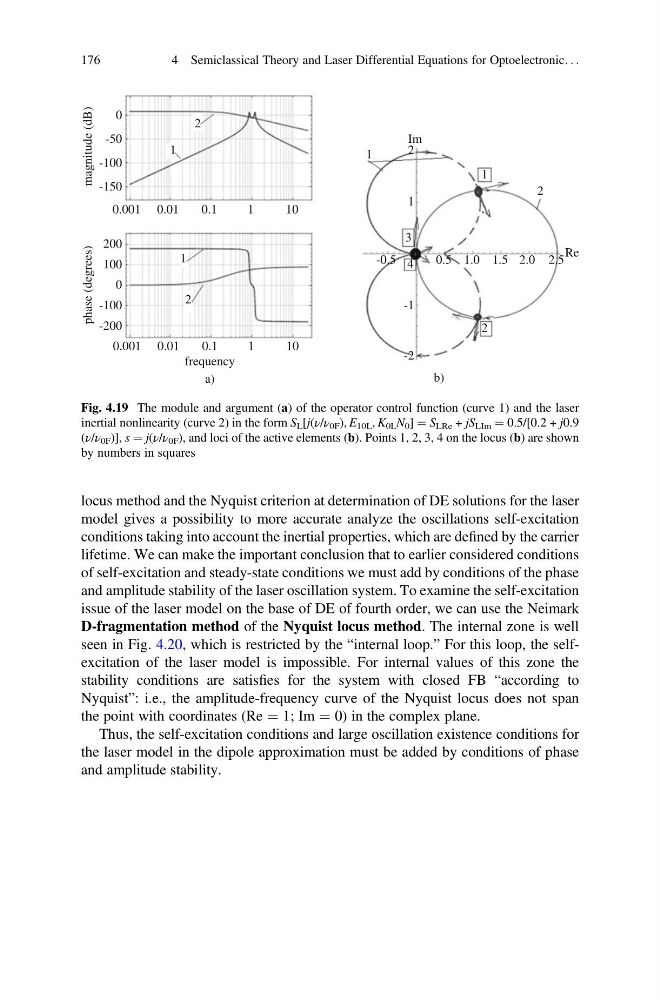
locus method and the Nyquist criterion at determination of DE solutions for the laser
model gives a possibility to more accurate analyze the oscillations self-excitation
conditions taking into account the inertial properties, which are defined by the carrier
lifetime. We can make the important conclusion that to earlier considered conditions
of self-excitation and steady-state conditions we must add by conditions of the phase
and amplitude stability of the laser oscillation system. To examine the self-excitation
issue of the laser model on the base of DE of fourth order, we can use the Neimark
D-fragmentation method of the Nyquist locus method. The internal zone is well
seen in Fig. 4.20, which is restricted by the “internal loop.” For this loop, the selfexcitation of the laser model is impossible. For internal values of this zone the
stability conditions are satisfies for the system with closed FB “according to
Nyquist”: i.e., the amplitude-frequency curve of the Nyquist locus does not span
the point with coordinates (Re ¼ 1; Im ¼ 0) in the complex plane.
Thus, the self-excitation conditions and large oscillation existence conditions for
the laser model in the dipole approximation must be added by conditions of phase
and amplitude stability.
0
-50
-100
-150
200
100
0
-100
phase (degrees)
magnitude (dB)
-200
0.001 0.01
0.1
1
10
1
Im
1
2
2
1
2
-1
-2
3
4
-0.5
0.5 1.0 1.5 2.0 2.5
Re
0.001 0.01
2
1
1
2
0.1
frequency
a)
b)
1
1 0
Fig. 4.19 The module and argument (a) of the operator control function (curve 1) and the laser
inertial nonlinearity (curve 2) in the form S L [j(ν/ν 0F ), E 10L , K 0L N 0 ] ¼ S LRe + jS LIm ¼ 0.5/[0.2 + j0.9
(ν/ν 0F )], s ¼ j(ν/ν 0F ), and loci of the active elements (b). Points 1, 2, 3, 4 on the locus (b) are shown
by numbers in squares
176
4 Semiclassical Theory and Laser Differential Equations for Optoelectronic. . .
model gives a possibility to more accurate analyze the oscillations self-excitation
conditions taking into account the inertial properties, which are defined by the carrier
lifetime. We can make the important conclusion that to earlier considered conditions
of self-excitation and steady-state conditions we must add by conditions of the phase
and amplitude stability of the laser oscillation system. To examine the self-excitation
issue of the laser model on the base of DE of fourth order, we can use the Neimark
D-fragmentation method of the Nyquist locus method. The internal zone is well
seen in Fig. 4.20, which is restricted by the “internal loop.” For this loop, the selfexcitation of the laser model is impossible. For internal values of this zone the
stability conditions are satisfies for the system with closed FB “according to
Nyquist”: i.e., the amplitude-frequency curve of the Nyquist locus does not span
the point with coordinates (Re ¼ 1; Im ¼ 0) in the complex plane.
Thus, the self-excitation conditions and large oscillation existence conditions for
the laser model in the dipole approximation must be added by conditions of phase
and amplitude stability.
0
-50
-100
-150
200
100
0
-100
phase (degrees)
magnitude (dB)
-200
0.001 0.01
0.1
1
10
1
Im
1
2
2
1
2
-1
-2
3
4
-0.5
0.5 1.0 1.5 2.0 2.5
Re
0.001 0.01
2
1
1
2
0.1
frequency
a)
b)
1
1 0
Fig. 4.19 The module and argument (a) of the operator control function (curve 1) and the laser
inertial nonlinearity (curve 2) in the form S L [j(ν/ν 0F ), E 10L , K 0L N 0 ] ¼ S LRe + jS LIm ¼ 0.5/[0.2 + j0.9
(ν/ν 0F )], s ¼ j(ν/ν 0F ), and loci of the active elements (b). Points 1, 2, 3, 4 on the locus (b) are shown
by numbers in squares
176
4 Semiclassical Theory and Laser Differential Equations for Optoelectronic. . .