

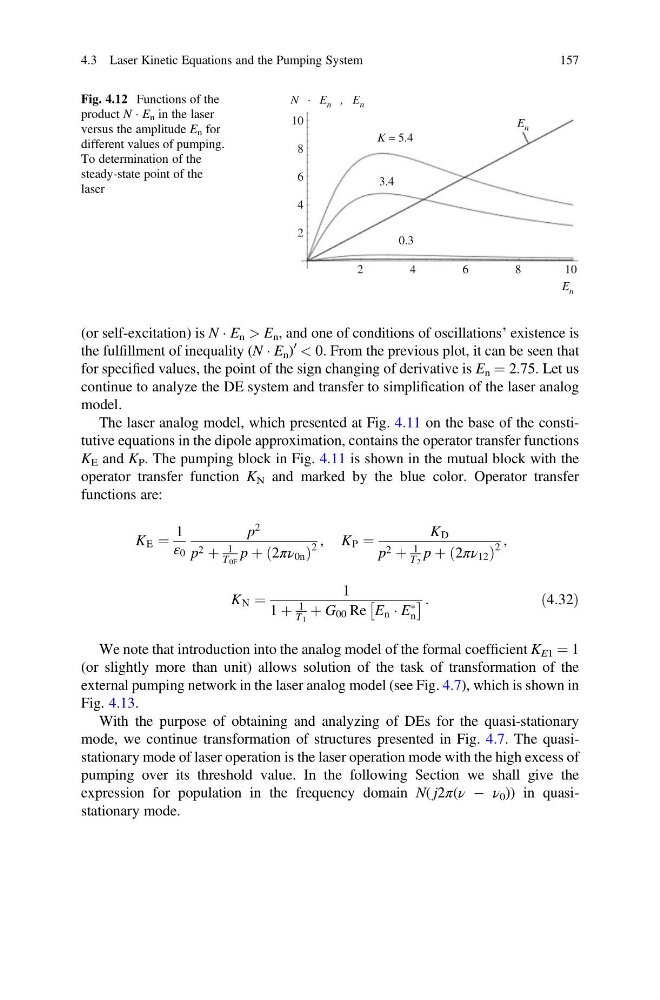
(or self-excitation) is N Á E n > E n , and one of conditions of oscillations’ existence is
the fulfillment of inequality (N Á E n )
0 < 0. From the previous plot, it can be seen that
for specified values, the point of the sign changing of derivative is E n ¼ 2.75. Let us
continue to analyze the DE system and transfer to simplification of the laser analog
model.
The laser analog model, which presented at Fig. 4.11 on the base of the constitutive equations in the dipole approximation, contains the operator transfer functions
K E and K P . The pumping block in Fig. 4.11 is shown in the mutual block with the
operator transfer function K N and marked by the blue color. Operator transfer
functions are:
K E ¼
1
ε 0
p
2
p 2 þ
1
T 0F
p þ 2πν 0n
ð
Þ
2
, K P ¼
K D
p 2 þ
1
T 2
p þ 2πν 12
ð
Þ
2
,
K N ¼
1
1 þ
1
T 1
þ G 00 Re E n Á E
Ã
n
Â
Ã:
ð4:32Þ
We note that introduction into the analog model of the formal coefficient K E1 ¼ 1
(or slightly more than unit) allows solution of the task of transformation of the
external pumping network in the laser analog model (see Fig. 4.7), which is shown in
Fig. 4.13.
With the purpose of obtaining and analyzing of DEs for the quasi-stationary
mode, we continue transformation of structures presented in Fig. 4.7. The quasistationary mode of laser operation is the laser operation mode with the high excess of
pumping over its threshold value. In the following Section we shall give the
expression for population in the frequency domain N( j2π(ν À ν 0 )) in quasistationary mode.
E n
E n
2
4
6
8
1 0
2
4
6
8
10
N · E n , E n
K = 5.4
3.4
0.3
Fig. 4.12 Functions of the
product N Á E n in the laser
versus the amplitude E n for
different values of pumping.
To determination of the
steady-state point of the
laser
4.3 Laser Kinetic Equations and the Pumping System
157
the fulfillment of inequality (N Á E n )
0 < 0. From the previous plot, it can be seen that
for specified values, the point of the sign changing of derivative is E n ¼ 2.75. Let us
continue to analyze the DE system and transfer to simplification of the laser analog
model.
The laser analog model, which presented at Fig. 4.11 on the base of the constitutive equations in the dipole approximation, contains the operator transfer functions
K E and K P . The pumping block in Fig. 4.11 is shown in the mutual block with the
operator transfer function K N and marked by the blue color. Operator transfer
functions are:
K E ¼
1
ε 0
p
2
p 2 þ
1
T 0F
p þ 2πν 0n
ð
Þ
2
, K P ¼
K D
p 2 þ
1
T 2
p þ 2πν 12
ð
Þ
2
,
K N ¼
1
1 þ
1
T 1
þ G 00 Re E n Á E
Ã
n
Â
Ã:
ð4:32Þ
We note that introduction into the analog model of the formal coefficient K E1 ¼ 1
(or slightly more than unit) allows solution of the task of transformation of the
external pumping network in the laser analog model (see Fig. 4.7), which is shown in
Fig. 4.13.
With the purpose of obtaining and analyzing of DEs for the quasi-stationary
mode, we continue transformation of structures presented in Fig. 4.7. The quasistationary mode of laser operation is the laser operation mode with the high excess of
pumping over its threshold value. In the following Section we shall give the
expression for population in the frequency domain N( j2π(ν À ν 0 )) in quasistationary mode.
E n
E n
2
4
6
8
1 0
2
4
6
8
10
N · E n , E n
K = 5.4
3.4
0.3
Fig. 4.12 Functions of the
product N Á E n in the laser
versus the amplitude E n for
different values of pumping.
To determination of the
steady-state point of the
laser
4.3 Laser Kinetic Equations and the Pumping System
157