

perform the analysis of the laser model on the base of classical scheme adopted in the
oscillation theory. For this, we transfer from the above-mentioned system from three
equations to the DE system consisting of two nonlinear symbolic differential
equations. Further, we reduce the system to the single differential symbolic equation,
which in quasi-stationary mode takes into account features and parameters of the
laser constitutive model, which are necessary for OEO investigation including the
phase noise analysis.
4.3.2 Nonlinear Symbolic DEs for QWLD
Let us obtain the system of nonlinear symbolic differential equations:
p
2
þ
1
T 0F
p þ 2πν 0n
ð
Þ
2
p
2
þ 1=T 2
ð
Þp þ 2πν 12
ð
Þ
2
h
i
E n ¼ K α p
2 S L N Á E n
ð
Þ
pN ¼ α N0 À
N
T 1
À G 00 N Á Re E n E
Ã
n
Â
Ã
8
> > <
> > :
:
ð4:28Þ
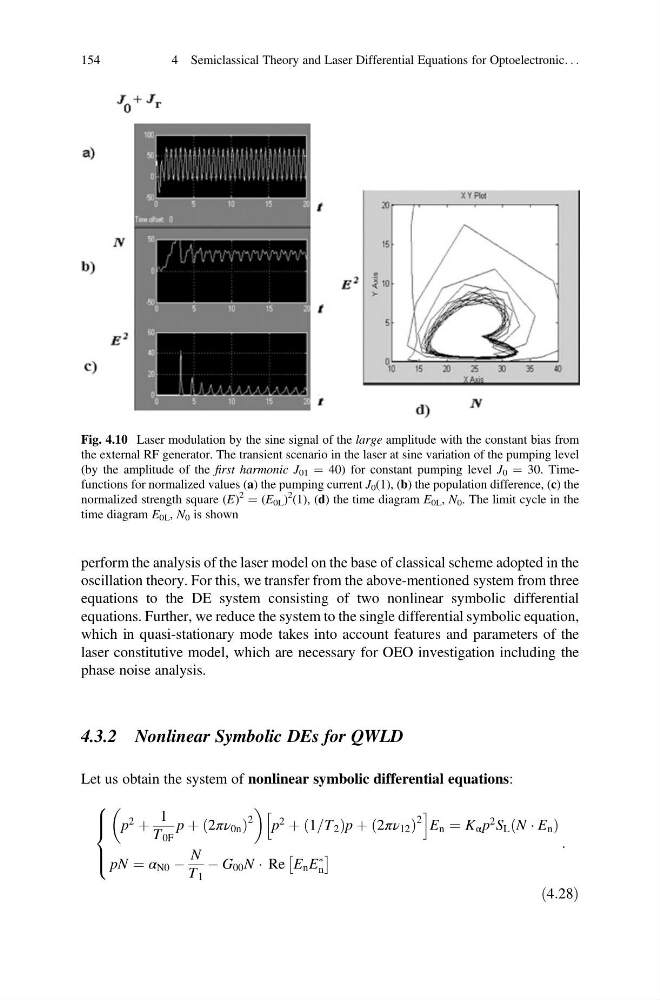
Fig. 4.10 Laser modulation by the sine signal of the large amplitude with the constant bias from
the external RF generator. The transient scenario in the laser at sine variation of the pumping level
(by the amplitude of the first harmonic J 01 ¼ 40) for constant pumping level J 0 ¼ 30. Timefunctions for normalized values (a) the pumping current J 0 (1), (b) the population difference, (c) the
normalized strength square (E)
2 ¼ (E 0L )
2
(1), (d) the time diagram E 0L , N 0 . The limit cycle in the
time diagram E 0L , N 0 is shown
154
4 Semiclassical Theory and Laser Differential Equations for Optoelectronic. . .
oscillation theory. For this, we transfer from the above-mentioned system from three
equations to the DE system consisting of two nonlinear symbolic differential
equations. Further, we reduce the system to the single differential symbolic equation,
which in quasi-stationary mode takes into account features and parameters of the
laser constitutive model, which are necessary for OEO investigation including the
phase noise analysis.
4.3.2 Nonlinear Symbolic DEs for QWLD
Let us obtain the system of nonlinear symbolic differential equations:
p
2
þ
1
T 0F
p þ 2πν 0n
ð
Þ
2
p
2
þ 1=T 2
ð
Þp þ 2πν 12
ð
Þ
2
h
i
E n ¼ K α p
2 S L N Á E n
ð
Þ
pN ¼ α N0 À
N
T 1
À G 00 N Á Re E n E
Ã
n
Â
Ã
8
> > <
> > :
:
ð4:28Þ
Fig. 4.10 Laser modulation by the sine signal of the large amplitude with the constant bias from
the external RF generator. The transient scenario in the laser at sine variation of the pumping level
(by the amplitude of the first harmonic J 01 ¼ 40) for constant pumping level J 0 ¼ 30. Timefunctions for normalized values (a) the pumping current J 0 (1), (b) the population difference, (c) the
normalized strength square (E)
2 ¼ (E 0L )
2
(1), (d) the time diagram E 0L , N 0 . The limit cycle in the
time diagram E 0L , N 0 is shown
154
4 Semiclassical Theory and Laser Differential Equations for Optoelectronic. . .