

In quasi-stationary mode, N(t) varies on the harmonic law with some delay in phase
2πf 0 T 1 . For N(t)we have: N t
ð Þ ¼ N 00 Á 1 þ
m 0
ffiffiffiffiffiffiffiffiffiffiffiffiffiffiffiffiffiffi
1þ 2πf 0 T 1
ð
Þ
2
p
cos 2πf 0 t þ 2πf 0 T 1
ð
Þ
!
. The
pumping current contains DC and AC components and is equal J L ¼ J L0 + J L1 . The
AC component J L1 of the pumping current is modeled by the generator of harmonic
oscillations, the DC component of the pumping current J 0L is modeled by the
generator of stepped current variation of by a jump. The transient scenario in the
laser at sine variation of the pumping level (by the amplitude of the first harmonic
J 01 ¼ 15) at the constant pumping level J 0 ¼ 30 is presented in Fig. 4.9. In presented
time-functions, we see that nonlinear transient in the oscillating system is close to the
sine process, which is interpreted in the phase portrait in the form of a cycle.
From presented plots of modulation by the sine signals, we see that at increase of
the oscillation amplitude (the modulation index), the nonlinear distortions arise
connected with appearance of harmonics in the spectrum.
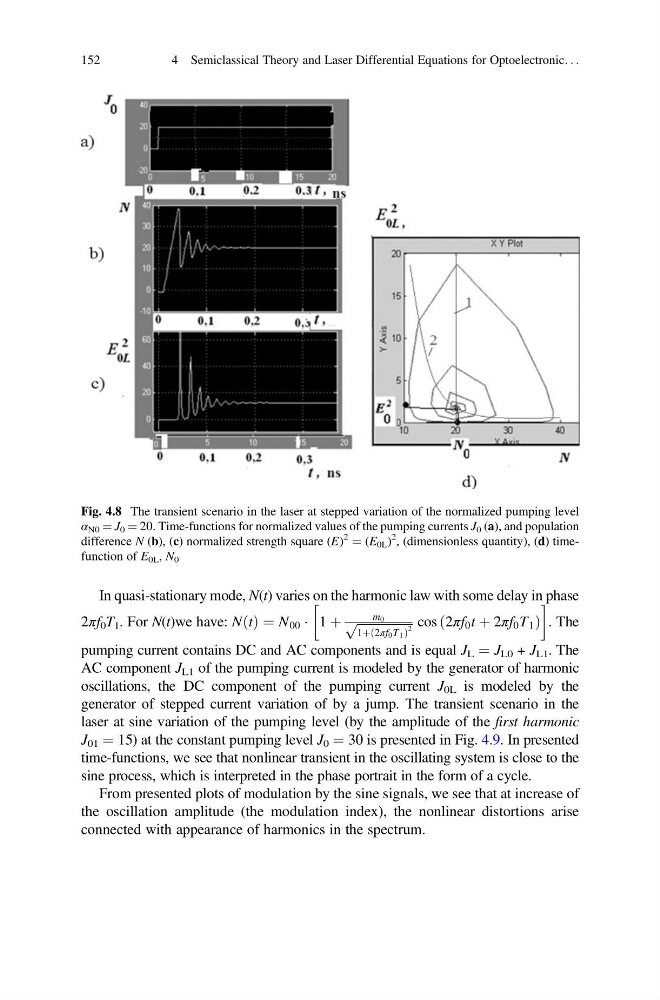
Fig. 4.8 The transient scenario in the laser at stepped variation of the normalized pumping level
α N0 ¼ J 0 ¼ 20. Time-functions for normalized values of the pumping currents J 0 (a), and population
difference N (b), (c) normalized strength square (E)
2 ¼ (E 0L )
2
, (dimensionless quantity), (d) timefunction of E 0L , N 0
152
4 Semiclassical Theory and Laser Differential Equations for Optoelectronic. . .
2πf 0 T 1 . For N(t)we have: N t
ð Þ ¼ N 00 Á 1 þ
m 0
ffiffiffiffiffiffiffiffiffiffiffiffiffiffiffiffiffiffi
1þ 2πf 0 T 1
ð
Þ
2
p
cos 2πf 0 t þ 2πf 0 T 1
ð
Þ
!
. The
pumping current contains DC and AC components and is equal J L ¼ J L0 + J L1 . The
AC component J L1 of the pumping current is modeled by the generator of harmonic
oscillations, the DC component of the pumping current J 0L is modeled by the
generator of stepped current variation of by a jump. The transient scenario in the
laser at sine variation of the pumping level (by the amplitude of the first harmonic
J 01 ¼ 15) at the constant pumping level J 0 ¼ 30 is presented in Fig. 4.9. In presented
time-functions, we see that nonlinear transient in the oscillating system is close to the
sine process, which is interpreted in the phase portrait in the form of a cycle.
From presented plots of modulation by the sine signals, we see that at increase of
the oscillation amplitude (the modulation index), the nonlinear distortions arise
connected with appearance of harmonics in the spectrum.
Fig. 4.8 The transient scenario in the laser at stepped variation of the normalized pumping level
α N0 ¼ J 0 ¼ 20. Time-functions for normalized values of the pumping currents J 0 (a), and population
difference N (b), (c) normalized strength square (E)
2 ¼ (E 0L )
2
, (dimensionless quantity), (d) timefunction of E 0L , N 0
152
4 Semiclassical Theory and Laser Differential Equations for Optoelectronic. . .