

during transients and how the time constants T 0F , T 2 , T 1 and the difference between
frequencies ν 0n and ν 12 influence on dynamics. The analog model permits to estimate
the influence of coefficients K D0 , G 00 and to perform clearly the analysis of different
types of lasers used in OEO: the injection laser diodes with “volumetric” (not
quantum-well) active media, QWLD with several quantum wells and quantum
points, fiber-optical lasers with the active media (erbium, ytterbium, Nd
3+ etc,). In
contrast to balance kinetic equations, which are presented below and derived from
the DE system, this DE system saves the phase relationships. As we shall prove in
the future, DE are added by the fluctuation sources, for instance, the population ξ N ,
to solve the task on determination of spectral densities of the phase noise of the laser
oscillations and PSD of the phase noise in OEO.
With the help of the correlation analysis adopted in radio engineering, it is not
rather complicate to obtain the spectral density of phase and amplitude noises of
QWLD. This model allows an analysis of the laser synchronization by the reference
laser and investigation of frequency control system in the dynamic mode including
PLL systems for lasers used in OEO.
4.2.6 Kinetic Equations of a Laser
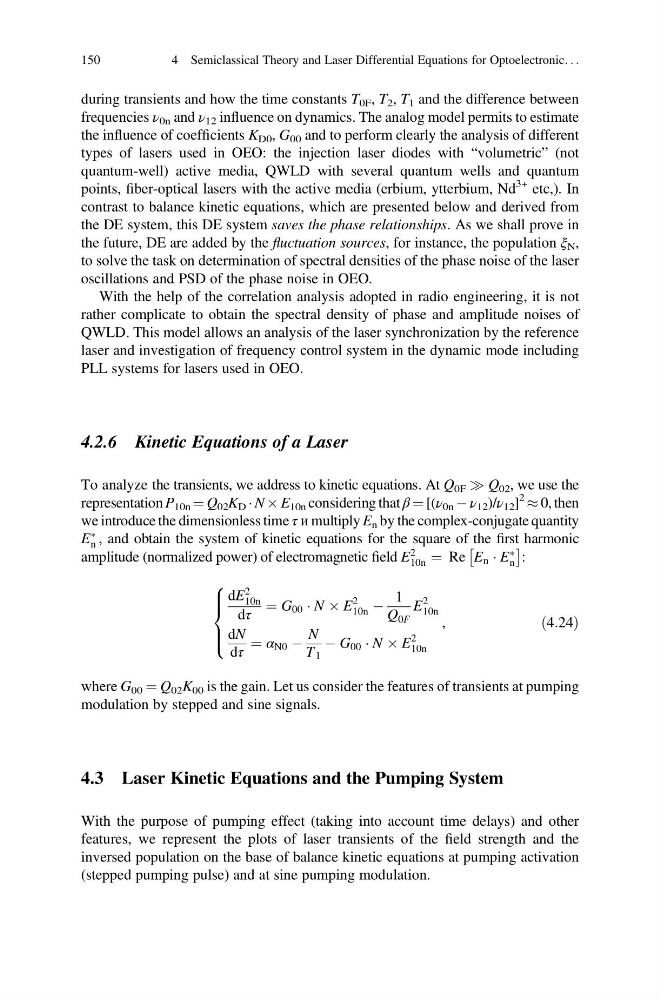
To analyze the transients, we address to kinetic equations. At Q 0F ) Q 02 , we use the
representation P 10n ¼ Q 02 K D Á N Â E 10n considering that β ¼ [(ν 0n À ν 12 )/ν 12 ]
2 % 0, then
we introduce the dimensionless time τ и multiply E n by the complex-conjugate quantity
E
Ã
n , and obtain the system of kinetic equations for the square of the first harmonic
amplitude (normalized power) of electromagnetic field E
2
10n ¼ Re E n Á E
Ã
n
Â
Ã
:
dE
2
10n
dτ
¼ G 00 Á N Â E
2
10n À
1
Q 0F
E
2
10n
dN
dτ
¼ α N0 À
N
T 1
À G 00 Á N Â E
2
10n
8
> > <
> > :
,
ð4:24Þ
where G 00 ¼ Q 02 K 00 is the gain. Let us consider the features of transients at pumping
modulation by stepped and sine signals.
4.3 Laser Kinetic Equations and the Pumping System
With the purpose of pumping effect (taking into account time delays) and other
features, we represent the plots of laser transients of the field strength and the
inversed population on the base of balance kinetic equations at pumping activation
(stepped pumping pulse) and at sine pumping modulation.
150
4 Semiclassical Theory and Laser Differential Equations for Optoelectronic. . .
frequencies ν 0n and ν 12 influence on dynamics. The analog model permits to estimate
the influence of coefficients K D0 , G 00 and to perform clearly the analysis of different
types of lasers used in OEO: the injection laser diodes with “volumetric” (not
quantum-well) active media, QWLD with several quantum wells and quantum
points, fiber-optical lasers with the active media (erbium, ytterbium, Nd
3+ etc,). In
contrast to balance kinetic equations, which are presented below and derived from
the DE system, this DE system saves the phase relationships. As we shall prove in
the future, DE are added by the fluctuation sources, for instance, the population ξ N ,
to solve the task on determination of spectral densities of the phase noise of the laser
oscillations and PSD of the phase noise in OEO.
With the help of the correlation analysis adopted in radio engineering, it is not
rather complicate to obtain the spectral density of phase and amplitude noises of
QWLD. This model allows an analysis of the laser synchronization by the reference
laser and investigation of frequency control system in the dynamic mode including
PLL systems for lasers used in OEO.
4.2.6 Kinetic Equations of a Laser
To analyze the transients, we address to kinetic equations. At Q 0F ) Q 02 , we use the
representation P 10n ¼ Q 02 K D Á N Â E 10n considering that β ¼ [(ν 0n À ν 12 )/ν 12 ]
2 % 0, then
we introduce the dimensionless time τ и multiply E n by the complex-conjugate quantity
E
Ã
n , and obtain the system of kinetic equations for the square of the first harmonic
amplitude (normalized power) of electromagnetic field E
2
10n ¼ Re E n Á E
Ã
n
Â
Ã
:
dE
2
10n
dτ
¼ G 00 Á N Â E
2
10n À
1
Q 0F
E
2
10n
dN
dτ
¼ α N0 À
N
T 1
À G 00 Á N Â E
2
10n
8
> > <
> > :
,
ð4:24Þ
where G 00 ¼ Q 02 K 00 is the gain. Let us consider the features of transients at pumping
modulation by stepped and sine signals.
4.3 Laser Kinetic Equations and the Pumping System
With the purpose of pumping effect (taking into account time delays) and other
features, we represent the plots of laser transients of the field strength and the
inversed population on the base of balance kinetic equations at pumping activation
(stepped pumping pulse) and at sine pumping modulation.
150
4 Semiclassical Theory and Laser Differential Equations for Optoelectronic. . .