

4.1.3 Wave Differential Equation of the Laser
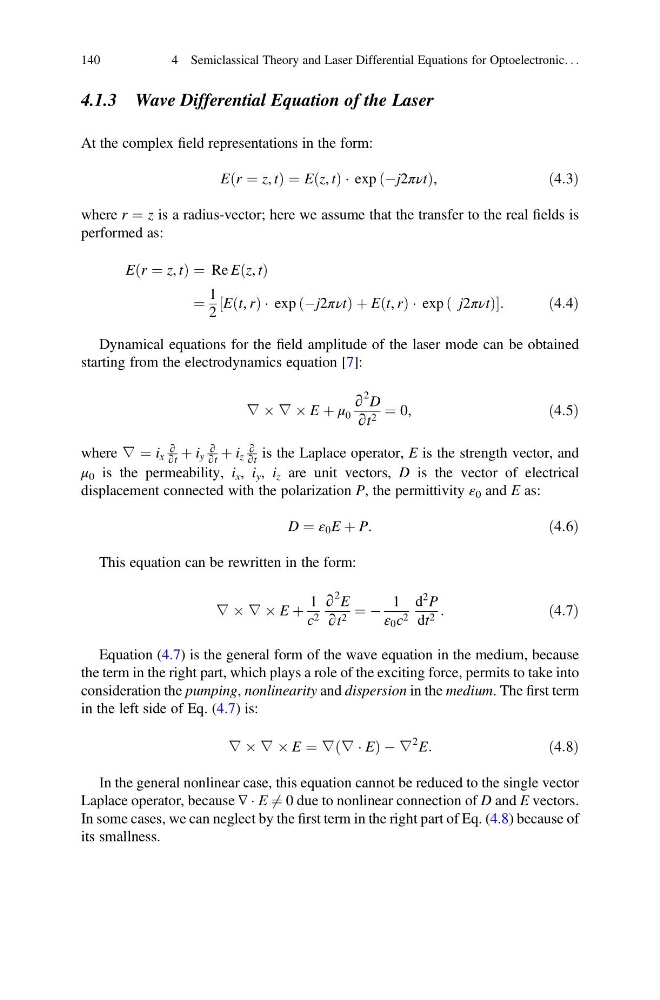
At the complex field representations in the form:
E r ¼ z, t
ð
Þ¼E z, t
ð Þ Á exp Àj2πνt
ð
Þ,
ð4:3Þ
where r ¼ z is a radius-vector; here we assume that the transfer to the real fields is
performed as:
E r ¼ z, t
ð
Þ¼ Re E z, t
ð Þ
¼
1
2
E t, r
ð Þ Á exp Àj2πνt
ð
ÞþE t, r
ð Þ Á exp j2πνt
ð
Þ
½
:
ð4:4Þ
Dynamical equations for the field amplitude of the laser mode can be obtained
starting from the electrodynamics equation [7]:
∇ Â ∇ Â E þ μ 0
∂
2 D
∂t 2 ¼ 0,
ð4:5Þ
where ∇ ¼ i х
∂
∂t
þ i y
∂
∂t
þ i z
∂
∂t
is the Laplace operator, E is the strength vector, and
μ 0 is the permeability, i х , i y , i z are unit vectors, D is the vector of electrical
displacement connected with the polarization P, the permittivity ε 0 and E as:
D ¼ ε 0 E þ P:
ð4:6Þ
This equation can be rewritten in the form:
∇ Â ∇ Â E þ
1
с 2
∂
2 E
∂t 2 ¼ À
1
ε 0 с 2
d
2 P
dt 2 :
ð4:7Þ
Equation (4.7) is the general form of the wave equation in the medium, because
the term in the right part, which plays a role of the exciting force, permits to take into
consideration the pumping, nonlinearity and dispersion in the medium. The first term
in the left side of Eq. (4.7) is:
∇ Â ∇ Â E ¼ ∇ ∇ Á E
ð
ÞÀ∇
2 E:
ð4:8Þ
In the general nonlinear case, this equation cannot be reduced to the single vector
Laplace operator, because ∇ Á E 6 ¼ 0 due to nonlinear connection of D and E vectors.
In some cases, we can neglect by the first term in the right part of Eq. (4.8) because of
its smallness.
140
4 Semiclassical Theory and Laser Differential Equations for Optoelectronic. . .
At the complex field representations in the form:
E r ¼ z, t
ð
Þ¼E z, t
ð Þ Á exp Àj2πνt
ð
Þ,
ð4:3Þ
where r ¼ z is a radius-vector; here we assume that the transfer to the real fields is
performed as:
E r ¼ z, t
ð
Þ¼ Re E z, t
ð Þ
¼
1
2
E t, r
ð Þ Á exp Àj2πνt
ð
ÞþE t, r
ð Þ Á exp j2πνt
ð
Þ
½
:
ð4:4Þ
Dynamical equations for the field amplitude of the laser mode can be obtained
starting from the electrodynamics equation [7]:
∇ Â ∇ Â E þ μ 0
∂
2 D
∂t 2 ¼ 0,
ð4:5Þ
where ∇ ¼ i х
∂
∂t
þ i y
∂
∂t
þ i z
∂
∂t
is the Laplace operator, E is the strength vector, and
μ 0 is the permeability, i х , i y , i z are unit vectors, D is the vector of electrical
displacement connected with the polarization P, the permittivity ε 0 and E as:
D ¼ ε 0 E þ P:
ð4:6Þ
This equation can be rewritten in the form:
∇ Â ∇ Â E þ
1
с 2
∂
2 E
∂t 2 ¼ À
1
ε 0 с 2
d
2 P
dt 2 :
ð4:7Þ
Equation (4.7) is the general form of the wave equation in the medium, because
the term in the right part, which plays a role of the exciting force, permits to take into
consideration the pumping, nonlinearity and dispersion in the medium. The first term
in the left side of Eq. (4.7) is:
∇ Â ∇ Â E ¼ ∇ ∇ Á E
ð
ÞÀ∇
2 E:
ð4:8Þ
In the general nonlinear case, this equation cannot be reduced to the single vector
Laplace operator, because ∇ Á E 6 ¼ 0 due to nonlinear connection of D and E vectors.
In some cases, we can neglect by the first term in the right part of Eq. (4.8) because of
its smallness.
140
4 Semiclassical Theory and Laser Differential Equations for Optoelectronic. . .