

– Determine the order of DEs,
– Extract the operator controlling transfer function in SOS,
– Study the control law of oscillation amplitude of EMF in the laser with the help of
the saturation effect or the inversed population variation,
– Analyze the nonlinear function of NE,
– Investigate oscillation excitation conditions and oscillation existence condition
for QWLD in steady-state modem,
– Determine the existence condition of the limit cycle on the phase plane of
generalized parameters and their bifurcations.
The special attention in the laser system analysis is attracted to the nonlinear
QWLD element. In contrast to kinetic equations, the phase relations are saved in
this DE system.
Since the main practical purpose of OEO systems is the creation of ultralow-noise
oscillators of microwave and mm-wave ranges, we must pay attention to features of
fluctuation and phase noise investigations in OEO.
At examination of noises, which is performed in Chap. 5, we supplement of DEs
(and the analog model considering and analyzing in this chapter) of the laser in
dipole approximation by Langevinian noise sources and we form the basing symbolic fluctuation DEs for OEO with the direct and external modulation.
Recently, QWLD with the spectral line width less than 10 kHz become commercially available. Such lasers have ultralow levels of PSD of the amplitude noise
(AN) and the phase noise (PN). Figure 4.1d shows the typical experimental function
of PSD of AN and PN of the semiconductor QWLD with the spectral line width of
10 kHz at power of 15 mW. Applying such lasers in OEO MZ and analyzing its
operation, we must have the appropriate adequate analog fluctuation dynamic and
static models.
This approach on the base of constitutive equations with formation of
Langevinian noise sources enables better understanding of how does oscillation
process develop in the laser, helps to obtain the phase and amplitude noises of its
emission. Such an approach gives an opportunity to connect functionally of the laser
with external (not included into the laser) optical and RF components: optical filters
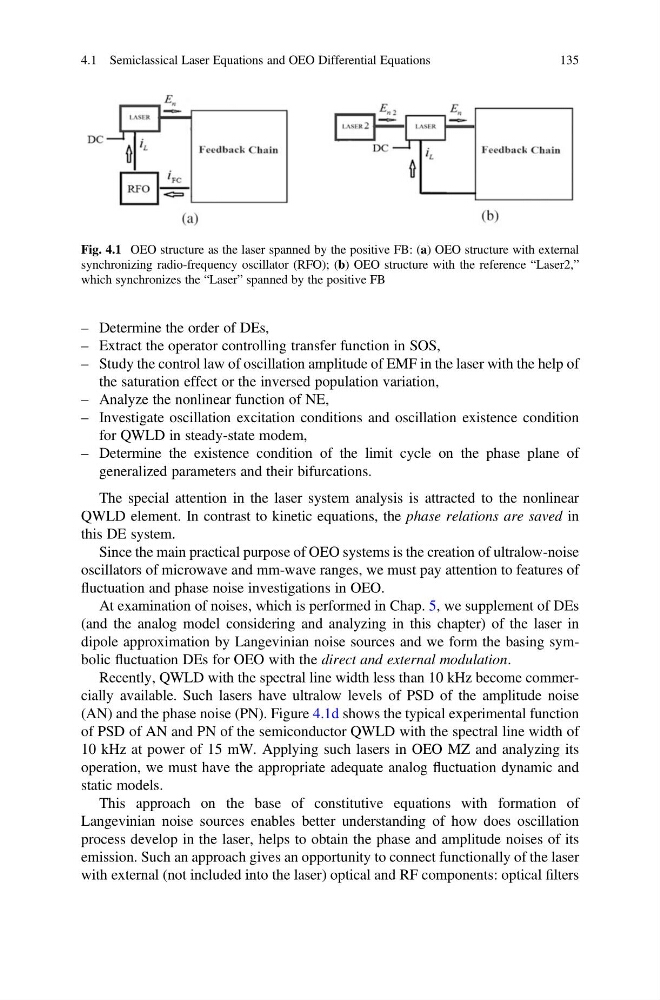
Fig. 4.1 OEO structure as the laser spanned by the positive FB: (a) OEO structure with external
synchronizing radio-frequency oscillator (RFO); (b) OEO structure with the reference “Laser2,”
which synchronizes the “Laser” spanned by the positive FB
4.1 Semiclassical Laser Equations and OEO Differential Equations
135
– Extract the operator controlling transfer function in SOS,
– Study the control law of oscillation amplitude of EMF in the laser with the help of
the saturation effect or the inversed population variation,
– Analyze the nonlinear function of NE,
– Investigate oscillation excitation conditions and oscillation existence condition
for QWLD in steady-state modem,
– Determine the existence condition of the limit cycle on the phase plane of
generalized parameters and their bifurcations.
The special attention in the laser system analysis is attracted to the nonlinear
QWLD element. In contrast to kinetic equations, the phase relations are saved in
this DE system.
Since the main practical purpose of OEO systems is the creation of ultralow-noise
oscillators of microwave and mm-wave ranges, we must pay attention to features of
fluctuation and phase noise investigations in OEO.
At examination of noises, which is performed in Chap. 5, we supplement of DEs
(and the analog model considering and analyzing in this chapter) of the laser in
dipole approximation by Langevinian noise sources and we form the basing symbolic fluctuation DEs for OEO with the direct and external modulation.
Recently, QWLD with the spectral line width less than 10 kHz become commercially available. Such lasers have ultralow levels of PSD of the amplitude noise
(AN) and the phase noise (PN). Figure 4.1d shows the typical experimental function
of PSD of AN and PN of the semiconductor QWLD with the spectral line width of
10 kHz at power of 15 mW. Applying such lasers in OEO MZ and analyzing its
operation, we must have the appropriate adequate analog fluctuation dynamic and
static models.
This approach on the base of constitutive equations with formation of
Langevinian noise sources enables better understanding of how does oscillation
process develop in the laser, helps to obtain the phase and amplitude noises of its
emission. Such an approach gives an opportunity to connect functionally of the laser
with external (not included into the laser) optical and RF components: optical filters
Fig. 4.1 OEO structure as the laser spanned by the positive FB: (a) OEO structure with external
synchronizing radio-frequency oscillator (RFO); (b) OEO structure with the reference “Laser2,”
which synchronizes the “Laser” spanned by the positive FB
4.1 Semiclassical Laser Equations and OEO Differential Equations
135