

RF oscillation in the load of PD. We would like to remind that in the beginning, we
here neglected the laser amplitude fluctuations m em (t) in the analysis, assuming that
they are small in the mode with the large excess of the pumping current above the
threshold value. The fluctuating phases in the last formula define the oscillation
spectrum.
Further, we analyze the QWLD emission modulation in OEO at using of the
external Mach–Zehnder modulator.
3.2.2 Modulation and Heterodyning in OEO MZ
The electro-optical MZ modulator is concerned to a class of modulators for electromagnetic field intensity. The phase modulation of optical emission oscillations is
performed in the one from two optical channels in the MZ modulator. The interference of the phase-modulated and non-phase-modulated EMF oscillations delayed
with regard to each other and passed through the first and second optical channels of
MZ (Fig. 3.13).
Let the laser optical emission with phase fluctuations be fed to the MZ optical
input. The influence of the u g (t) voltage in the one from two optical MZ channels
(Fig. 3.1) upon the material refraction index (usually, the lithium niobate is used),
from which the MZ optical channels are made, leads to the phase modulation of the
optical oscillation. And adding of two emissions passed through different MZ optical
channels leads to intensity modulation of laser emission on the PD area, where their
interference occurs. Delayed output emissions of the first and second channels of MZ
modulator E 1L and E 2L , in the general case, pass to the input of PD. When the fiber
optical system (FOS) is formed by the single lengthy optical fiber, the difference in
delay is defined as ΔT M ¼ T M20 À T M10 .
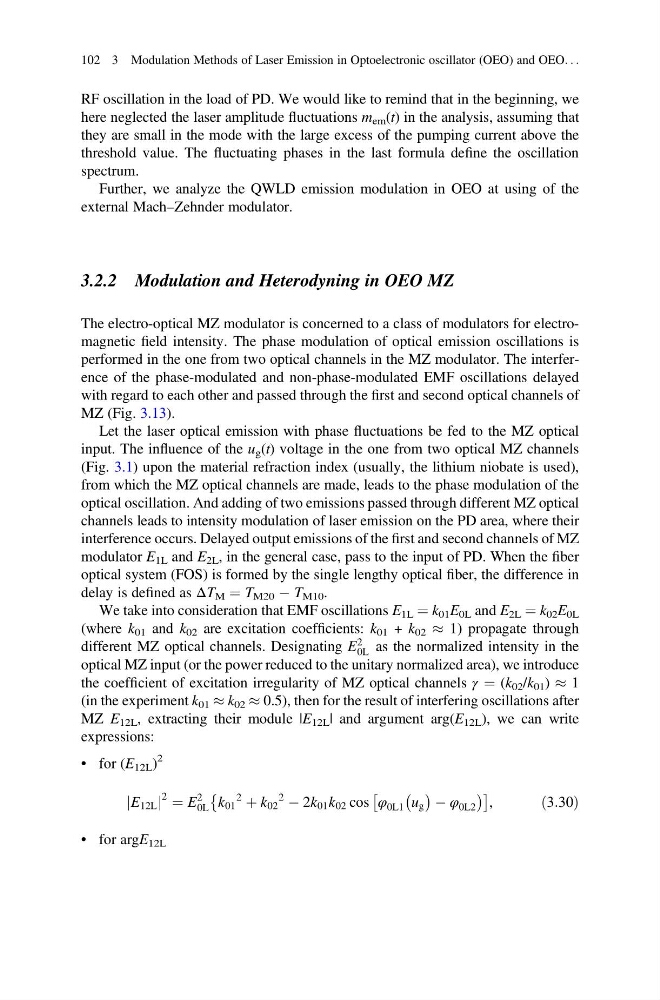
We take into consideration that EMF oscillations E 1L ¼ k 01 E 0L and E 2L ¼ k 02 E 0L
(where k 01 and k 02 are excitation coefficients: k 01 + k 02 % 1) propagate through
different MZ optical channels. Designating E
2
0L as the normalized intensity in the
optical MZ input (or the power reduced to the unitary normalized area), we introduce
the coefficient of excitation irregularity of MZ optical channels γ ¼ (k 02 /k 01 ) % 1
(in the experiment k 01 % k 02 % 0.5), then for the result of interfering oscillations after
MZ E 12L , extracting their module |E 12L | and argument arg(E 12L ), we can write
expressions:
• for (E 12L )
2
E 12L
j
j
2 ¼ E
2
0L k 01
2
þ k 02
2
À 2k 01 k 02 cos φ 0L1 u g
À Á À φ 0L2
Á
Â
Ã
È
,
ð3:30Þ
• for argE 12L
102 3 Modulation Methods of Laser Emission in Optoelectronic oscillator (OEO) and OEO. . .
here neglected the laser amplitude fluctuations m em (t) in the analysis, assuming that
they are small in the mode with the large excess of the pumping current above the
threshold value. The fluctuating phases in the last formula define the oscillation
spectrum.
Further, we analyze the QWLD emission modulation in OEO at using of the
external Mach–Zehnder modulator.
3.2.2 Modulation and Heterodyning in OEO MZ
The electro-optical MZ modulator is concerned to a class of modulators for electromagnetic field intensity. The phase modulation of optical emission oscillations is
performed in the one from two optical channels in the MZ modulator. The interference of the phase-modulated and non-phase-modulated EMF oscillations delayed
with regard to each other and passed through the first and second optical channels of
MZ (Fig. 3.13).
Let the laser optical emission with phase fluctuations be fed to the MZ optical
input. The influence of the u g (t) voltage in the one from two optical MZ channels
(Fig. 3.1) upon the material refraction index (usually, the lithium niobate is used),
from which the MZ optical channels are made, leads to the phase modulation of the
optical oscillation. And adding of two emissions passed through different MZ optical
channels leads to intensity modulation of laser emission on the PD area, where their
interference occurs. Delayed output emissions of the first and second channels of MZ
modulator E 1L and E 2L , in the general case, pass to the input of PD. When the fiber
optical system (FOS) is formed by the single lengthy optical fiber, the difference in
delay is defined as ΔT M ¼ T M20 À T M10 .
We take into consideration that EMF oscillations E 1L ¼ k 01 E 0L and E 2L ¼ k 02 E 0L
(where k 01 and k 02 are excitation coefficients: k 01 + k 02 % 1) propagate through
different MZ optical channels. Designating E
2
0L as the normalized intensity in the
optical MZ input (or the power reduced to the unitary normalized area), we introduce
the coefficient of excitation irregularity of MZ optical channels γ ¼ (k 02 /k 01 ) % 1
(in the experiment k 01 % k 02 % 0.5), then for the result of interfering oscillations after
MZ E 12L , extracting their module |E 12L | and argument arg(E 12L ), we can write
expressions:
• for (E 12L )
2
E 12L
j
j
2 ¼ E
2
0L k 01
2
þ k 02
2
À 2k 01 k 02 cos φ 0L1 u g
À Á À φ 0L2
Á
Â
Ã
È
,
ð3:30Þ
• for argE 12L
102 3 Modulation Methods of Laser Emission in Optoelectronic oscillator (OEO) and OEO. . .