

emanation. At that, the complete probability of the phonon emanation (or the
spontaneous emission) in time unit is defined as
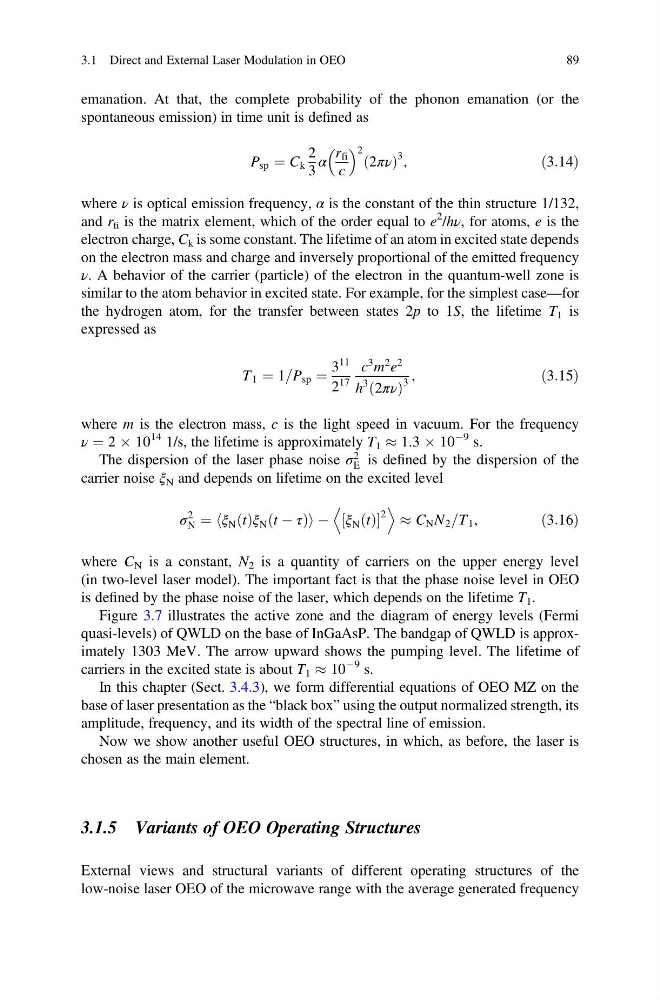
P sp ¼ C k
2
3
α
r fi
c
2
2πν
ð
Þ
3 ,
ð3:14Þ
where ν is optical emission frequency, α is the constant of the thin structure 1/132,
and r fi is the matrix element, which of the order equal to e
2 /hν, for atoms, e is the
electron charge, C k is some constant. The lifetime of an atom in excited state depends
on the electron mass and charge and inversely proportional of the emitted frequency
ν. A behavior of the carrier (particle) of the electron in the quantum-well zone is
similar to the atom behavior in excited state. For example, for the simplest case—for
the hydrogen atom, for the transfer between states 2p to 1S, the lifetime T 1 is
expressed as
T 1 ¼ 1=P sp ¼
3
11
2
17
c
3 m
2 e
2
h
3 2πν
ð
Þ
3
,
ð3:15Þ
where m is the electron mass, c is the light speed in vacuum. For the frequency
ν ¼ 2 Â 10
14 1/s, the lifetime is approximately T 1 % 1.3 Â 10
À9 s.
The dispersion of the laser phase noise σ
2
E is defined by the dispersion of the
carrier noise ξ N and depends on lifetime on the excited level
σ
2
N ¼ ξ N t
ð Þξ N t À τ
ð
Þ
h
i À ξ N t
ð Þ
½
2
D
E
% C N N 2 =T 1 ,
ð3:16Þ
where C N is a constant, N 2 is a quantity of carriers on the upper energy level
(in two-level laser model). The important fact is that the phase noise level in OEO
is defined by the phase noise of the laser, which depends on the lifetime T 1 .
Figure 3.7 illustrates the active zone and the diagram of energy levels (Fermi
quasi-levels) of QWLD on the base of InGaAsP. The bandgap of QWLD is approximately 1303 MeV. The arrow upward shows the pumping level. The lifetime of
carriers in the excited state is about T 1 % 10
À9 s.
In this chapter (Sect. 3.4.3), we form differential equations of OEO MZ on the
base of laser presentation as the “black box” using the output normalized strength, its
amplitude, frequency, and its width of the spectral line of emission.
Now we show another useful OEO structures, in which, as before, the laser is
chosen as the main element.
3.1.5 Variants of OEO Operating Structures
External views and structural variants of different operating structures of the
low-noise laser OEO of the microwave range with the average generated frequency
3.1 Direct and External Laser Modulation in OEO
89
spontaneous emission) in time unit is defined as
P sp ¼ C k
2
3
α
r fi
c
2
2πν
ð
Þ
3 ,
ð3:14Þ
where ν is optical emission frequency, α is the constant of the thin structure 1/132,
and r fi is the matrix element, which of the order equal to e
2 /hν, for atoms, e is the
electron charge, C k is some constant. The lifetime of an atom in excited state depends
on the electron mass and charge and inversely proportional of the emitted frequency
ν. A behavior of the carrier (particle) of the electron in the quantum-well zone is
similar to the atom behavior in excited state. For example, for the simplest case—for
the hydrogen atom, for the transfer between states 2p to 1S, the lifetime T 1 is
expressed as
T 1 ¼ 1=P sp ¼
3
11
2
17
c
3 m
2 e
2
h
3 2πν
ð
Þ
3
,
ð3:15Þ
where m is the electron mass, c is the light speed in vacuum. For the frequency
ν ¼ 2 Â 10
14 1/s, the lifetime is approximately T 1 % 1.3 Â 10
À9 s.
The dispersion of the laser phase noise σ
2
E is defined by the dispersion of the
carrier noise ξ N and depends on lifetime on the excited level
σ
2
N ¼ ξ N t
ð Þξ N t À τ
ð
Þ
h
i À ξ N t
ð Þ
½
2
D
E
% C N N 2 =T 1 ,
ð3:16Þ
where C N is a constant, N 2 is a quantity of carriers on the upper energy level
(in two-level laser model). The important fact is that the phase noise level in OEO
is defined by the phase noise of the laser, which depends on the lifetime T 1 .
Figure 3.7 illustrates the active zone and the diagram of energy levels (Fermi
quasi-levels) of QWLD on the base of InGaAsP. The bandgap of QWLD is approximately 1303 MeV. The arrow upward shows the pumping level. The lifetime of
carriers in the excited state is about T 1 % 10
À9 s.
In this chapter (Sect. 3.4.3), we form differential equations of OEO MZ on the
base of laser presentation as the “black box” using the output normalized strength, its
amplitude, frequency, and its width of the spectral line of emission.
Now we show another useful OEO structures, in which, as before, the laser is
chosen as the main element.
3.1.5 Variants of OEO Operating Structures
External views and structural variants of different operating structures of the
low-noise laser OEO of the microwave range with the average generated frequency
3.1 Direct and External Laser Modulation in OEO
89