

1 3
Topics in Current Chemistry (2020) 378:40
In this review, we describe the recent advances in regard to the synthesis, functionalization and in vivo applications of IONPs as MRI CAs for the diagnosis of
several pathologies, with special emphasis on cancer diagnosis.
2 Methods for the Synthesis of IONPs
Over the past few decades, various procedures to synthesize IONPs have come to
fruition. The ultimate goal of these procedures is to gain complete control over the
properties of IONPs, such as size, shape, saturation magnetization, etc. However,
this has not yet been achieved completely. The main hindrance behind this failure
is the inability to fully determine the science behind the processes and their mutual
interactions, but it is not so distant in the future that we will be successful. Figure 1
shows different methods to synthesize IONPs, which are described in detail below,
along with their pros and cons.
2.1 Coprecipitation
Coprecipitation is the method most commonly used for the synthesis of IONPs due
to its facile nature. Massart [7] pioneered the existing scientific knowledge established by Le Fort [8] and Elmore [9] regarding the synthesis of magnetic colloids,
and stressed the importance of the stoichiometric ratio between Fe(II):Fe(III) being
1:2. The synthesis process described by Massart requires the addition of alkaline
medium (pH ~ 11, slowly or rapidly) into the iron salts solution at room temperature or at elevated temperature. This mixture requires an inert atmosphere to prevent
nanoparticles from oxidizing. It was later established that the synthesis of particles
follows the LaMer’s model of nucleation and growth [10] (Fig. 2). The synthesis
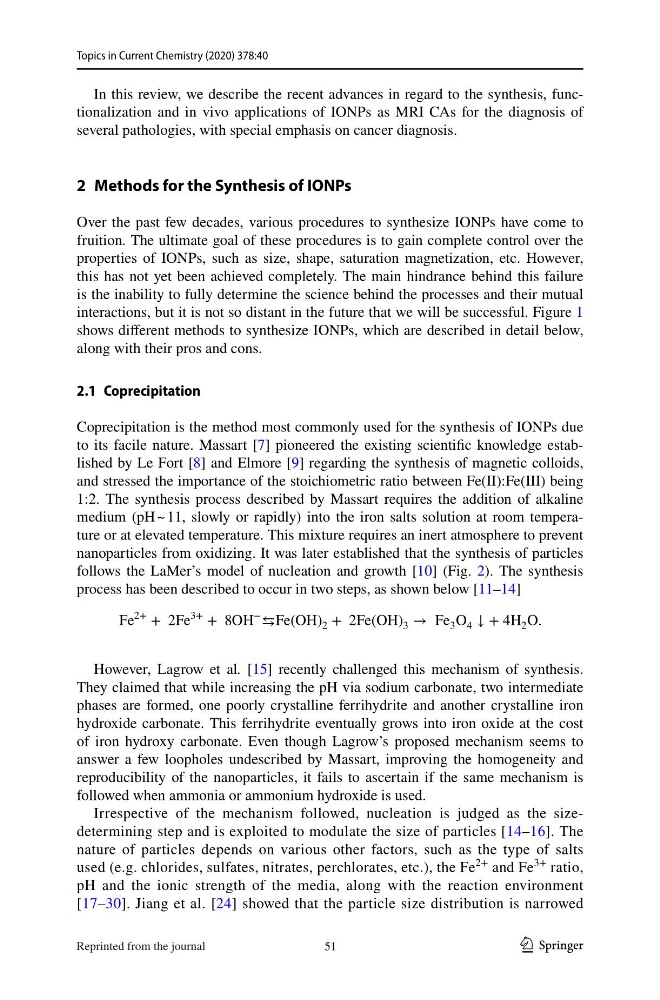
process has been described to occur in two steps, as shown below [11–14]
However, Lagrow et al. [15] recently challenged this mechanism of synthesis.
They claimed that while increasing the pH via sodium carbonate, two intermediate
phases are formed, one poorly crystalline ferrihydrite and another crystalline iron
hydroxide carbonate. This ferrihydrite eventually grows into iron oxide at the cost
of iron hydroxy carbonate. Even though Lagrow’s proposed mechanism seems to
answer a few loopholes undescribed by Massart, improving the homogeneity and
reproducibility of the nanoparticles, it fails to ascertain if the same mechanism is
followed when ammonia or ammonium hydroxide is used.
Irrespective of the mechanism followed, nucleation is judged as the sizedetermining step and is exploited to modulate the size of particles [14–16]. The
nature of particles depends on various other factors, such as the type of salts
used (e.g. chlorides, sulfates, nitrates, perchlorates, etc.), the Fe
2+
and Fe
3+
ratio,
pH and the ionic strength of the media, along with the reaction environment
[17–30]. Jiang et al. [24] showed that the particle size distribution is narrowed
Fe
2+ + 2Fe
3+ + 8OH
− ⇆Fe(OH) 2 + 2Fe(OH) 3 → Fe 3 O 4 ↓ + 4H 2 O.
51
Reprinted from the journal
Topics in Current Chemistry (2020) 378:40
In this review, we describe the recent advances in regard to the synthesis, functionalization and in vivo applications of IONPs as MRI CAs for the diagnosis of
several pathologies, with special emphasis on cancer diagnosis.
2 Methods for the Synthesis of IONPs
Over the past few decades, various procedures to synthesize IONPs have come to
fruition. The ultimate goal of these procedures is to gain complete control over the
properties of IONPs, such as size, shape, saturation magnetization, etc. However,
this has not yet been achieved completely. The main hindrance behind this failure
is the inability to fully determine the science behind the processes and their mutual
interactions, but it is not so distant in the future that we will be successful. Figure 1
shows different methods to synthesize IONPs, which are described in detail below,
along with their pros and cons.
2.1 Coprecipitation
Coprecipitation is the method most commonly used for the synthesis of IONPs due
to its facile nature. Massart [7] pioneered the existing scientific knowledge established by Le Fort [8] and Elmore [9] regarding the synthesis of magnetic colloids,
and stressed the importance of the stoichiometric ratio between Fe(II):Fe(III) being
1:2. The synthesis process described by Massart requires the addition of alkaline
medium (pH ~ 11, slowly or rapidly) into the iron salts solution at room temperature or at elevated temperature. This mixture requires an inert atmosphere to prevent
nanoparticles from oxidizing. It was later established that the synthesis of particles
follows the LaMer’s model of nucleation and growth [10] (Fig. 2). The synthesis
process has been described to occur in two steps, as shown below [11–14]
However, Lagrow et al. [15] recently challenged this mechanism of synthesis.
They claimed that while increasing the pH via sodium carbonate, two intermediate
phases are formed, one poorly crystalline ferrihydrite and another crystalline iron
hydroxide carbonate. This ferrihydrite eventually grows into iron oxide at the cost
of iron hydroxy carbonate. Even though Lagrow’s proposed mechanism seems to
answer a few loopholes undescribed by Massart, improving the homogeneity and
reproducibility of the nanoparticles, it fails to ascertain if the same mechanism is
followed when ammonia or ammonium hydroxide is used.
Irrespective of the mechanism followed, nucleation is judged as the sizedetermining step and is exploited to modulate the size of particles [14–16]. The
nature of particles depends on various other factors, such as the type of salts
used (e.g. chlorides, sulfates, nitrates, perchlorates, etc.), the Fe
2+
and Fe
3+
ratio,
pH and the ionic strength of the media, along with the reaction environment
[17–30]. Jiang et al. [24] showed that the particle size distribution is narrowed
Fe
2+ + 2Fe
3+ + 8OH
− ⇆Fe(OH) 2 + 2Fe(OH) 3 → Fe 3 O 4 ↓ + 4H 2 O.
51
Reprinted from the journal