

1 3
Topics in Current Chemistry (2020) 378:13
and consequently affect the sensitivity and specificity of the analysis. In this regard,
molecular recognition involves specific noncovalent phenomena, such as hydrogen
bonding, van der Waals, and hydrophobic forces, coordination to metals ions, π–π
stacking, electrostatic or magnetic interactions, among others. These interactions
play an important role in biological systems, as well as in the designing of biosensors for the early diagnosis of diseases and for therapeutic treatments by coupling
with MNPs. For example, the double helix structure of DNA is found to be very
stable due to some of these forces; specifically the Watson–Crick type of hydrogen
bonds (guanine–cytosine and adenine–thymine). This type of interaction allows the
development of specific nucleic acid probes, such as aptamers, for the molecular
recognition of a wide range of targets comprising small molecules, proteins, and
cells [26, 42, 90].
The development of new approaches for the selective detection of nucleic acids
is currently one of the main challenges of the scientific community. Given the DNA
sequence mismatches and structural folding of ssODN, strategies need to be developed that allow the detection of trace levels of specific sequences. The molecular
recognition capacity of systems using ssODNs is a very sensitive and very specific
compared with traditional recognition systems.
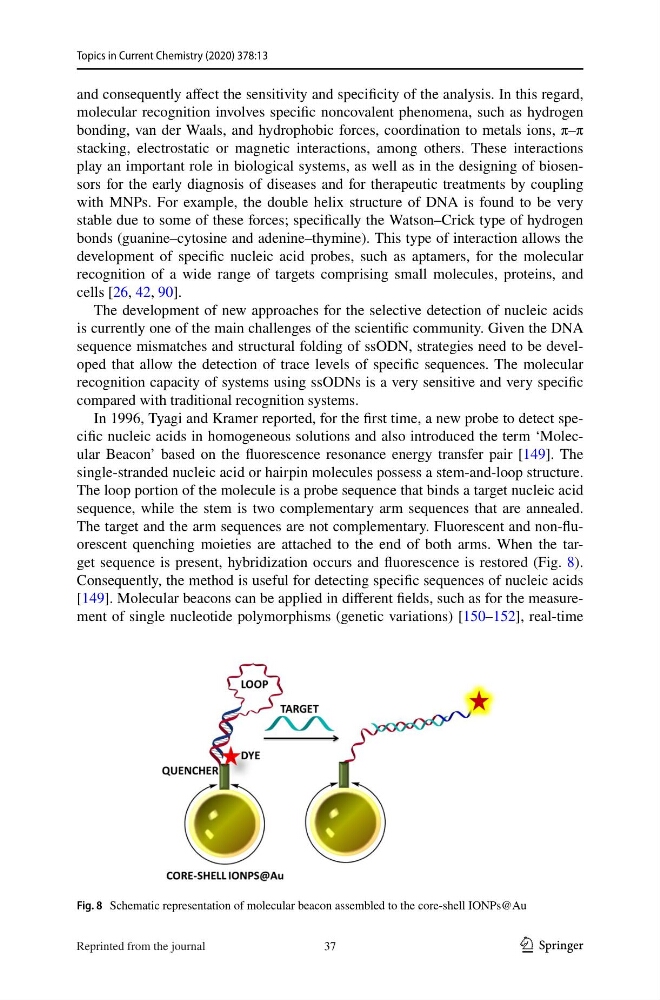
In 1996, Tyagi and Kramer reported, for the first time, a new probe to detect specific nucleic acids in homogeneous solutions and also introduced the term ‘Molecular Beacon’ based on the fluorescence resonance energy transfer pair [149]. The
single-stranded nucleic acid or hairpin molecules possess a stem-and-loop structure.
The loop portion of the molecule is a probe sequence that binds a target nucleic acid
sequence, while the stem is two complementary arm sequences that are annealed.
The target and the arm sequences are not complementary. Fluorescent and non-fluorescent quenching moieties are attached to the end of both arms. When the target sequence is present, hybridization occurs and fluorescence is restored (Fig. 8).
Consequently, the method is useful for detecting specific sequences of nucleic acids
[149]. Molecular beacons can be applied in different fields, such as for the measurement of single nucleotide polymorphisms (genetic variations) [150–152], real-time
Fig. 8 Schematic representation of molecular beacon assembled to the core-shell IONPs@Au
37
Reprinted from the journal
Topics in Current Chemistry (2020) 378:13
and consequently affect the sensitivity and specificity of the analysis. In this regard,
molecular recognition involves specific noncovalent phenomena, such as hydrogen
bonding, van der Waals, and hydrophobic forces, coordination to metals ions, π–π
stacking, electrostatic or magnetic interactions, among others. These interactions
play an important role in biological systems, as well as in the designing of biosensors for the early diagnosis of diseases and for therapeutic treatments by coupling
with MNPs. For example, the double helix structure of DNA is found to be very
stable due to some of these forces; specifically the Watson–Crick type of hydrogen
bonds (guanine–cytosine and adenine–thymine). This type of interaction allows the
development of specific nucleic acid probes, such as aptamers, for the molecular
recognition of a wide range of targets comprising small molecules, proteins, and
cells [26, 42, 90].
The development of new approaches for the selective detection of nucleic acids
is currently one of the main challenges of the scientific community. Given the DNA
sequence mismatches and structural folding of ssODN, strategies need to be developed that allow the detection of trace levels of specific sequences. The molecular
recognition capacity of systems using ssODNs is a very sensitive and very specific
compared with traditional recognition systems.
In 1996, Tyagi and Kramer reported, for the first time, a new probe to detect specific nucleic acids in homogeneous solutions and also introduced the term ‘Molecular Beacon’ based on the fluorescence resonance energy transfer pair [149]. The
single-stranded nucleic acid or hairpin molecules possess a stem-and-loop structure.
The loop portion of the molecule is a probe sequence that binds a target nucleic acid
sequence, while the stem is two complementary arm sequences that are annealed.
The target and the arm sequences are not complementary. Fluorescent and non-fluorescent quenching moieties are attached to the end of both arms. When the target sequence is present, hybridization occurs and fluorescence is restored (Fig. 8).
Consequently, the method is useful for detecting specific sequences of nucleic acids
[149]. Molecular beacons can be applied in different fields, such as for the measurement of single nucleotide polymorphisms (genetic variations) [150–152], real-time
Fig. 8 Schematic representation of molecular beacon assembled to the core-shell IONPs@Au
37
Reprinted from the journal