

Topics in Current Chemistry (2020) 378:13
1 3
Non-viral vector platforms or carriers should fulfill four important requirements: (1) capability to complex nucleic acids and protect them against nuclease enzymes at the extracellular compartment; (2) a positive net electric surface
charge at physiological pH to overcome the negative potential of the cell membrane, since otherwise the cell membrane hinders the incorporation of negatively
charged phosphate-containing DNA; (3) a mechanism to protect DNA from the
acidic environment inside endosomes; and (4) chemical stability to maintain the
integrity until the nucleus is reached [132].
Magnetofection techniques have been introduced in an attempt to fulfill these
four important requirements and address the transient damage caused by the
invasive methods mentioned above (i.e., microinjection, electroporation, among
others). Magnetofection techniques are excellent alternative procedures that can
significantly reduce the transfection time from several hours to < 60 min [28,
30, 132]. The association of superparamagnetic nanoparticles with gene vectors
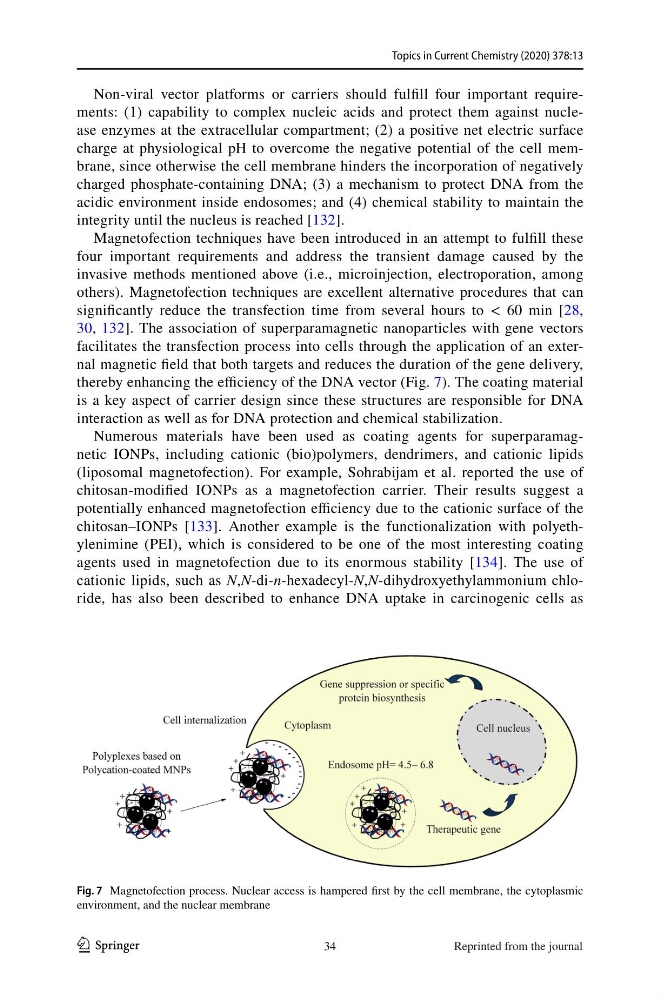
facilitates the transfection process into cells through the application of an external magnetic field that both targets and reduces the duration of the gene delivery,
thereby enhancing the efficiency of the DNA vector (Fig. 7). The coating material
is a key aspect of carrier design since these structures are responsible for DNA
interaction as well as for DNA protection and chemical stabilization.
Numerous materials have been used as coating agents for superparamagnetic IONPs, including cationic (bio)polymers, dendrimers, and cationic lipids
(liposomal magnetofection). For example, Sohrabijam et al. reported the use of
chitosan-modified IONPs as a magnetofection carrier. Their results suggest a
potentially enhanced magnetofection efficiency due to the cationic surface of the
chitosan–IONPs [133]. Another example is the functionalization with polyethylenimine (PEI), which is considered to be one of the most interesting coating
agents used in magnetofection due to its enormous stability [134]. The use of
cationic lipids, such as N,N-di-n-hexadecyl-N,N-dihydroxyethylammonium chloride, has also been described to enhance DNA uptake in carcinogenic cells as
Fig. 7 Magnetofection process. Nuclear access is hampered first by the cell membrane, the cytoplasmic
environment, and the nuclear membrane
34
Reprinted from the journal
1 3
Non-viral vector platforms or carriers should fulfill four important requirements: (1) capability to complex nucleic acids and protect them against nuclease enzymes at the extracellular compartment; (2) a positive net electric surface
charge at physiological pH to overcome the negative potential of the cell membrane, since otherwise the cell membrane hinders the incorporation of negatively
charged phosphate-containing DNA; (3) a mechanism to protect DNA from the
acidic environment inside endosomes; and (4) chemical stability to maintain the
integrity until the nucleus is reached [132].
Magnetofection techniques have been introduced in an attempt to fulfill these
four important requirements and address the transient damage caused by the
invasive methods mentioned above (i.e., microinjection, electroporation, among
others). Magnetofection techniques are excellent alternative procedures that can
significantly reduce the transfection time from several hours to < 60 min [28,
30, 132]. The association of superparamagnetic nanoparticles with gene vectors
facilitates the transfection process into cells through the application of an external magnetic field that both targets and reduces the duration of the gene delivery,
thereby enhancing the efficiency of the DNA vector (Fig. 7). The coating material
is a key aspect of carrier design since these structures are responsible for DNA
interaction as well as for DNA protection and chemical stabilization.
Numerous materials have been used as coating agents for superparamagnetic IONPs, including cationic (bio)polymers, dendrimers, and cationic lipids
(liposomal magnetofection). For example, Sohrabijam et al. reported the use of
chitosan-modified IONPs as a magnetofection carrier. Their results suggest a
potentially enhanced magnetofection efficiency due to the cationic surface of the
chitosan–IONPs [133]. Another example is the functionalization with polyethylenimine (PEI), which is considered to be one of the most interesting coating
agents used in magnetofection due to its enormous stability [134]. The use of
cationic lipids, such as N,N-di-n-hexadecyl-N,N-dihydroxyethylammonium chloride, has also been described to enhance DNA uptake in carcinogenic cells as
Fig. 7 Magnetofection process. Nuclear access is hampered first by the cell membrane, the cytoplasmic
environment, and the nuclear membrane
34
Reprinted from the journal