

Topics in Current Chemistry (2020) 378:13
1 3
negatively charged DNA backbone towards the positively charged interface. Sodium
also plays a role as a cation bridge that attracts the negatively charged oxygen in the
phosphate backbone of nucleic acids. As a chaotropic agent, sodium cations at high
concentrations also promote the disruption of ordered water molecules along the
DNA [119]. Since the nucleic acid is tightly bound, washings remove all contamination, and the purified DNA molecules can subsequently be eluted under low ionic
strength using TE buffer or distilled water. In all of these cases no centrifugation
steps are necessary due to the magnetic properties of the nanoparticle cores, and this
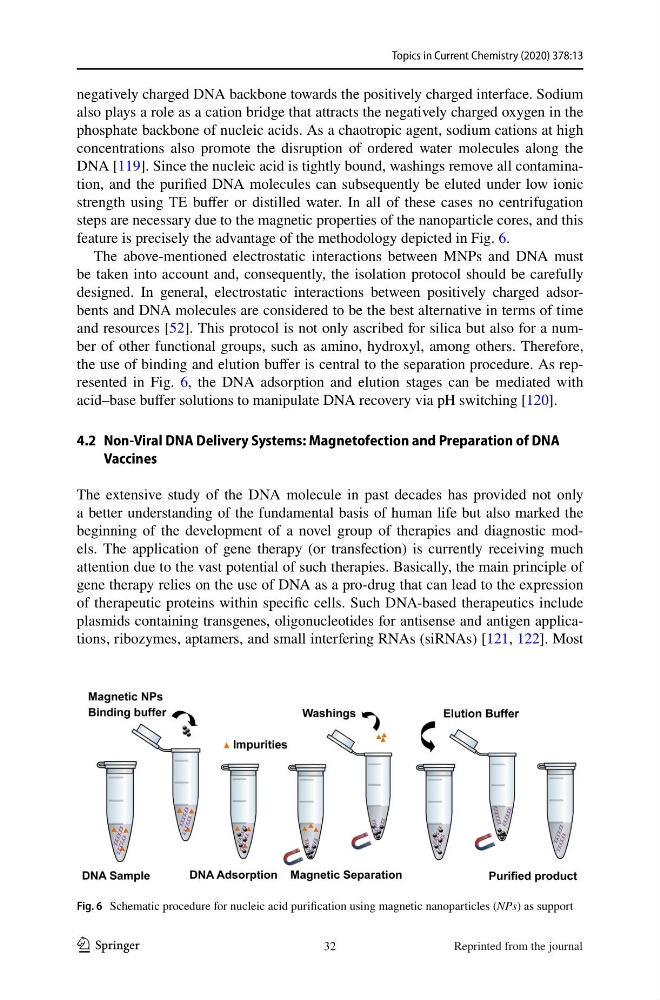
feature is precisely the advantage of the methodology depicted in Fig. 6.
The above-mentioned electrostatic interactions between MNPs and DNA must
be taken into account and, consequently, the isolation protocol should be carefully
designed. In general, electrostatic interactions between positively charged adsorbents and DNA molecules are considered to be the best alternative in terms of time
and resources [52]. This protocol is not only ascribed for silica but also for a number of other functional groups, such as amino, hydroxyl, among others. Therefore,
the use of binding and elution buffer is central to the separation procedure. As represented in Fig. 6, the DNA adsorption and elution stages can be mediated with
acid–base buffer solutions to manipulate DNA recovery via pH switching [120].
4.2 Non‑Viral DNA Delivery Systems: Magnetofection and Preparation of DNA
Vaccines
The extensive study of the DNA molecule in past decades has provided not only
a better understanding of the fundamental basis of human life but also marked the
beginning of the development of a novel group of therapies and diagnostic models. The application of gene therapy (or transfection) is currently receiving much
attention due to the vast potential of such therapies. Basically, the main principle of
gene therapy relies on the use of DNA as a pro-drug that can lead to the expression
of therapeutic proteins within specific cells. Such DNA-based therapeutics include
plasmids containing transgenes, oligonucleotides for antisense and antigen applications, ribozymes, aptamers, and small interfering RNAs (siRNAs) [121, 122]. Most
Fig. 6 Schematic procedure for nucleic acid purification using magnetic nanoparticles (NPs) as support
32
Reprinted from the journal
1 3
negatively charged DNA backbone towards the positively charged interface. Sodium
also plays a role as a cation bridge that attracts the negatively charged oxygen in the
phosphate backbone of nucleic acids. As a chaotropic agent, sodium cations at high
concentrations also promote the disruption of ordered water molecules along the
DNA [119]. Since the nucleic acid is tightly bound, washings remove all contamination, and the purified DNA molecules can subsequently be eluted under low ionic
strength using TE buffer or distilled water. In all of these cases no centrifugation
steps are necessary due to the magnetic properties of the nanoparticle cores, and this
feature is precisely the advantage of the methodology depicted in Fig. 6.
The above-mentioned electrostatic interactions between MNPs and DNA must
be taken into account and, consequently, the isolation protocol should be carefully
designed. In general, electrostatic interactions between positively charged adsorbents and DNA molecules are considered to be the best alternative in terms of time
and resources [52]. This protocol is not only ascribed for silica but also for a number of other functional groups, such as amino, hydroxyl, among others. Therefore,
the use of binding and elution buffer is central to the separation procedure. As represented in Fig. 6, the DNA adsorption and elution stages can be mediated with
acid–base buffer solutions to manipulate DNA recovery via pH switching [120].
4.2 Non‑Viral DNA Delivery Systems: Magnetofection and Preparation of DNA
Vaccines
The extensive study of the DNA molecule in past decades has provided not only
a better understanding of the fundamental basis of human life but also marked the
beginning of the development of a novel group of therapies and diagnostic models. The application of gene therapy (or transfection) is currently receiving much
attention due to the vast potential of such therapies. Basically, the main principle of
gene therapy relies on the use of DNA as a pro-drug that can lead to the expression
of therapeutic proteins within specific cells. Such DNA-based therapeutics include
plasmids containing transgenes, oligonucleotides for antisense and antigen applications, ribozymes, aptamers, and small interfering RNAs (siRNAs) [121, 122]. Most
Fig. 6 Schematic procedure for nucleic acid purification using magnetic nanoparticles (NPs) as support
32
Reprinted from the journal