

1 3
mononuclear iron porphyrins adsorbed onto graphite surfaces have been employed
successfully as catalysts for the mentioned reaction through a 4H
+
/4e
−
pathway.
Immobilization of iron porphyrin catalysts onto edge plane graphite shifts the potential of FeIII/II redox couple to more positive values than those observed in homogeneous solutions, and, therefore, results in lower ORR overpotentials, in comparison
to the homogeneous cases [70–73].
Furthermore, cobalt-porphyrin based catalysts have also been widely recognized
as efficient electrocatalysts for oxygen electroreduction reactions. Nonetheless, such
systems possess disadvantages related to the poor selectivity towards H 2 O, obtaining
predominantly H 2 O 2 . In turn, Co-porphine immobilized onto edge plane graphite
surface have shown 4e
−
reduction of O 2 under air-saturated 1 M HClO 4 solution
[74].
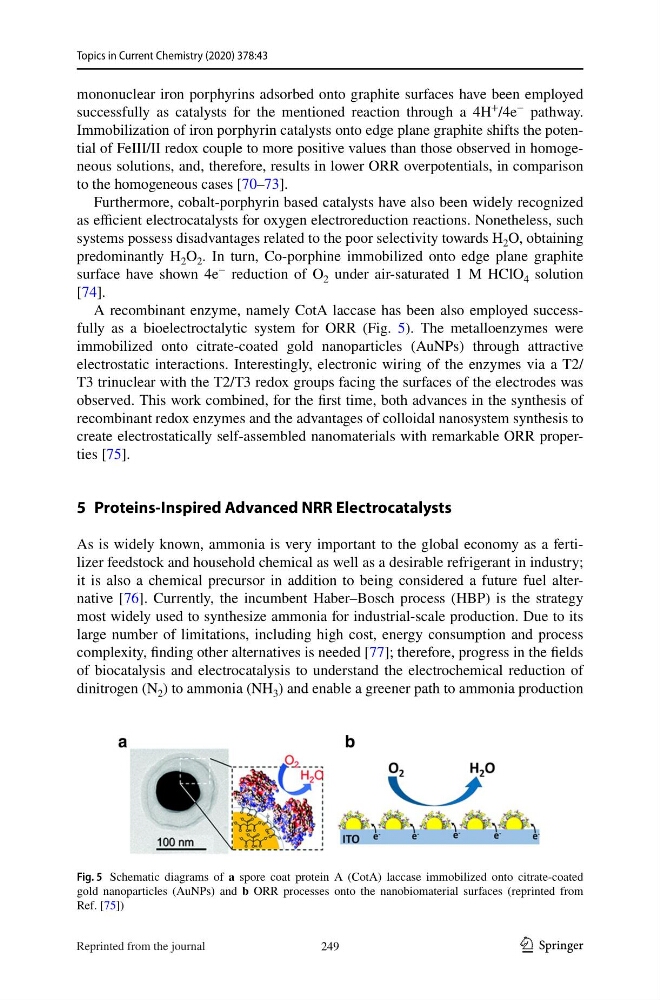
A recombinant enzyme, namely CotA laccase has been also employed successfully as a bioelectroctalytic system for ORR (Fig. 5). The metalloenzymes were
immobilized onto citrate-coated gold nanoparticles (AuNPs) through attractive
electrostatic interactions. Interestingly, electronic wiring of the enzymes via a T2/
T3 trinuclear with the T2/T3 redox groups facing the surfaces of the electrodes was
observed. This work combined, for the first time, both advances in the synthesis of
recombinant redox enzymes and the advantages of colloidal nanosystem synthesis to
create electrostatically self-assembled nanomaterials with remarkable ORR properties [75].
5 Proteins‑Inspired Advanced NRR Electrocatalysts
As is widely known, ammonia is very important to the global economy as a fertilizer feedstock and household chemical as well as a desirable refrigerant in industry;
it is also a chemical precursor in addition to being considered a future fuel alternative [76]. Currently, the incumbent Haber–Bosch process (HBP) is the strategy
most widely used to synthesize ammonia for industrial-scale production. Due to its
large number of limitations, including high cost, energy consumption and process
complexity, finding other alternatives is needed [77]; therefore, progress in the fields
of biocatalysis and electrocatalysis to understand the electrochemical reduction of
dinitrogen (N 2 ) to ammonia (NH 3 ) and enable a greener path to ammonia production
Fig. 5 Schematic diagrams of a spore coat protein A (CotA) laccase immobilized onto citrate-coated
gold nanoparticles (AuNPs) and b ORR processes onto the nanobiomaterial surfaces (reprinted from
Ref. [75])
249
Reprinted from the journal
Topics in Current Chemistry (2020) 378:43
mononuclear iron porphyrins adsorbed onto graphite surfaces have been employed
successfully as catalysts for the mentioned reaction through a 4H
+
/4e
−
pathway.
Immobilization of iron porphyrin catalysts onto edge plane graphite shifts the potential of FeIII/II redox couple to more positive values than those observed in homogeneous solutions, and, therefore, results in lower ORR overpotentials, in comparison
to the homogeneous cases [70–73].
Furthermore, cobalt-porphyrin based catalysts have also been widely recognized
as efficient electrocatalysts for oxygen electroreduction reactions. Nonetheless, such
systems possess disadvantages related to the poor selectivity towards H 2 O, obtaining
predominantly H 2 O 2 . In turn, Co-porphine immobilized onto edge plane graphite
surface have shown 4e
−
reduction of O 2 under air-saturated 1 M HClO 4 solution
[74].
A recombinant enzyme, namely CotA laccase has been also employed successfully as a bioelectroctalytic system for ORR (Fig. 5). The metalloenzymes were
immobilized onto citrate-coated gold nanoparticles (AuNPs) through attractive
electrostatic interactions. Interestingly, electronic wiring of the enzymes via a T2/
T3 trinuclear with the T2/T3 redox groups facing the surfaces of the electrodes was
observed. This work combined, for the first time, both advances in the synthesis of
recombinant redox enzymes and the advantages of colloidal nanosystem synthesis to
create electrostatically self-assembled nanomaterials with remarkable ORR properties [75].
5 Proteins‑Inspired Advanced NRR Electrocatalysts
As is widely known, ammonia is very important to the global economy as a fertilizer feedstock and household chemical as well as a desirable refrigerant in industry;
it is also a chemical precursor in addition to being considered a future fuel alternative [76]. Currently, the incumbent Haber–Bosch process (HBP) is the strategy
most widely used to synthesize ammonia for industrial-scale production. Due to its
large number of limitations, including high cost, energy consumption and process
complexity, finding other alternatives is needed [77]; therefore, progress in the fields
of biocatalysis and electrocatalysis to understand the electrochemical reduction of
dinitrogen (N 2 ) to ammonia (NH 3 ) and enable a greener path to ammonia production
Fig. 5 Schematic diagrams of a spore coat protein A (CotA) laccase immobilized onto citrate-coated
gold nanoparticles (AuNPs) and b ORR processes onto the nanobiomaterial surfaces (reprinted from
Ref. [75])
249
Reprinted from the journal
Topics in Current Chemistry (2020) 378:43