

1 3
(0.86 V). Also, the reduction reaction followed the four-electron transfer ORR
mechanism including the direct reduction pathway. The authors suggested that the
graphitic-nitrogen species that are mostly responsible for the ORR performance can
also function as an active center for the ORR reaction, whereas the pyrrolic-nitrogen
species can behave as an active promoter for ORR only.
Nature offers many biological materials such as proteins, enzymes, etc. that
contain histidines, which could be utilized as a natural source of “pyridine-like”
nitrogen species offering catalytically active sites for ORR. Among such proteins,
hemoglobin (Hb) is a tetrameric redox protein comprised of four polypeptide chains
wherein each polypeptide chain encircles at least one active iron redox center.
Puente-Santiago et al. [6] reported an unprecedented bottom-up method to prepare a
high-performance bioelectrocatalytic system for ORR from the covalent anchorage
of Hb to fructose-modified graphene oxide nanoplatforms via the glycosylation reaction mechanism. The resulting nanobiomaterials were prepared at room temperature
(GO-Fruc@Hb-RT) as well as at 80 °C (GO-Fruc@Hb-HT) to gain information on
the structural characteristics of the redox enzymes in the prepared nanomaterials as
well as their electrocatalytic activity toward ORR reactions. Electrocatalytic experiments revealed that the measured onset potentials for both three-component nanocomposites moved to more positive values than their individual parts, demonstrating
their higher electrocatalytic activities. Furthermore, the limiting current density was
also increased for both nanocomposites, with the best electrocatalytic activity for
the nanocomposite being synthesized at a higher temperature because the number
of pyridinic nitrogen species is increased at higher temperature due to the additional
conformational changes.
Additionally, a few examples in the literature have addressed the fabrication of
protein-based nanosystems as high-performance HER catalysts. One outstanding strategy is the synthesis of engineered biocatalysts for H 2 evolution. In this
sense, Bren and coworkers [58] have elegantly synthesized a synthetic protein
named cobalt mimochrome VI*, which is able to remarkably catalyze the hydrogen
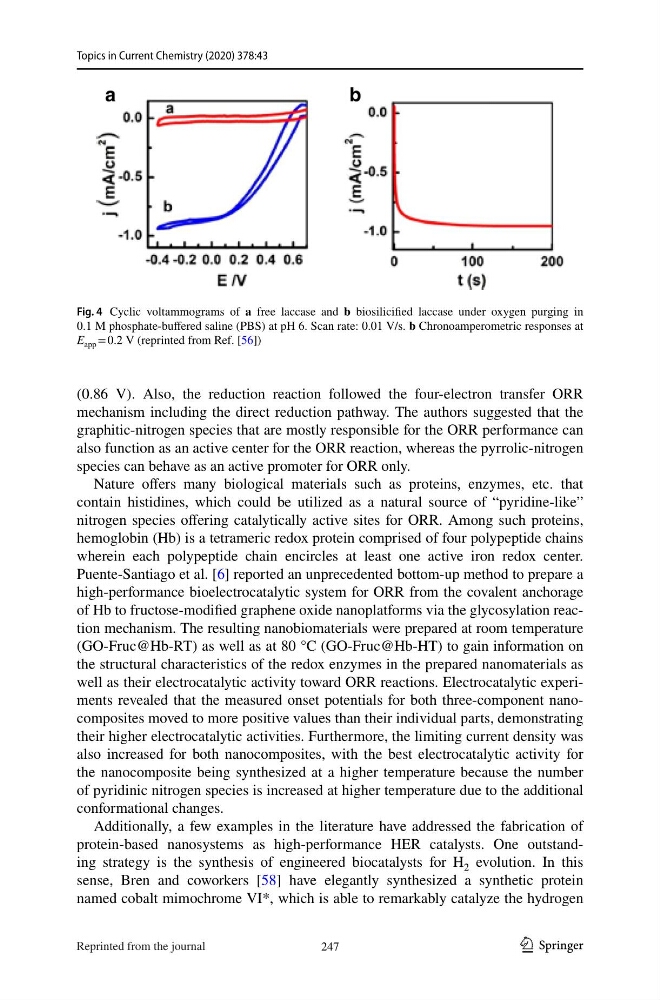
Fig. 4 Cyclic voltammograms of a free laccase and b biosilicified laccase under oxygen purging in
0.1 M phosphate-buffered saline (PBS) at pH 6. Scan rate: 0.01 V/s. b Chronoamperometric responses at
E app = 0.2 V (reprinted from Ref. [56])
247
Reprinted from the journal
Topics in Current Chemistry (2020) 378:43
(0.86 V). Also, the reduction reaction followed the four-electron transfer ORR
mechanism including the direct reduction pathway. The authors suggested that the
graphitic-nitrogen species that are mostly responsible for the ORR performance can
also function as an active center for the ORR reaction, whereas the pyrrolic-nitrogen
species can behave as an active promoter for ORR only.
Nature offers many biological materials such as proteins, enzymes, etc. that
contain histidines, which could be utilized as a natural source of “pyridine-like”
nitrogen species offering catalytically active sites for ORR. Among such proteins,
hemoglobin (Hb) is a tetrameric redox protein comprised of four polypeptide chains
wherein each polypeptide chain encircles at least one active iron redox center.
Puente-Santiago et al. [6] reported an unprecedented bottom-up method to prepare a
high-performance bioelectrocatalytic system for ORR from the covalent anchorage
of Hb to fructose-modified graphene oxide nanoplatforms via the glycosylation reaction mechanism. The resulting nanobiomaterials were prepared at room temperature
(GO-Fruc@Hb-RT) as well as at 80 °C (GO-Fruc@Hb-HT) to gain information on
the structural characteristics of the redox enzymes in the prepared nanomaterials as
well as their electrocatalytic activity toward ORR reactions. Electrocatalytic experiments revealed that the measured onset potentials for both three-component nanocomposites moved to more positive values than their individual parts, demonstrating
their higher electrocatalytic activities. Furthermore, the limiting current density was
also increased for both nanocomposites, with the best electrocatalytic activity for
the nanocomposite being synthesized at a higher temperature because the number
of pyridinic nitrogen species is increased at higher temperature due to the additional
conformational changes.
Additionally, a few examples in the literature have addressed the fabrication of
protein-based nanosystems as high-performance HER catalysts. One outstanding strategy is the synthesis of engineered biocatalysts for H 2 evolution. In this
sense, Bren and coworkers [58] have elegantly synthesized a synthetic protein
named cobalt mimochrome VI*, which is able to remarkably catalyze the hydrogen
Fig. 4 Cyclic voltammograms of a free laccase and b biosilicified laccase under oxygen purging in
0.1 M phosphate-buffered saline (PBS) at pH 6. Scan rate: 0.01 V/s. b Chronoamperometric responses at
E app = 0.2 V (reprinted from Ref. [56])
247
Reprinted from the journal
Topics in Current Chemistry (2020) 378:43