

1 3
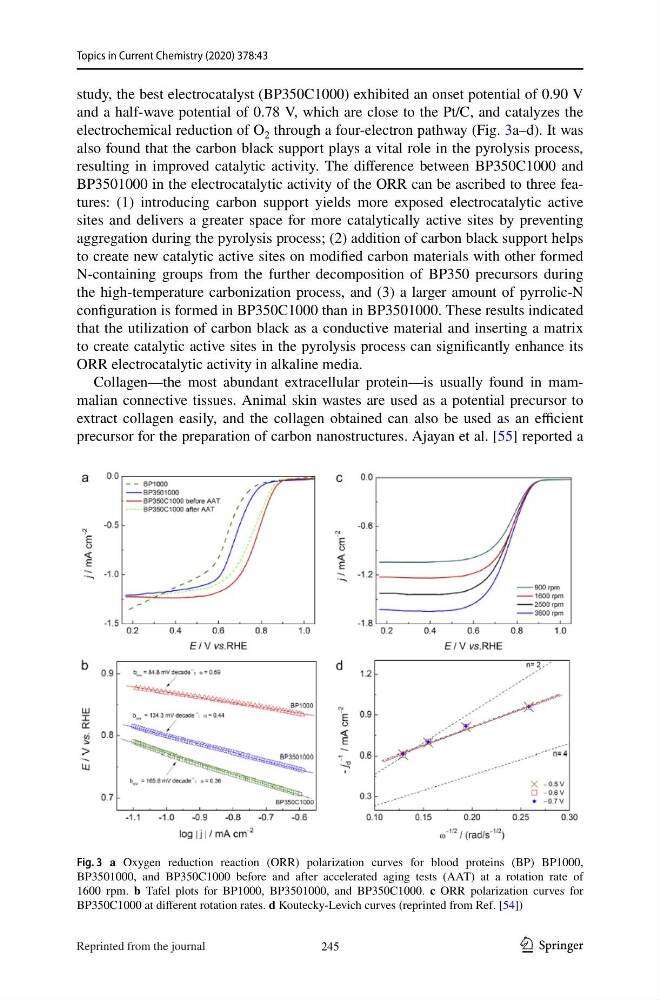
study, the best electrocatalyst (BP350C1000) exhibited an onset potential of 0.90 V
and a half-wave potential of 0.78 V, which are close to the Pt/C, and catalyzes the
electrochemical reduction of O 2 through a four-electron pathway (Fig. 3a–d). It was
also found that the carbon black support plays a vital role in the pyrolysis process,
resulting in improved catalytic activity. The difference between BP350C1000 and
BP3501000 in the electrocatalytic activity of the ORR can be ascribed to three features: (1) introducing carbon support yields more exposed electrocatalytic active
sites and delivers a greater space for more catalytically active sites by preventing
aggregation during the pyrolysis process; (2) addition of carbon black support helps
to create new catalytic active sites on modified carbon materials with other formed
N-containing groups from the further decomposition of BP350 precursors during
the high-temperature carbonization process, and (3) a larger amount of pyrrolic-N
configuration is formed in BP350C1000 than in BP3501000. These results indicated
that the utilization of carbon black as a conductive material and inserting a matrix
to create catalytic active sites in the pyrolysis process can significantly enhance its
ORR electrocatalytic activity in alkaline media.
Collagen—the most abundant extracellular protein—is usually found in mammalian connective tissues. Animal skin wastes are used as a potential precursor to
extract collagen easily, and the collagen obtained can also be used as an efficient
precursor for the preparation of carbon nanostructures. Ajayan et al. [55] reported a
Fig. 3 a Oxygen reduction reaction (ORR) polarization curves for blood proteins (BP) BP1000,
BP3501000, and BP350C1000 before and after accelerated aging tests (AAT) at a rotation rate of
1600 rpm. b Tafel plots for BP1000, BP3501000, and BP350C1000. c ORR polarization curves for
BP350C1000 at different rotation rates. d Koutecky-Levich curves (reprinted from Ref. [54])
245
Reprinted from the journal
Topics in Current Chemistry (2020) 378:43
study, the best electrocatalyst (BP350C1000) exhibited an onset potential of 0.90 V
and a half-wave potential of 0.78 V, which are close to the Pt/C, and catalyzes the
electrochemical reduction of O 2 through a four-electron pathway (Fig. 3a–d). It was
also found that the carbon black support plays a vital role in the pyrolysis process,
resulting in improved catalytic activity. The difference between BP350C1000 and
BP3501000 in the electrocatalytic activity of the ORR can be ascribed to three features: (1) introducing carbon support yields more exposed electrocatalytic active
sites and delivers a greater space for more catalytically active sites by preventing
aggregation during the pyrolysis process; (2) addition of carbon black support helps
to create new catalytic active sites on modified carbon materials with other formed
N-containing groups from the further decomposition of BP350 precursors during
the high-temperature carbonization process, and (3) a larger amount of pyrrolic-N
configuration is formed in BP350C1000 than in BP3501000. These results indicated
that the utilization of carbon black as a conductive material and inserting a matrix
to create catalytic active sites in the pyrolysis process can significantly enhance its
ORR electrocatalytic activity in alkaline media.
Collagen—the most abundant extracellular protein—is usually found in mammalian connective tissues. Animal skin wastes are used as a potential precursor to
extract collagen easily, and the collagen obtained can also be used as an efficient
precursor for the preparation of carbon nanostructures. Ajayan et al. [55] reported a
Fig. 3 a Oxygen reduction reaction (ORR) polarization curves for blood proteins (BP) BP1000,
BP3501000, and BP350C1000 before and after accelerated aging tests (AAT) at a rotation rate of
1600 rpm. b Tafel plots for BP1000, BP3501000, and BP350C1000. c ORR polarization curves for
BP350C1000 at different rotation rates. d Koutecky-Levich curves (reprinted from Ref. [54])
245
Reprinted from the journal
Topics in Current Chemistry (2020) 378:43