

1 3
carbon monoxide dehydrogenase enzymes present in anaerobic organisms contain
a group (NiFe-4 S) that catalyzes the interconversion of CO 2 and CO [41]. The
enzyme formate dehydrogenase, with active sites of pyranopterin molybdenum/
tungsten, can catalyze the interconversion of CO 2 and formate [45]. In particular,
formate has attracted much interest as an energy source, since it is easier to store and
transport than hydrogen.
Using a bio-synthetic approach, many scientists have developed models to mimic
metalloenzymes such as hydrogenases and nitric oxide reductase, among others
[46–48]. Although the catalytic efficiencies obtained for these artificial systems are
still low in comparison with natural systems, such strategies are very promising and
have great potential for the future.
3 Influence of Protein Conformational Variations
on the Electrocatalytic Activity
The structure–function relationship of protein-based nanocatalysts has been investigated thoroughly in order to gain insights into the rules that govern the bioelectrocatalytic process at the molecular scale. The understanding of bioelectrocatalytic
mechanisms at a structural level constitutes vital knowledge towards the design of
enzyme-based nanomaterials as potential electrocatalysts for bioenergy applications.
Nevertheless, although the catalytic activity of various redox proteins has been studied widely and linked with their structural properties, the influence of structural
modifications to the protein architecture on the bioelectrocatalytic properties of protein-based nanosystems have been scarcely reported.
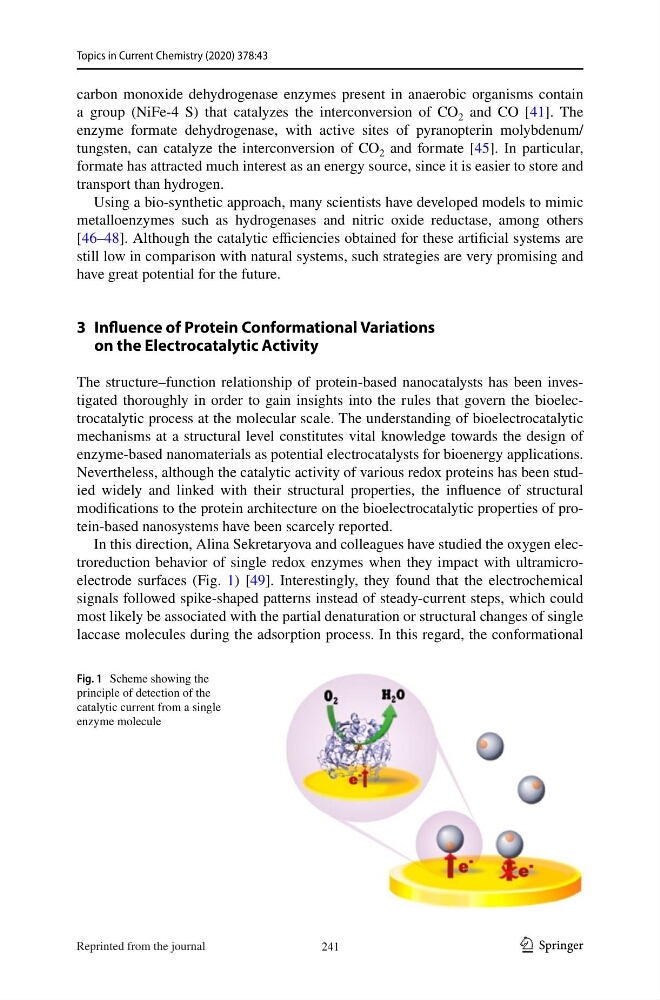
In this direction, Alina Sekretaryova and colleagues have studied the oxygen electroreduction behavior of single redox enzymes when they impact with ultramicroelectrode surfaces (Fig. 1) [49]. Interestingly, they found that the electrochemical
signals followed spike-shaped patterns instead of steady-current steps, which could
most likely be associated with the partial denaturation or structural changes of single
laccase molecules during the adsorption process. In this regard, the conformational
Fig. 1 Scheme showing the
principle of detection of the
catalytic current from a single
enzyme molecule
241
Reprinted from the journal
Topics in Current Chemistry (2020) 378:43
carbon monoxide dehydrogenase enzymes present in anaerobic organisms contain
a group (NiFe-4 S) that catalyzes the interconversion of CO 2 and CO [41]. The
enzyme formate dehydrogenase, with active sites of pyranopterin molybdenum/
tungsten, can catalyze the interconversion of CO 2 and formate [45]. In particular,
formate has attracted much interest as an energy source, since it is easier to store and
transport than hydrogen.
Using a bio-synthetic approach, many scientists have developed models to mimic
metalloenzymes such as hydrogenases and nitric oxide reductase, among others
[46–48]. Although the catalytic efficiencies obtained for these artificial systems are
still low in comparison with natural systems, such strategies are very promising and
have great potential for the future.
3 Influence of Protein Conformational Variations
on the Electrocatalytic Activity
The structure–function relationship of protein-based nanocatalysts has been investigated thoroughly in order to gain insights into the rules that govern the bioelectrocatalytic process at the molecular scale. The understanding of bioelectrocatalytic
mechanisms at a structural level constitutes vital knowledge towards the design of
enzyme-based nanomaterials as potential electrocatalysts for bioenergy applications.
Nevertheless, although the catalytic activity of various redox proteins has been studied widely and linked with their structural properties, the influence of structural
modifications to the protein architecture on the bioelectrocatalytic properties of protein-based nanosystems have been scarcely reported.
In this direction, Alina Sekretaryova and colleagues have studied the oxygen electroreduction behavior of single redox enzymes when they impact with ultramicroelectrode surfaces (Fig. 1) [49]. Interestingly, they found that the electrochemical
signals followed spike-shaped patterns instead of steady-current steps, which could
most likely be associated with the partial denaturation or structural changes of single
laccase molecules during the adsorption process. In this regard, the conformational
Fig. 1 Scheme showing the
principle of detection of the
catalytic current from a single
enzyme molecule
241
Reprinted from the journal
Topics in Current Chemistry (2020) 378:43