

1 3
Topics in Current Chemistry (2020) 378:15
3 Characterization of Carbon Nanotubes
As stated before, all the production methods for carbon nanotubes generate nonhomogeneous material, varying in diameter, length, chirality, purity, etc. Thus,
adequate CNTs characterization is a fundamental step previous to the use of these
NPs in biomedicine. Parameters to be studied include thermal stability, homogeneity, conductivity, optical properties, and identification of the functional groups
in case of covalent modifications. Characterization is also key in determining the
metal traces from the synthesis, estimating carbonaceous impurities and studying structural defects in the sidewalls and tips. The main techniques for CNT
characterization include photoluminescence spectroscopy, X-ray photoelectron
spectroscopy, electron microscopy, scanning tunneling microscopy, X-ray diffraction, neutron diffraction, Raman spectroscopy, thermal analysis, absorption
spectroscopy, and infrared spectroscopy, among others [116]. It is important to
bear in mind that despite the wide range of techniques available, multiple characterization techniques must be used to obtain a complete description of a carbon
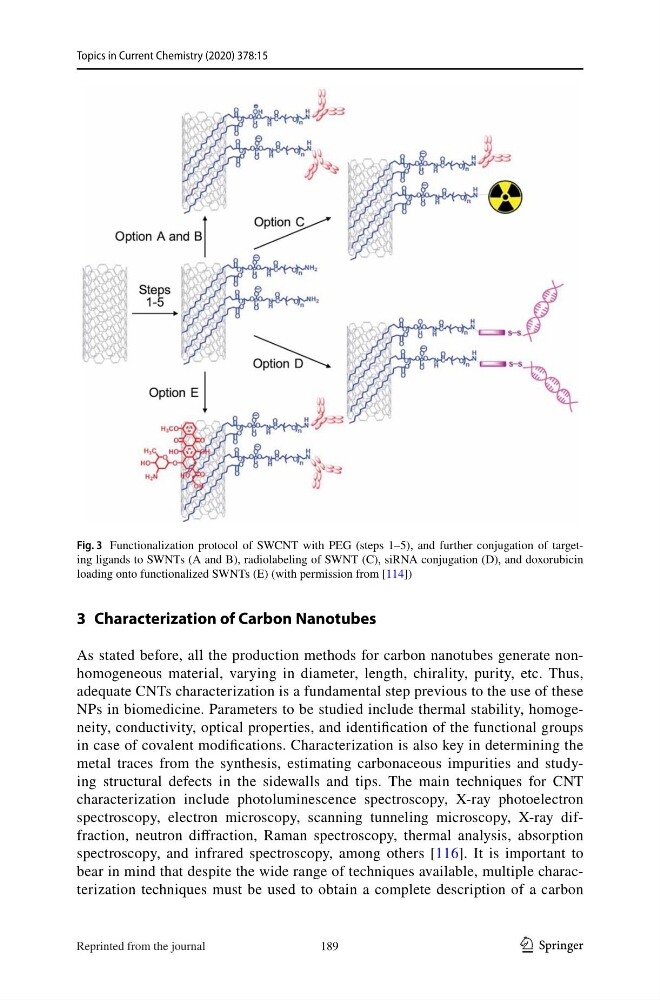
Fig. 3 Functionalization protocol of SWCNT with PEG (steps 1–5), and further conjugation of targeting ligands to SWNTs (A and B), radiolabeling of SWNT (C), siRNA conjugation (D), and doxorubicin
loading onto functionalized SWNTs (E) (with permission from [114])
189
Reprinted from the journal
Topics in Current Chemistry (2020) 378:15
3 Characterization of Carbon Nanotubes
As stated before, all the production methods for carbon nanotubes generate nonhomogeneous material, varying in diameter, length, chirality, purity, etc. Thus,
adequate CNTs characterization is a fundamental step previous to the use of these
NPs in biomedicine. Parameters to be studied include thermal stability, homogeneity, conductivity, optical properties, and identification of the functional groups
in case of covalent modifications. Characterization is also key in determining the
metal traces from the synthesis, estimating carbonaceous impurities and studying structural defects in the sidewalls and tips. The main techniques for CNT
characterization include photoluminescence spectroscopy, X-ray photoelectron
spectroscopy, electron microscopy, scanning tunneling microscopy, X-ray diffraction, neutron diffraction, Raman spectroscopy, thermal analysis, absorption
spectroscopy, and infrared spectroscopy, among others [116]. It is important to
bear in mind that despite the wide range of techniques available, multiple characterization techniques must be used to obtain a complete description of a carbon
Fig. 3 Functionalization protocol of SWCNT with PEG (steps 1–5), and further conjugation of targeting ligands to SWNTs (A and B), radiolabeling of SWNT (C), siRNA conjugation (D), and doxorubicin
loading onto functionalized SWNTs (E) (with permission from [114])
189
Reprinted from the journal