

Topics in Current Chemistry (2020) 378:15
1 3
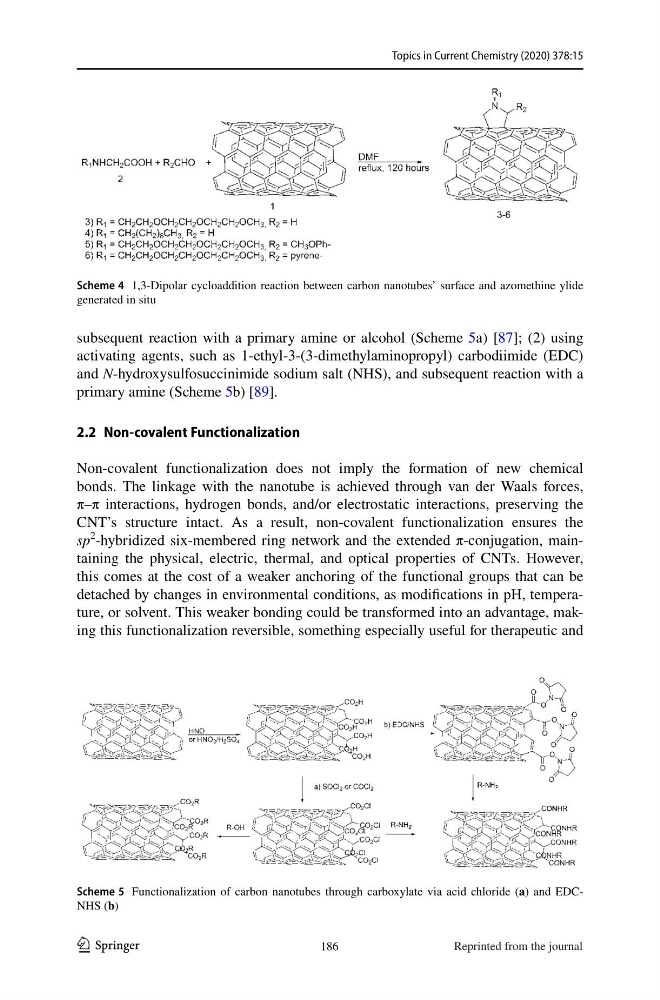
subsequent reaction with a primary amine or alcohol (Scheme 5a) [87]; (2) using
activating agents, such as 1-ethyl-3-(3-dimethylaminopropyl) carbodiimide (EDC)
and N-hydroxysulfosuccinimide sodium salt (NHS), and subsequent reaction with a
primary amine (Scheme 5b) [89].
2.2 Non‑covalent Functionalization
Non-covalent functionalization does not imply the formation of new chemical
bonds. The linkage with the nanotube is achieved through van der Waals forces,
π–π interactions, hydrogen bonds, and/or electrostatic interactions, preserving the
CNT’s structure intact. As a result, non-covalent functionalization ensures the
sp
2
-hybridized six-membered ring network and the extended π-conjugation, maintaining the physical, electric, thermal, and optical properties of CNTs. However,
this comes at the cost of a weaker anchoring of the functional groups that can be
detached by changes in environmental conditions, as modifications in pH, temperature, or solvent. This weaker bonding could be transformed into an advantage, making this functionalization reversible, something especially useful for therapeutic and
Scheme 4 1,3-Dipolar cycloaddition reaction between carbon nanotubes’ surface and azomethine ylide
generated in situ
Scheme 5 Functionalization of carbon nanotubes through carboxylate via acid chloride (a) and EDCNHS (b)
186
Reprinted from the journal
1 3
subsequent reaction with a primary amine or alcohol (Scheme 5a) [87]; (2) using
activating agents, such as 1-ethyl-3-(3-dimethylaminopropyl) carbodiimide (EDC)
and N-hydroxysulfosuccinimide sodium salt (NHS), and subsequent reaction with a
primary amine (Scheme 5b) [89].
2.2 Non‑covalent Functionalization
Non-covalent functionalization does not imply the formation of new chemical
bonds. The linkage with the nanotube is achieved through van der Waals forces,
π–π interactions, hydrogen bonds, and/or electrostatic interactions, preserving the
CNT’s structure intact. As a result, non-covalent functionalization ensures the
sp
2
-hybridized six-membered ring network and the extended π-conjugation, maintaining the physical, electric, thermal, and optical properties of CNTs. However,
this comes at the cost of a weaker anchoring of the functional groups that can be
detached by changes in environmental conditions, as modifications in pH, temperature, or solvent. This weaker bonding could be transformed into an advantage, making this functionalization reversible, something especially useful for therapeutic and
Scheme 4 1,3-Dipolar cycloaddition reaction between carbon nanotubes’ surface and azomethine ylide
generated in situ
Scheme 5 Functionalization of carbon nanotubes through carboxylate via acid chloride (a) and EDCNHS (b)
186
Reprinted from the journal