

1 3
Topics in Current Chemistry (2020) 378:28
metallothioneins, which presented a LOD that reached down to the ng/mL level.
Interestingly, Tsuneyasu et al. [34] proved that TiO 2 NPs amplify the ECL intensity
of Ru(bpy) 3
2+
, thus improving the properties of an ECL device based on Ru(bpy) 3
2+
.
The optical and electrochemical properties of the resulting system were studied in
detail, and it was found that the ECL improvement induced by the TiO 2 NPs was
due to their ability to suppress the nonradiative quenching of the excited states
of Ru(bpy) 3
2+
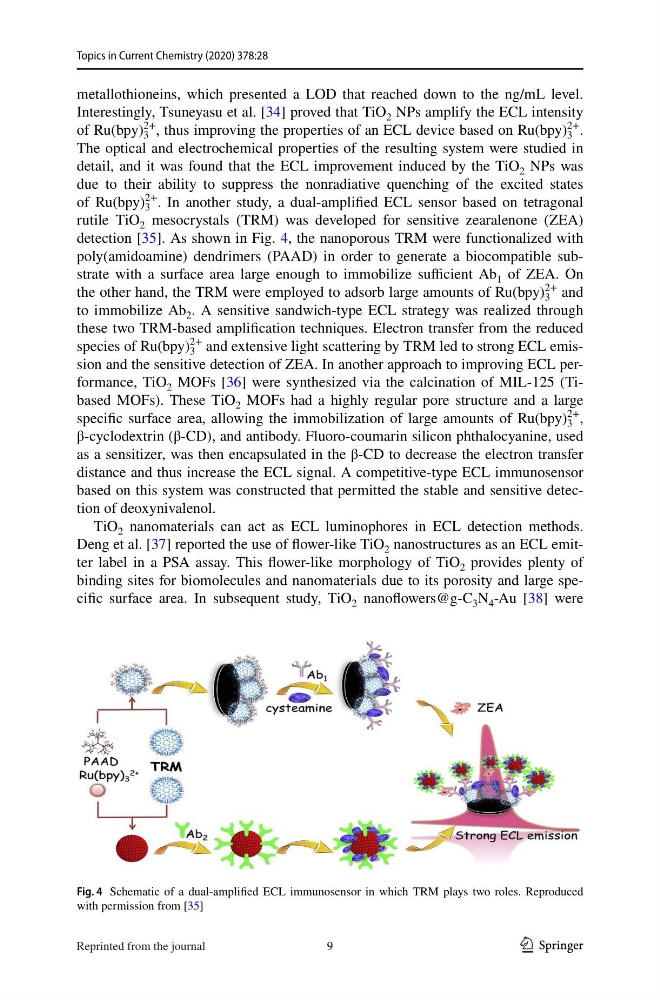
. In another study, a dual-amplified ECL sensor based on tetragonal
rutile TiO 2 mesocrystals (TRM) was developed for sensitive zearalenone (ZEA)
detection [35]. As shown in Fig. 4, the nanoporous TRM were functionalized with
poly(amidoamine) dendrimers (PAAD) in order to generate a biocompatible substrate with a surface area large enough to immobilize sufficient Ab 1 of ZEA. On
the other hand, the TRM were employed to adsorb large amounts of Ru(bpy) 3
2+
and
to immobilize Ab 2 . A sensitive sandwich-type ECL strategy was realized through
these two TRM-based amplification techniques. Electron transfer from the reduced
species of Ru(bpy) 3
2+
and extensive light scattering by TRM led to strong ECL emission and the sensitive detection of ZEA. In another approach to improving ECL performance, TiO 2 MOFs [36] were synthesized via the calcination of MIL-125 (Tibased MOFs). These TiO 2 MOFs had a highly regular pore structure and a large
specific surface area, allowing the immobilization of large amounts of Ru(bpy) 3
2+
,
β-cyclodextrin (β-CD), and antibody. Fluoro-coumarin silicon phthalocyanine, used
as a sensitizer, was then encapsulated in the β-CD to decrease the electron transfer
distance and thus increase the ECL signal. A competitive-type ECL immunosensor
based on this system was constructed that permitted the stable and sensitive detection of deoxynivalenol.
TiO 2 nanomaterials can act as ECL luminophores in ECL detection methods.
Deng et al. [37] reported the use of flower-like TiO 2 nanostructures as an ECL emitter label in a PSA assay. This flower-like morphology of TiO 2 provides plenty of
binding sites for biomolecules and nanomaterials due to its porosity and large specific surface area. In subsequent study, TiO 2 nanoflowers@g-C 3 N 4 -Au [38] were
Fig. 4 Schematic of a dual-amplified ECL immunosensor in which TRM plays two roles. Reproduced
with permission from [35]
9
Reprinted from the journal
Topics in Current Chemistry (2020) 378:28
metallothioneins, which presented a LOD that reached down to the ng/mL level.
Interestingly, Tsuneyasu et al. [34] proved that TiO 2 NPs amplify the ECL intensity
of Ru(bpy) 3
2+
, thus improving the properties of an ECL device based on Ru(bpy) 3
2+
.
The optical and electrochemical properties of the resulting system were studied in
detail, and it was found that the ECL improvement induced by the TiO 2 NPs was
due to their ability to suppress the nonradiative quenching of the excited states
of Ru(bpy) 3
2+
. In another study, a dual-amplified ECL sensor based on tetragonal
rutile TiO 2 mesocrystals (TRM) was developed for sensitive zearalenone (ZEA)
detection [35]. As shown in Fig. 4, the nanoporous TRM were functionalized with
poly(amidoamine) dendrimers (PAAD) in order to generate a biocompatible substrate with a surface area large enough to immobilize sufficient Ab 1 of ZEA. On
the other hand, the TRM were employed to adsorb large amounts of Ru(bpy) 3
2+
and
to immobilize Ab 2 . A sensitive sandwich-type ECL strategy was realized through
these two TRM-based amplification techniques. Electron transfer from the reduced
species of Ru(bpy) 3
2+
and extensive light scattering by TRM led to strong ECL emission and the sensitive detection of ZEA. In another approach to improving ECL performance, TiO 2 MOFs [36] were synthesized via the calcination of MIL-125 (Tibased MOFs). These TiO 2 MOFs had a highly regular pore structure and a large
specific surface area, allowing the immobilization of large amounts of Ru(bpy) 3
2+
,
β-cyclodextrin (β-CD), and antibody. Fluoro-coumarin silicon phthalocyanine, used
as a sensitizer, was then encapsulated in the β-CD to decrease the electron transfer
distance and thus increase the ECL signal. A competitive-type ECL immunosensor
based on this system was constructed that permitted the stable and sensitive detection of deoxynivalenol.
TiO 2 nanomaterials can act as ECL luminophores in ECL detection methods.
Deng et al. [37] reported the use of flower-like TiO 2 nanostructures as an ECL emitter label in a PSA assay. This flower-like morphology of TiO 2 provides plenty of
binding sites for biomolecules and nanomaterials due to its porosity and large specific surface area. In subsequent study, TiO 2 nanoflowers@g-C 3 N 4 -Au [38] were
Fig. 4 Schematic of a dual-amplified ECL immunosensor in which TRM plays two roles. Reproduced
with permission from [35]
9
Reprinted from the journal