

1 3
Topics in Current Chemistry (2020) 378:35
All NPs have a very high surface-to-volume ratio; consequently, the role of the
NP surface is of paramount importance [57]. The properties of the NP surface are
determined not only by their own chemical nature, but also by the layer of capping molecules, referred to as ligands because they bind to the QD surface metals
in a similar way as ligands do to the central atom in the metal complexes. Thus,
ligands “stop particles aggregating, resist nonspecific adsorption of surrounding
molecules, and provide a conjugation point for functional biomolecules” [58].
The synthetic method utilized to prepare QDs determines not only the size, shape
and chemical nature of the QDs, but also the ligands that cap their surface. In
fact, these ligands are chosen mainly because they have to control the size, shape
and polydispersity of the QDs during the synthesis and to maintain their homogeneous dispersion in the solvent post synthesis. Ligand exchange reactions extend
the versatility of QD material.
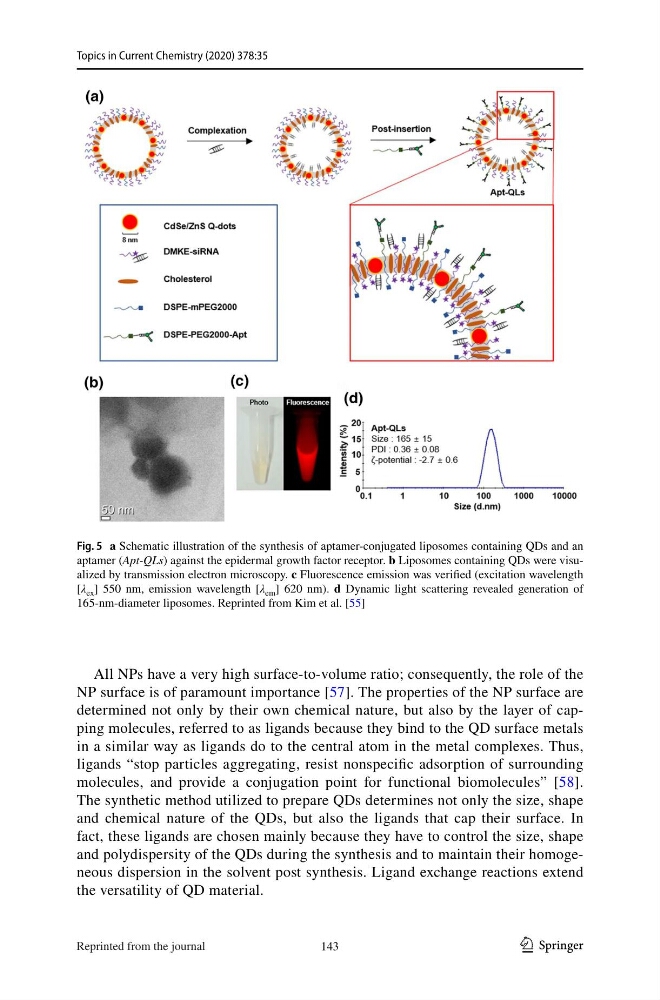
Fig. 5 a Schematic illustration of the synthesis of aptamer-conjugated liposomes containing QDs and an
aptamer (Apt-QLs) against the epidermal growth factor receptor. b Liposomes containing QDs were visualized by transmission electron microscopy. c Fluorescence emission was verified (excitation wavelength
[λ ex ] 550 nm, emission wavelength [λ em ] 620 nm). d Dynamic light scattering revealed generation of
165-nm-diameter liposomes. Reprinted from Kim et al. [55]
143
Reprinted from the journal
Topics in Current Chemistry (2020) 378:35
All NPs have a very high surface-to-volume ratio; consequently, the role of the
NP surface is of paramount importance [57]. The properties of the NP surface are
determined not only by their own chemical nature, but also by the layer of capping molecules, referred to as ligands because they bind to the QD surface metals
in a similar way as ligands do to the central atom in the metal complexes. Thus,
ligands “stop particles aggregating, resist nonspecific adsorption of surrounding
molecules, and provide a conjugation point for functional biomolecules” [58].
The synthetic method utilized to prepare QDs determines not only the size, shape
and chemical nature of the QDs, but also the ligands that cap their surface. In
fact, these ligands are chosen mainly because they have to control the size, shape
and polydispersity of the QDs during the synthesis and to maintain their homogeneous dispersion in the solvent post synthesis. Ligand exchange reactions extend
the versatility of QD material.
Fig. 5 a Schematic illustration of the synthesis of aptamer-conjugated liposomes containing QDs and an
aptamer (Apt-QLs) against the epidermal growth factor receptor. b Liposomes containing QDs were visualized by transmission electron microscopy. c Fluorescence emission was verified (excitation wavelength
[λ ex ] 550 nm, emission wavelength [λ em ] 620 nm). d Dynamic light scattering revealed generation of
165-nm-diameter liposomes. Reprinted from Kim et al. [55]
143
Reprinted from the journal