

1 3
Topics in Current Chemistry (2020) 378:28
provided us with the theoretical basis for developing TiO 2 nanomaterials with
enhanced properties [3, 8]. In this section, the rational design and engineering of
various TiO 2 nanomaterials to minimize the shortcomings of pure TiO 2 are discussed. Many methods have been used to obtain high-performance PEC biosensors
based on TiO 2 nanomaterials, including the coupling of TiO 2 with a narrow bandgap semiconductor, the dye sensitization of TiO 2 , the deposition of noble metal nanoparticles onto TiO 2 , the doping of TiO 2 with metal and nonmetal atoms, and the
preparation of TiO 2 with engineered defects.
Due to the ability to control their band gap and size, quantum dots (QDs) are
commonly combined with other photoactive materials to achieve improved PEC
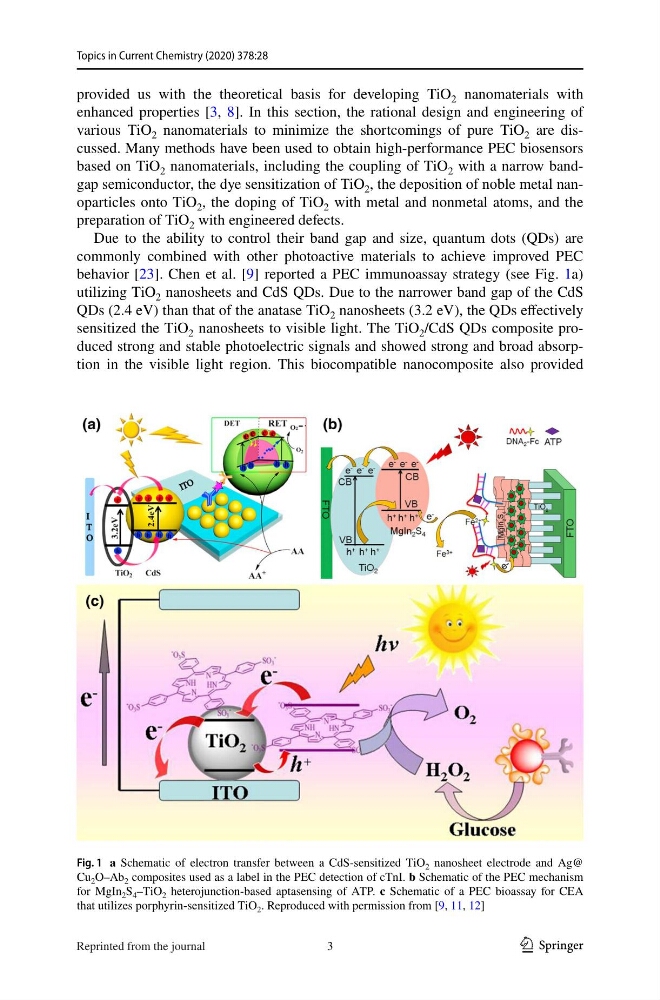
behavior [23]. Chen et al. [9] reported a PEC immunoassay strategy (see Fig. 1a)
utilizing TiO 2 nanosheets and CdS QDs. Due to the narrower band gap of the CdS
QDs (2.4 eV) than that of the anatase TiO 2 nanosheets (3.2 eV), the QDs effectively
sensitized the TiO 2 nanosheets to visible light. The TiO 2 /CdS QDs composite produced strong and stable photoelectric signals and showed strong and broad absorption in the visible light region. This biocompatible nanocomposite also provided
Fig. 1 a Schematic of electron transfer between a CdS-sensitized TiO 2 nanosheet electrode and Ag@
Cu 2 O–Ab 2 composites used as a label in the PEC detection of cTnI. b Schematic of the PEC mechanism
for MgIn 2 S 4 –TiO 2 heterojunction-based aptasensing of ATP. c Schematic of a PEC bioassay for CEA
that utilizes porphyrin-sensitized TiO 2 . Reproduced with permission from [9, 11, 12]
3
Reprinted from the journal
Topics in Current Chemistry (2020) 378:28
provided us with the theoretical basis for developing TiO 2 nanomaterials with
enhanced properties [3, 8]. In this section, the rational design and engineering of
various TiO 2 nanomaterials to minimize the shortcomings of pure TiO 2 are discussed. Many methods have been used to obtain high-performance PEC biosensors
based on TiO 2 nanomaterials, including the coupling of TiO 2 with a narrow bandgap semiconductor, the dye sensitization of TiO 2 , the deposition of noble metal nanoparticles onto TiO 2 , the doping of TiO 2 with metal and nonmetal atoms, and the
preparation of TiO 2 with engineered defects.
Due to the ability to control their band gap and size, quantum dots (QDs) are
commonly combined with other photoactive materials to achieve improved PEC
behavior [23]. Chen et al. [9] reported a PEC immunoassay strategy (see Fig. 1a)
utilizing TiO 2 nanosheets and CdS QDs. Due to the narrower band gap of the CdS
QDs (2.4 eV) than that of the anatase TiO 2 nanosheets (3.2 eV), the QDs effectively
sensitized the TiO 2 nanosheets to visible light. The TiO 2 /CdS QDs composite produced strong and stable photoelectric signals and showed strong and broad absorption in the visible light region. This biocompatible nanocomposite also provided
Fig. 1 a Schematic of electron transfer between a CdS-sensitized TiO 2 nanosheet electrode and Ag@
Cu 2 O–Ab 2 composites used as a label in the PEC detection of cTnI. b Schematic of the PEC mechanism
for MgIn 2 S 4 –TiO 2 heterojunction-based aptasensing of ATP. c Schematic of a PEC bioassay for CEA
that utilizes porphyrin-sensitized TiO 2 . Reproduced with permission from [9, 11, 12]
3
Reprinted from the journal