

1 3
Topics in Current Chemistry (2020) 378:12
The crucial parameters to consider during the design of functional bioconjugates
are (1) the dispersion of the colloidal system in an aqueous medium, (2) the stability
of the association of the biomolecule with the support, and (3) the orientation and
functionality of the conjugated biomolecule [113, 114]. The most commonly used
strategies for bioconjugation include physical adsorption [115], covalent binding
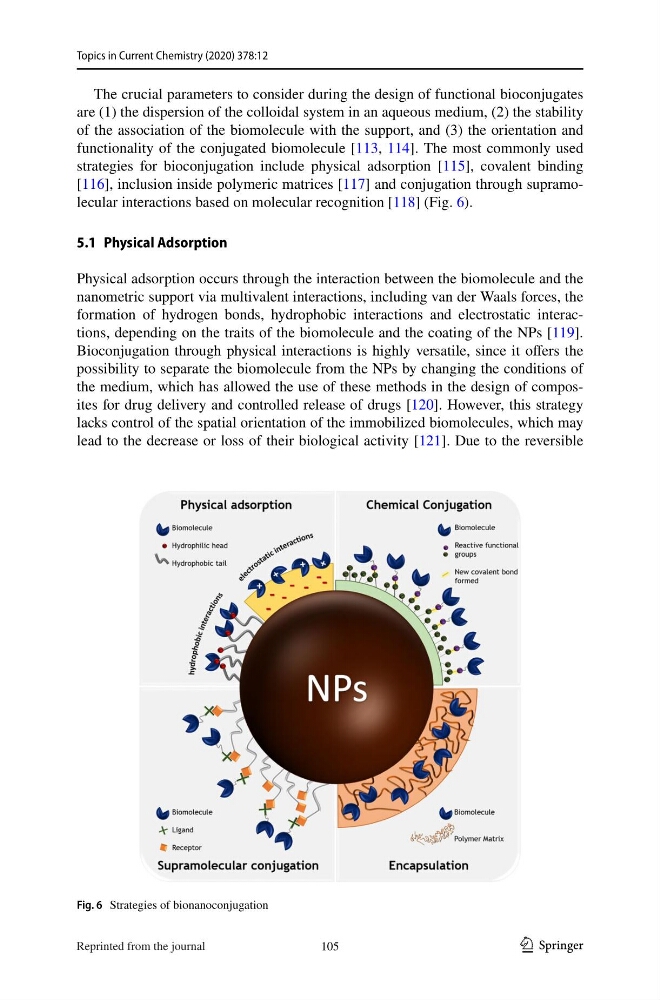
[116], inclusion inside polymeric matrices [117] and conjugation through supramolecular interactions based on molecular recognition [118] (Fig. 6).
5.1 Physical Adsorption
Physical adsorption occurs through the interaction between the biomolecule and the
nanometric support via multivalent interactions, including van der Waals forces, the
formation of hydrogen bonds, hydrophobic interactions and electrostatic interactions, depending on the traits of the biomolecule and the coating of the NPs [119].
Bioconjugation through physical interactions is highly versatile, since it offers the
possibility to separate the biomolecule from the NPs by changing the conditions of
the medium, which has allowed the use of these methods in the design of composites for drug delivery and controlled release of drugs [120]. However, this strategy
lacks control of the spatial orientation of the immobilized biomolecules, which may
lead to the decrease or loss of their biological activity [121]. Due to the reversible
Fig. 6 Strategies of bionanoconjugation
105
Reprinted from the journal
Topics in Current Chemistry (2020) 378:12
The crucial parameters to consider during the design of functional bioconjugates
are (1) the dispersion of the colloidal system in an aqueous medium, (2) the stability
of the association of the biomolecule with the support, and (3) the orientation and
functionality of the conjugated biomolecule [113, 114]. The most commonly used
strategies for bioconjugation include physical adsorption [115], covalent binding
[116], inclusion inside polymeric matrices [117] and conjugation through supramolecular interactions based on molecular recognition [118] (Fig. 6).
5.1 Physical Adsorption
Physical adsorption occurs through the interaction between the biomolecule and the
nanometric support via multivalent interactions, including van der Waals forces, the
formation of hydrogen bonds, hydrophobic interactions and electrostatic interactions, depending on the traits of the biomolecule and the coating of the NPs [119].
Bioconjugation through physical interactions is highly versatile, since it offers the
possibility to separate the biomolecule from the NPs by changing the conditions of
the medium, which has allowed the use of these methods in the design of composites for drug delivery and controlled release of drugs [120]. However, this strategy
lacks control of the spatial orientation of the immobilized biomolecules, which may
lead to the decrease or loss of their biological activity [121]. Due to the reversible
Fig. 6 Strategies of bionanoconjugation
105
Reprinted from the journal