

1 3
Topics in Current Chemistry (2020) 378:12
strategy to stabilize and functionalize NPs depends strongly on the envisaged application. Certainly, if the final application of the NPs is a biosensor, the preferred
ligand will be a biomolecule capable of specifically recognizing a molecule of interest. If the aim is to provide biocompatibility, ligands with biological significance are
preferred, such as polyethylenimine (PEI), carboxymethyl dextran (CMX) or polyethylene glycol (PEG) [98].
4.2 Ligand Exchange
Ligand exchange consists of replacing the coating agent of the NP with another
coating agent presenting higher affinity toward the NP surface. This process may be
performed right after the synthesis of the NPs. Kluenker and co-workers conducted
a study for the thiol exchange process on AuNPs coated with oleylamine [99]. The
ligand exchange process was followed by solution NMR. When oleylamine was
replaced by 1-octadecanethiol, the tests showed that the procedure corresponded
to an equilibrium reaction. This study reveals how complex the ligand exchange
process is, and that efficient surface coverage depends on the repeated exchange
reactions with large ligand excess, the size of NPs, and the size of the ligand. The
authors found that a more effective ligand replacement is achieved after repeated
functionalization reactions using high ligand concentration or by reducing NP
size [99]. Moreover, the cellular uptake of AuNPs through ligand exchange has
been reported recently; 12 different ligands (small thiolated molecules, thiolated
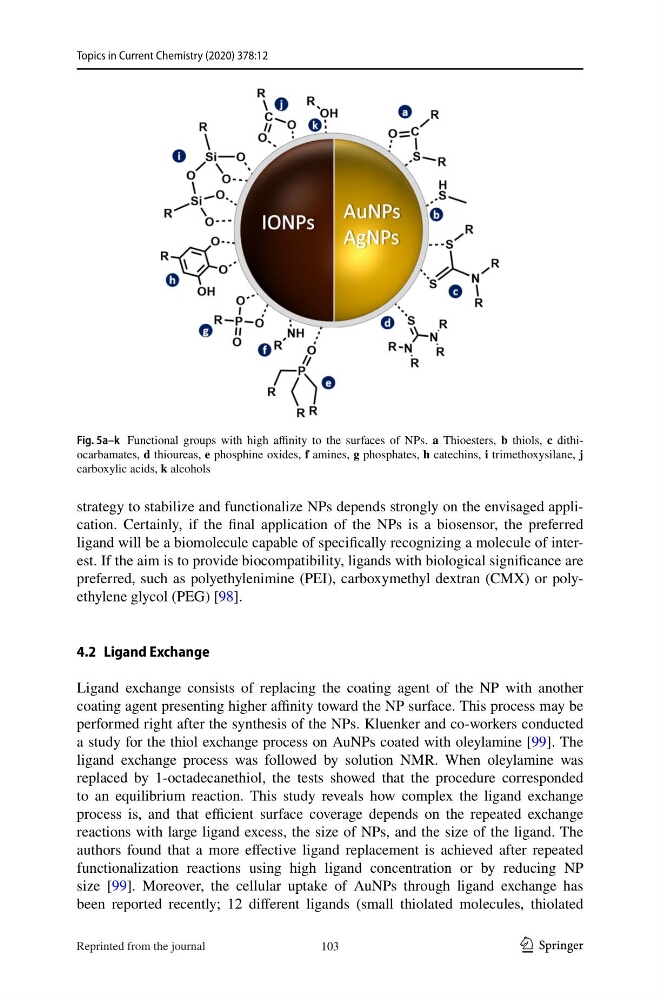
Fig. 5a–k Functional groups with high affinity to the surfaces of NPs. a Thioesters, b thiols, c dithiocarbamates, d thioureas, e phosphine oxides, f amines, g phosphates, h catechins, i trimethoxysilane, j
carboxylic acids, k alcohols
103
Reprinted from the journal
Topics in Current Chemistry (2020) 378:12
strategy to stabilize and functionalize NPs depends strongly on the envisaged application. Certainly, if the final application of the NPs is a biosensor, the preferred
ligand will be a biomolecule capable of specifically recognizing a molecule of interest. If the aim is to provide biocompatibility, ligands with biological significance are
preferred, such as polyethylenimine (PEI), carboxymethyl dextran (CMX) or polyethylene glycol (PEG) [98].
4.2 Ligand Exchange
Ligand exchange consists of replacing the coating agent of the NP with another
coating agent presenting higher affinity toward the NP surface. This process may be
performed right after the synthesis of the NPs. Kluenker and co-workers conducted
a study for the thiol exchange process on AuNPs coated with oleylamine [99]. The
ligand exchange process was followed by solution NMR. When oleylamine was
replaced by 1-octadecanethiol, the tests showed that the procedure corresponded
to an equilibrium reaction. This study reveals how complex the ligand exchange
process is, and that efficient surface coverage depends on the repeated exchange
reactions with large ligand excess, the size of NPs, and the size of the ligand. The
authors found that a more effective ligand replacement is achieved after repeated
functionalization reactions using high ligand concentration or by reducing NP
size [99]. Moreover, the cellular uptake of AuNPs through ligand exchange has
been reported recently; 12 different ligands (small thiolated molecules, thiolated
Fig. 5a–k Functional groups with high affinity to the surfaces of NPs. a Thioesters, b thiols, c dithiocarbamates, d thioureas, e phosphine oxides, f amines, g phosphates, h catechins, i trimethoxysilane, j
carboxylic acids, k alcohols
103
Reprinted from the journal