

1 3
Topics in Current Chemistry (2020) 378:12
β-hydroxy carboxylates as stabilizers in order to prepare nanoparticles of various
sizes, size distribution, and shape [62].
The Brust-Schiffrin approach [63] was reported in 1994 and presented a new procedure for the synthesis of spherical NPs somewhat similar to the Turkevich method,
but the size of the particles obtained was below 10 nm. In this method, metallic
clusters are grown at the same time as a self-assembled thiol monolayer is attached
to the growing nuclei. In order to achieve both processes simultaneously, the reaction occurs in two phases (water and toluene). Sodium borohydride (NaBH 4 ) is used
as a reducing agent and tetraoctylammonium bromide (TOAB) as a phase-transfer
catalyst. The gold complex anion, [AuCl 4 ]
−
, is transferred from the aqueous phase to
the organic phase by electrostatic interactions between the positively charged TOAB
and the negative gold ion.
Seed-mediated growth method is another strategy to obtain AuNPs. Unlike the
above-mentioned methodologies, seed-mediated growth is one of the easiest ways
to effectively control the size of the NPs [64, 65]. It was first reported by Wiesner
in 1989 [66] and consists of obtaining gold seeds via reduction of HAuCl 4 , and
then adding more HAuCl 4 , which is reduced using phosphorus. This methodology
has evolved, and is currently used for the preparation of AuNPs with narrow size
distribution [67]. Other strategies report the use of fungi [68] and plant extracts
[69] as reducing agents; photosynthesis [70], and laser ablation [71] are additional
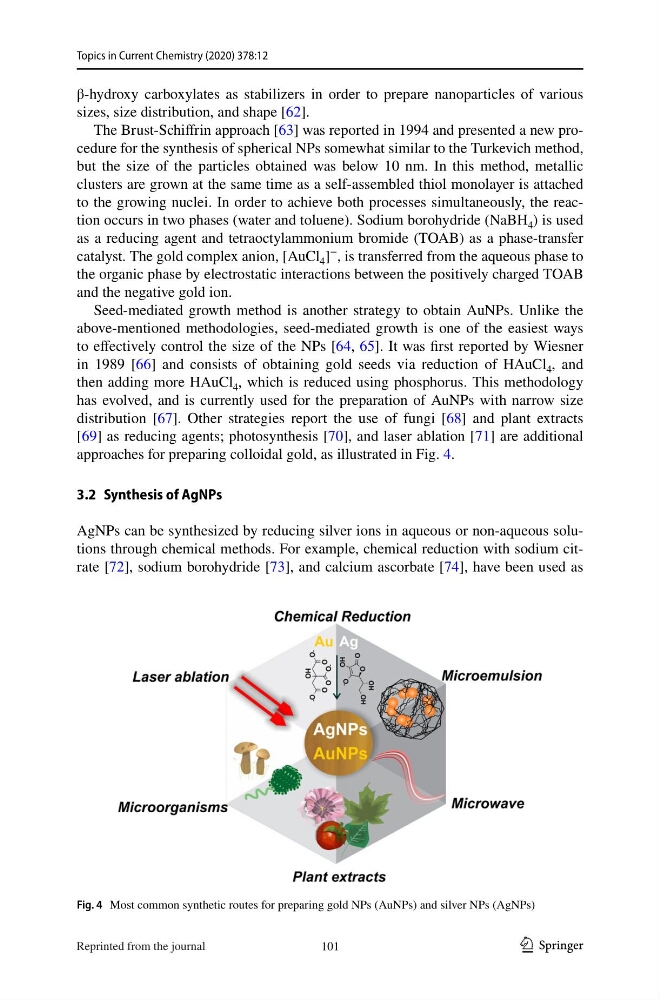
approaches for preparing colloidal gold, as illustrated in Fig. 4.
3.2 Synthesis of AgNPs
AgNPs can be synthesized by reducing silver ions in aqueous or non-aqueous solutions through chemical methods. For example, chemical reduction with sodium citrate [72], sodium borohydride [73], and calcium ascorbate [74], have been used as
Fig. 4 Most common synthetic routes for preparing gold NPs (AuNPs) and silver NPs (AgNPs)
101
Reprinted from the journal
Topics in Current Chemistry (2020) 378:12
β-hydroxy carboxylates as stabilizers in order to prepare nanoparticles of various
sizes, size distribution, and shape [62].
The Brust-Schiffrin approach [63] was reported in 1994 and presented a new procedure for the synthesis of spherical NPs somewhat similar to the Turkevich method,
but the size of the particles obtained was below 10 nm. In this method, metallic
clusters are grown at the same time as a self-assembled thiol monolayer is attached
to the growing nuclei. In order to achieve both processes simultaneously, the reaction occurs in two phases (water and toluene). Sodium borohydride (NaBH 4 ) is used
as a reducing agent and tetraoctylammonium bromide (TOAB) as a phase-transfer
catalyst. The gold complex anion, [AuCl 4 ]
−
, is transferred from the aqueous phase to
the organic phase by electrostatic interactions between the positively charged TOAB
and the negative gold ion.
Seed-mediated growth method is another strategy to obtain AuNPs. Unlike the
above-mentioned methodologies, seed-mediated growth is one of the easiest ways
to effectively control the size of the NPs [64, 65]. It was first reported by Wiesner
in 1989 [66] and consists of obtaining gold seeds via reduction of HAuCl 4 , and
then adding more HAuCl 4 , which is reduced using phosphorus. This methodology
has evolved, and is currently used for the preparation of AuNPs with narrow size
distribution [67]. Other strategies report the use of fungi [68] and plant extracts
[69] as reducing agents; photosynthesis [70], and laser ablation [71] are additional
approaches for preparing colloidal gold, as illustrated in Fig. 4.
3.2 Synthesis of AgNPs
AgNPs can be synthesized by reducing silver ions in aqueous or non-aqueous solutions through chemical methods. For example, chemical reduction with sodium citrate [72], sodium borohydride [73], and calcium ascorbate [74], have been used as
Fig. 4 Most common synthetic routes for preparing gold NPs (AuNPs) and silver NPs (AgNPs)
101
Reprinted from the journal